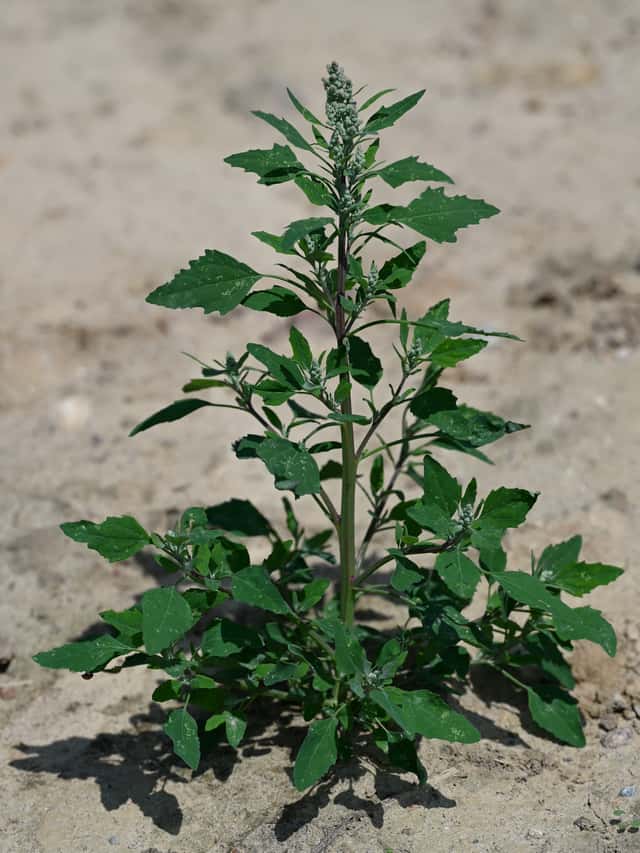
Amaranthaceae
Lamb's Quarters (Chenopodium album): Edible Weed & Medicinal Herb
Chenopodium album
A low-maintenance, tough plant that thrives in full sun with moderate watering. Extremely drought-tolerant once established. Suitable for natural gardens, permaculture systems, or foraging plots.
Every 7 days
Direct sun
5° - 38°C
40% - 70%
Categories
What is Lamb's Quarters?
Lamb's Quarters (Chenopodium album) is a easy-care plant from the Amaranthaceae family. Lamb's quarters (Chenopodium album) is a fast-growing annual herb found across the world in disturbed soils, garden beds, and agricultural fields. Often considered an invasive weed, it is also a highly nutritious edible and medicinal plant used for thousands of years across cultures.
Lamb's Quarters grows up to 1.5m, spread of 50cm, watering every 7 days, 5°C – 38°C, 40–70% humidity. It is not suitable for indoor environments and not safe for pets.
Unlike many tropical plants, Lamb's Quarters tolerates watering mistakes. Best for beginners. Without precautions, ingestion can cause irritation in pets. Keep out of reach of cats and dogs.
How to Care for Lamb's Quarters?
TLDR: Lamb's Quarters needs Direct sun, watering every 7 days, and temperatures between 5-38°C with 40-70% humidity.
How Often Should You Water Lamb's Quarters?
Water weekly during establishment. Once established, the plant tolerates drought and can go 10-14 days between waterings. Avoid waterlogged soil to prevent root rot.
How Much Light Does Lamb's Quarters Need?
Requires full sun for optimal growth. Does not tolerate dense shade. Choose a location with at least 6 hours of direct sunlight per day.
What Is the Best Soil for Lamb's Quarters?
Adapts to nearly any soil type — sandy to clay — with pH between 4.5 and 8.3. Prefers fertile, well-draining soil but thrives in poor conditions too.
What Pot Should You Use for Lamb's Quarters?
Open garden bed preferred. Large containers at least 30 cm deep work as well.
What Is Lamb's Quarters and Where Does It Come From?
Lamb's quarters (Chenopodium album) is a fast-growing annual herb found across the world in disturbed soils, garden beds, and agricultural fields. Often considered an invasive weed, it is also a highly nutritious edible and medicinal plant used for thousands of years across cultures.
How to Propagate Lamb's Quarters?
Direct seeding
Seeds germinate very quickly. The plant self-seeds freely each season.
- 1 Prepare soil by removing weeds and loosening the top layer
- 2 Scatter seeds directly in the final growing location
- 3 Cover lightly with a thin layer of soil
- 4 Water gently and keep moist until germination
- 5 Thin seedlings to 20-30 cm apart once established
Materials needed:
How Big Does Lamb's Quarters Grow?
TLDR: Lamb's Quarters can reach up to 1.5m tall with Fast growth rate.
Max height
1.5m
Spread
50cm
Growth rate
Fast
Foliage
Deciduous
Warning: Toxic Plant
This plant can be toxic if ingested. Keep out of reach of:
Plant Uses
Edible
Can be consumed
Medicinal
Medicinal properties
Medicinal Uses
- Anthelmintic (expels intestinal parasites)
- Anti-inflammatory
- Antirheumatic
- Mild laxative
- Toothache relief
- Urinary tract support
Culinary Uses
- Young leaves raw in salads (in moderation)
- Cooked leaves as spinach substitute
- Ground seeds as flour
- Sautéed young shoots
Is your plant showing symptoms?
Click on the symptom to discover possible causes:
What Diseases Commonly Affect Lamb's Quarters?
TLDR: Lamb's Quarters is susceptible to 8 known diseases. Monitor regularly for early detection.
Downy Mildew
Downy mildew is a fungal-like disease caused by oomycetes (water molds) that thrives in cool, wet conditions. It affects a wide range of plants, causing yellowing leaves with fuzzy white-gray growth underneath, leading to defoliation and reduced yields if left untreated.
Cercospora Leaf Spot
Cercospora leaf spot is a common fungal disease caused by Cercospora species that affects many plant types, particularly beets, roses, and leafy vegetables. The disease thrives in warm, humid conditions and can cause significant defoliation, reducing plant vigor and yield. It spreads rapidly through water splash, wind, and contaminated tools.
Aphids
Aphids are small, soft-bodied, pear-shaped insects (1/16 to 1/8 inch long) that feed by sucking nutrient-rich sap from plants. They reproduce rapidly and can quickly weaken plants, causing distorted growth and transmitting plant viruses. Aphids come in various colors including green, black, red, yellow, brown, and gray. They secrete honeydew, a sticky substance that attracts ants and encourages sooty mold growth.
Root Rot
Root rot is a serious fungal disease that affects the root system of plants, causing them to decay and die. It is primarily caused by overwatering, poor drainage, or soil-borne fungi such as Pythium, Phytophthora, Rhizoctonia, and Fusarium. The disease thrives in waterlogged conditions where roots are deprived of oxygen, making them susceptible to fungal infection.
Meaning & Symbolism
A symbol of resilience and adaptability, growing where other plants cannot. Represents the ability to thrive in adversity.
Fun Facts
A single plant can produce up to 70,000 seeds per season
Leaves contain more calcium per gram than milk and more iron than cultivated spinach
Archaeological evidence shows humans have eaten it for over 5,000 years in Europe
In India it is cultivated as a vegetable called 'bathua' in traditional northern cuisine
Frequently asked questions
Is lamb's quarters edible?
Is it toxic to pets?
How do I control lamb's quarters?
When is the best time to harvest?
Does it need fertilizing?
Compare with similar plants
| Attribute | Difficulty | Light | Watering | Pet Safe |
|---|---|---|---|---|
| Field Maple | Easy | Bright indirect | 14d | ✓ |
| Silver Birch | Easy | Direct sun | 14d | ✓ |
| Cushion Bush | Easy | Direct sun | 14d | ✓ |
| Peruvian peppertree | Easy | Direct sun | 14d | ⚠️ |





