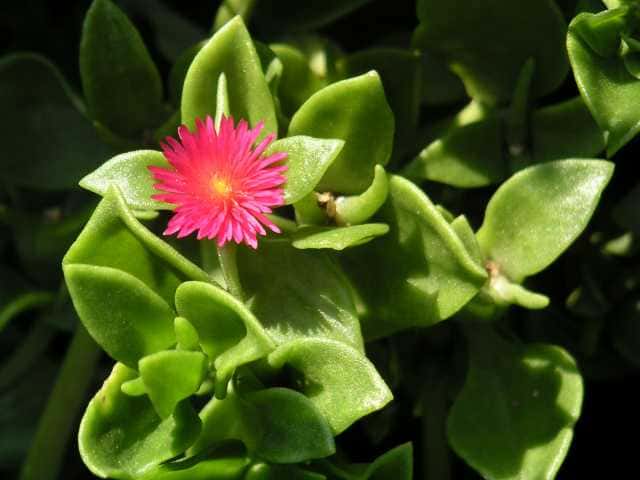
Aizoaceae
Baby Sun Rose (Aptenia cordifolia): Full Care Guide
Aptenia cordifolia
Baby Sun Rose is one of the easiest succulents to grow. It thrives in full sun, tolerates drought well, and requires minimal fertilization. Water deeply but infrequently—about every 14 days in summer, and once a month in winter. Plant in well-draining, sandy or loamy soil. It grows fast and can be used as ground cover, in containers, or hanging baskets. Prune occasionally to keep a compact shape.
Every 14 days
Direct sun
4° - 35°C
30% - 60%
Categories
What is Baby Sun Rose?
Baby Sun Rose (Aptenia cordifolia) is a easy-care plant from the Aizoaceae family. Aptenia cordifolia, commonly known as Baby Sun Rose or Heartleaf Ice Plant, is a fast-growing succulent ground cover native to the Eastern Cape and KwaZulu-Natal regions of South Africa. It belongs to the Aizoaceae family and forms dense, low-lying mats of glossy, heart-shaped leaves that can spread...
Baby Sun Rose grows up to 30cm, spread of 60cm, watering every 14 days, 4°C – 35°C, 30–60% humidity. It is suitable for indoor environments and safe for pets.
Unlike many tropical plants, Baby Sun Rose tolerates watering mistakes. Best for beginners. Unlike many popular species, Baby Sun Rose is safe to keep around pets. Without adequate drainage, root rot can develop within 28 days.
How to Care for Baby Sun Rose?
TLDR: Baby Sun Rose needs Direct sun, watering every 14 days, and temperatures between 4-35°C with 30-60% humidity.
How Often Should You Water Baby Sun Rose?
Allow the soil to dry out completely between waterings. Water deeply approximately every 14 days during warm seasons, reducing to once a month in winter. Never let the plant sit in waterlogged soil, as root rot is its primary threat. Use the soak-and-dry method.
How Much Light Does Baby Sun Rose Need?
Baby Sun Rose thrives in full sun with at least 6 hours of direct sunlight daily. It can tolerate partial shade but will produce fewer flowers and may lose some of its vibrant leaf color. Indoors, place near the brightest window available.
What Is the Best Soil for Baby Sun Rose?
Use a well-draining cactus or succulent mix. Outdoors, sandy or loamy soil with added perlite or grit works best. Avoid heavy clay soils that retain moisture. A slightly acidic to neutral pH of 6.0–7.5 is ideal.
What Pot Should You Use for Baby Sun Rose?
Terracotta or unglazed clay pots are ideal as they allow moisture to evaporate quickly, preventing root rot. Ensure pots have drainage holes. Hanging baskets work beautifully to showcase its trailing stems.
Care Schedule
Fertilize
Every 60 days
Rotate
Every 30 days
Repot
Every 730 days
What Is Baby Sun Rose and Where Does It Come From?
Aptenia cordifolia, commonly known as Baby Sun Rose or Heartleaf Ice Plant, is a fast-growing succulent ground cover native to the Eastern Cape and KwaZulu-Natal regions of South Africa. It belongs to the Aizoaceae family and forms dense, low-lying mats of glossy, heart-shaped leaves that can spread up to 60 cm wide. Despite its succulent nature, it produces an abundance of vivid pink to magenta daisy-like flowers from spring through fall, making it a beloved ornamental plant worldwide. It is also edible, with leaves that have a flavor reminiscent of spinach.
How to Propagate Baby Sun Rose?
Stem Cuttings
Spring and early summer cuttings root fastest. Dip the cut end in rooting hormone to increase success rate.
- 1 Select a healthy stem
Choose a vigorous stem 5–10 cm long with at least 2–3 leaf nodes. Avoid damaged or diseased stems.
- 2 Allow callusing
Let the cut end dry and callus over for 1–2 days in a dry, shaded spot. This prevents rot when planted.
- 3 Plant the cutting
Insert the callused end about 2 cm into slightly moist succulent mix. Do not water immediately.
- 4 Provide warmth and light
Place in bright indirect light at 18–27°C. Avoid direct sun until roots form.
- 5 Begin gentle watering
After 2–3 weeks, tug gently to check for root resistance. Once rooted, resume normal watering schedule.
Materials needed:
Seeds
Use fresh seeds for best germination rates.
- 1 Sow seeds
Scatter seeds on the surface of moist, well-draining seed mix. Do not bury deeply—just press gently onto the surface.
- 2 Cover lightly
Sprinkle a very thin layer of sand or fine grit over seeds to anchor them.
- 3 Maintain warmth
Keep at 20–25°C in bright indirect light. Cover with a clear dome or plastic wrap to retain humidity.
- 4 Germination
Seeds typically germinate in 2–3 weeks. Remove cover once seedlings appear.
- 5 Transplant
Once seedlings have 2–3 true leaves, transplant to individual pots.
Materials needed:
How Big Does Baby Sun Rose Grow?
TLDR: Baby Sun Rose can reach up to 30cm tall with Fast growth rate.
Max height
30cm
Spread
60cm
Growth rate
Fast
Foliage
Evergreen
Plant Uses
Ornamental
Great for decoration
Ground Cover
Soil coverage
Edible
Can be consumed
Culinary Uses
- Leaves can be eaten raw in salads, similar to spinach in flavor and texture.
- Young leaves and stems are used in some cuisines as a green vegetable.
Is your plant showing symptoms?
Click on the symptom to discover possible causes:
What Diseases Commonly Affect Baby Sun Rose?
TLDR: Baby Sun Rose is susceptible to 9 known diseases. Monitor regularly for early detection.
Root Rot
Root rot is a serious fungal disease that affects the root system of plants, causing them to decay and die. It is primarily caused by overwatering, poor drainage, or soil-borne fungi such as Pythium, Phytophthora, Rhizoctonia, and Fusarium. The disease thrives in waterlogged conditions where roots are deprived of oxygen, making them susceptible to fungal infection.
Phytophthora Root Rot
Disease caused by fungus-like organisms (oomycetes) that live in soil and can survive for years. It affects roots, stem, and crown of plants, being especially severe in waterlogged or poorly drained soils. It is the second most common cause of root rot in trees and shrubs.
Overwatering
Overwatering occurs when plants receive too much water, depriving roots of oxygen and causing root rot. This environmental stress is one of the most common causes of houseplant death, as waterlogged soil prevents roots from breathing and functioning properly.
Aphids
Aphids are small, soft-bodied, pear-shaped insects (1/16 to 1/8 inch long) that feed by sucking nutrient-rich sap from plants. They reproduce rapidly and can quickly weaken plants, causing distorted growth and transmitting plant viruses. Aphids come in various colors including green, black, red, yellow, brown, and gray. They secrete honeydew, a sticky substance that attracts ants and encourages sooty mold growth.
Meaning & Symbolism
Abundance, vitality, and cheerfulness. Its spreading habit symbolizes generosity and the ability to thrive even in harsh conditions.
Fun Facts
Aptenia cordifolia is considered an invasive species in parts of California, Australia, and the Mediterranean, where its fast-spreading habit can outcompete native plants.
Despite being a succulent, Baby Sun Rose produces an impressive number of flowers throughout much of the year—its blooms open in sunlight and close at sunset, much like a sundial.
The leaves of Aptenia cordifolia are edible and have been consumed in salads in some parts of the world, tasting similarly to spinach or purslane.
It is one of the most effective succulents for erosion control on slopes, thanks to its dense mat-forming growth habit and extensive root system.
Frequently asked questions
How often should I water Baby Sun Rose?
Is Baby Sun Rose toxic to pets?
Why is my Baby Sun Rose not flowering?
Can Baby Sun Rose grow indoors?
How do I propagate Baby Sun Rose?
Compare with similar plants
| Attribute | Difficulty | Light | Watering | Pet Safe |
|---|---|---|---|---|
| Field Maple | Easy | Bright indirect | 14d | ✓ |
| Silver Birch | Easy | Direct sun | 14d | ✓ |
| Common Blanketflower | Easy | Direct sun | 10d | ✓ |
| Cushion Bush | Easy | Direct sun | 14d | ✓ |





