Cyperaceae
Spikerush: Ground Cover Plant
Eleocharis
Spikerush requires a constantly moist or submerged substrate and intense lighting. It is suitable for both aquariums (as a foreground carpeting plant) and outdoor ponds or wetland gardens. It is an undemanding plant suitable for beginners; regular trimming is recommended to encourage dense growth.
Every 1 days
Bright indirect
10° - 28°C
70% - 100%
Categories
What is Spikerush?
Spikerush (Eleocharis) is a easy-care plant from the Cyperaceae family. Eleocharis (spikerush) is a large genus of perennial wetland and aquatic plants in the sedge family (Cyperaceae), comprising over 200 species distributed worldwide. The plants are characterized by their leafless, tubular, light green stems that grow in dense, grass-like clumps. In the aquarium hobby...
Spikerush grows up to 60cm, spread of 50cm, watering every 1 days, 10°C – 28°C, 70–100% humidity. It is suitable for indoor environments and safe for pets.
Unlike many tropical plants, Spikerush tolerates watering mistakes. Best for beginners. Unlike many popular species, Spikerush is safe to keep around pets. Without adequate drainage, root rot can develop within 7 days.
How to Care for Spikerush?
TLDR: Spikerush needs Bright indirect, watering every 1 days, and temperatures between 10-28°C with 70-100% humidity.
How Often Should You Water Spikerush?
The substrate must be permanently saturated with water or completely submerged. In an aquarium, ensure good water circulation around the stems. In a pond, it tolerates water depths up to 5–10 cm above the substrate surface. A lack of water causes rapid wilting and browning.
How Much Light Does Spikerush Need?
Spikerush needs strong lighting (40+ PAR, 5,000–30,000 lux). Insufficient light causes the stems to grow tall instead of wide, and the plant loses its ability to form a compact carpet. For aquarium cultivation, we recommend a full-spectrum LED light with a color temperature around 6,500 K.
What Is the Best Soil for Spikerush?
A fine-grained, nutrient-rich substrate (aquarium soil, sandy-clay soil) is ideal. The substrate depth should be at least 5 cm for good root anchoring. For pond species, a muddy or clayey substrate is sufficient. Adding CO₂ in an aquarium significantly accelerates growth and carpet formation.
What Pot Should You Use for Spikerush?
In an aquarium, plant directly into the foreground substrate. For a pond, use a non-permeable basket or a container with a muddy substrate. Avoid standard garden containers without protection against drying out.
Care Schedule
Fertilize
Every 14 days
What Is Spikerush and Where Does It Come From?
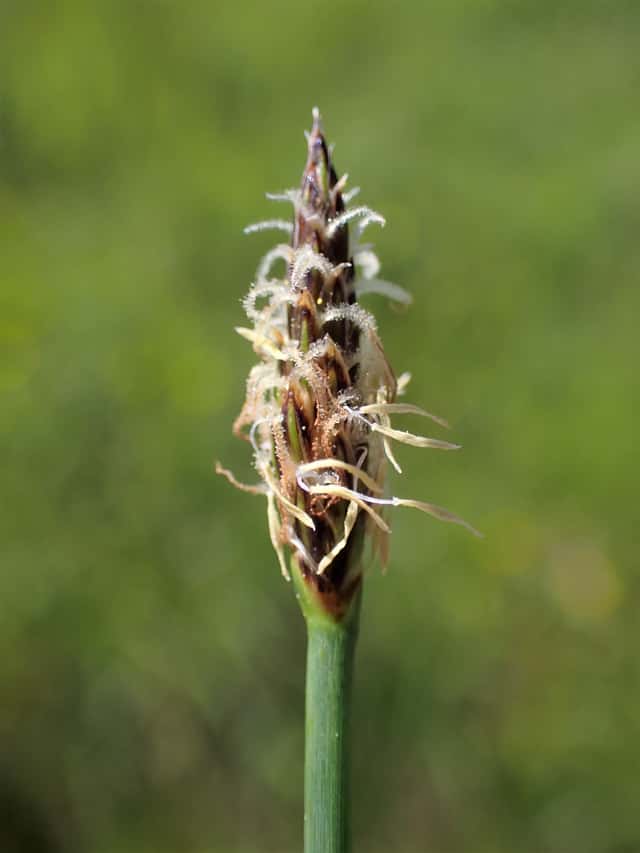
Eleocharis (spikerush) is a large genus of perennial wetland and aquatic plants in the sedge family (Cyperaceae), comprising over 200 species distributed worldwide. The plants are characterized by their leafless, tubular, light green stems that grow in dense, grass-like clumps. In the aquarium hobby, the most popular species is Eleocharis acicularis – "dwarf hairgrass" – favored for creating a dense green carpet on the aquarium floor. The species Eleocharis palustris (common spikerush) is widely grown in garden ponds and wetland habitats. The plant spreads naturally via underground rhizomes and runners (stolons); it produces small, brownish-green spikelet flowers at the tips of the stems.
How to Propagate Spikerush?
Division of clumps
- Trim the stems to 2–3 cm before planting so the plant directs its energy into the roots.
- Use fine tweezers for aquarium planting.
- 1 Removing the plant
Carefully pull the mature clump from the substrate to avoid damaging the roots.
- 2 Division
Using your fingers or sharp scissors, divide the large clump into smaller sections, each with its own roots. Trim the stems to approximately 3–4 cm.
- 3 Planting
Plant the individual clumps into the substrate 1–2 cm apart; they will connect into a dense carpet within a few weeks.
Materials needed:
Propagation by stolons (runners)
- Sufficient CO₂ levels in the aquarium significantly accelerate the formation and spread of runners.
- 1 Natural spreading
Under favorable conditions, the plant sends out underground runners (stolons), with new plantlets growing at their ends.
- 2 Separation
Once the new plantlet has developed its own roots, cut the connecting stolon.
Materials needed:
How Big Does Spikerush Grow?
TLDR: Spikerush can reach up to 60cm tall with Slow growth rate.
Max height
60cm
Spread
50cm
Growth rate
Slow
Foliage
Evergreen
Plant Uses
Ornamental
Great for decoration
Edible
Can be consumed
Ground Cover
Soil coverage
Medicinal Uses
- The tubers of the species Eleocharis dulcis (Chinese water chestnut) are used in traditional Chinese medicine to reduce fever and aid digestion.
Culinary Uses
- The tubers of the species Eleocharis dulcis are known as Chinese water chestnuts and are widely used in Asian cuisine – fresh, boiled, stir-fried, or canned.
Is your plant showing symptoms?
Click on the symptom to discover possible causes:
What Diseases Commonly Affect Spikerush?
TLDR: Spikerush is susceptible to 7 known diseases. Monitor regularly for early detection.
Root Rot
Root rot is a serious fungal disease that affects the root system of plants, causing them to decay and die. It is primarily caused by overwatering, poor drainage, or soil-borne fungi such as Pythium, Phytophthora, Rhizoctonia, and Fusarium. The disease thrives in waterlogged conditions where roots are deprived of oxygen, making them susceptible to fungal infection.
Overwatering
Overwatering occurs when plants receive too much water, depriving roots of oxygen and causing root rot. This environmental stress is one of the most common causes of houseplant death, as waterlogged soil prevents roots from breathing and functioning properly.
Nutrient Deficiency
Nutrient deficiency occurs when a plant cannot access one or more essential mineral elements in sufficient quantities for healthy growth. Plants require 17 essential nutrients: macronutrients (N, P, K, Ca, Mg, S) and micronutrients (Fe, Zn, Mn, Cu, B, Mo, Cl). Each plays a unique role in metabolism, structure, and reproduction. Deficiencies arise from depleted soils, incorrect pH blocking uptake, poor watering practices leaching nutrients, root damage, or imbalanced fertilization. Understanding whether a nutrient is mobile or immobile determines where symptoms first appear: mobile nutrients (N, P, K, Mg) show symptoms on older leaves first, while immobile nutrients (Ca, Fe, Zn, Cu, B) show symptoms on new growth first.
Fungus Gnats
Fungus gnats are small, gray-to-black mosquito-like insects (1/8 to 1/10 inches long) commonly found in indoor plants. Adult gnats are mostly a nuisance, but their larvae feed on plant roots and organic matter in soil, potentially causing serious damage to young or vulnerable plants. The larvae are translucent white with distinctive black heads and can leave slime trails on the soil surface in heavy infestations.
Meaning & Symbolism
Spikerush symbolizes adaptability and fluidity — it forms a natural boundary between water and land and represents the harmony of elements in garden culture.
Compare with similar plants
| Attribute | Difficulty | Light | Watering | Pet Safe |
|---|---|---|---|---|
| Flame Violet | Easy | Partial shade | 7d | ✓ |
| Prickly Lettuce | Easy | Direct sun | 7d | ✓ |
| Christmas Tree Plant | Easy | Bright indirect | 10d | ⚠️ |
| Peace Lily | Easy | Low light | 7d | ⚠️ |