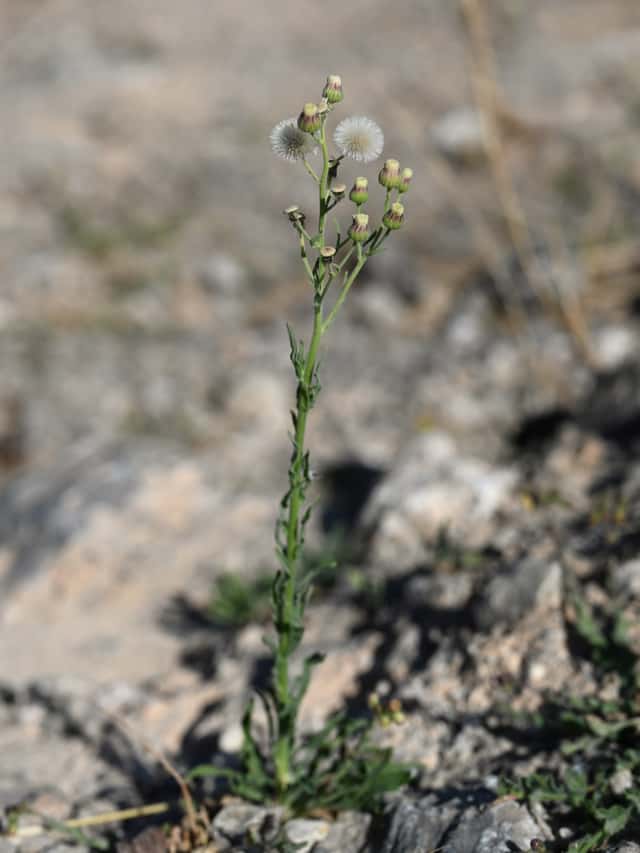
Asteraceae
Flax-leaf fleabane: Ground Cover Plant
Erigeron bonariensis
An extremely hardy plant that prefers full sun and well-drained soils. It requires minimal maintenance and is highly drought-tolerant.
Every 7 days
Direct sun
15° - 35°C
30% - 70%
Categories
What is Flax-leaf fleabane?
Flax-leaf fleabane (Erigeron bonariensis) is a easy-care plant from the Asteraceae family. Erigeron bonariensis, commonly known as flax-leaf fleabane, is an annual herbaceous plant native to South America. It is widely recognized for its hardiness and ability to colonize disturbed areas, being considered one of the main invasive weeds in crops due to its herbicide resistance. It has narro...
Flax-leaf fleabane grows up to 1.0m, with spread of 40cm, watering every 7 days, 15°C – 35°C, 30–70% humidity. It is not suitable for indoor environments and not safe for pets.
Unlike many tropical plants, Flax-leaf fleabane tolerates watering mistakes. Best for beginners. Without precautions, ingestion can cause irritation in pets. Keep out of reach of cats and dogs.
How to Care for Flax-leaf fleabane?
TLDR: Flax-leaf fleabane needs Direct sun, watering every 7 days, and temperatures between 15-35°C with 30-70% humidity.
How Often Should You Water Flax-leaf fleabane?
Water only when the soil is completely dry; the plant survives well on rainwater alone.
How Much Light Does Flax-leaf fleabane Need?
Requires direct sun exposure for full development; does not tolerate dense shade.
What Is the Best Soil for Flax-leaf fleabane?
Adapts to various soil types, including nutrient-poor and compacted soils.
What Pot Should You Use for Flax-leaf fleabane?
It is not common to grow it in pots, but if necessary, use large containers with excellent drainage.
Care Schedule
Fertilize
Every 14 days
What Is Flax-leaf fleabane and Where Does It Come From?
Erigeron bonariensis, commonly known as flax-leaf fleabane, is an annual herbaceous plant native to South America. It is widely recognized for its hardiness and ability to colonize disturbed areas, being considered one of the main invasive weeds in crops due to its herbicide resistance. It has narrow, hairy leaves and small inflorescences that produce thousands of wind-dispersed seeds.
How to Propagate Flax-leaf fleabane?
Sowing
- Keep the soil slightly moist until germination
- Protect the site from strong winds during initial sowing
- 1 Seed Collection
Collect mature seeds from dry inflorescences when they have a white plume appearance.
- 2 Soil Preparation
Use a light substrate or common garden soil, ensuring it is well-loosened.
- 3 Sowing
Scatter the seeds over the surface and press lightly against the soil without burying them deeply.
Materials needed:
How Big Does Flax-leaf fleabane Grow?
TLDR: Flax-leaf fleabane can reach up to 1.0m tall with Fast growth rate.
Max height
1.0m
Spread
40cm
Growth rate
Fast
Foliage
Deciduous
Warning: Toxic Plant
This plant can be toxic if ingested. Keep out of reach of:
Plant Uses
Ornamental
Great for decoration
Medicinal
Medicinal properties
Ground Cover
Soil coverage
Medicinal Uses
- Treatment of urinary problems
- Anti-inflammatory action
- Healing use on wounds
Is your plant showing symptoms?
Click on the symptom to discover possible causes:
What Diseases Commonly Affect Flax-leaf fleabane?
TLDR: Flax-leaf fleabane is susceptible to 9 known diseases. Monitor regularly for early detection.
Root Rot
Root rot is a serious fungal disease that affects the root system of plants, causing them to decay and die. It is primarily caused by overwatering, poor drainage, or soil-borne fungi such as Pythium, Phytophthora, Rhizoctonia, and Fusarium. The disease thrives in waterlogged conditions where roots are deprived of oxygen, making them susceptible to fungal infection.
Powdery Mildew
Powdery mildew is a common fungal disease caused by various fungi species including Erysiphe, Podosphaera, Oïdium, and Leveillula. It affects over 10,000 plant species worldwide. The disease thrives in warm, dry climates with high humidity and appears as a distinctive white powdery coating on plant surfaces.
Rust
Rust is a common fungal disease caused by fungi in the order Pucciniales that affects a wide variety of plants. The disease gets its name from the characteristic orange, yellow, or reddish-brown pustules that appear on leaves, resembling metal rust. This obligate fungal parasite requires living plants to survive and can cause significant economic losses in agricultural crops.
Aphids
Aphids are small, soft-bodied, pear-shaped insects (1/16 to 1/8 inch long) that feed by sucking nutrient-rich sap from plants. They reproduce rapidly and can quickly weaken plants, causing distorted growth and transmitting plant viruses. Aphids come in various colors including green, black, red, yellow, brown, and gray. They secrete honeydew, a sticky substance that attracts ants and encourages sooty mold growth.
Meaning & Symbolism
Symbolizes the resilience and persistence of wild life in hostile environments.
Compare with similar plants
| Attribute | Difficulty | Light | Watering | Pet Safe |
|---|---|---|---|---|
| Peace Lily | Easy | Low light | 4d | ⚠️ |
| Swiss Cheese Plant | Easy | Partial shade | 10d | ⚠️ |
| Golden Pothos | Easy | Low light | 8d | ⚠️ |
| ZZ Plant | Easy | Low light | 18d | ⚠️ |





