Asteraceae
perennial cornflower: Medicinal Uses & Care Tips
Centaurea montana
Extremely easy to grow in full sun and well-drained soil. Deadhead spent blooms to encourage a second flowering in late summer and prevent excessive self-seeding.
Every 10 days
Bright indirect
-20° - 32°C
30% - 50%
Categories
What is perennial cornflower?
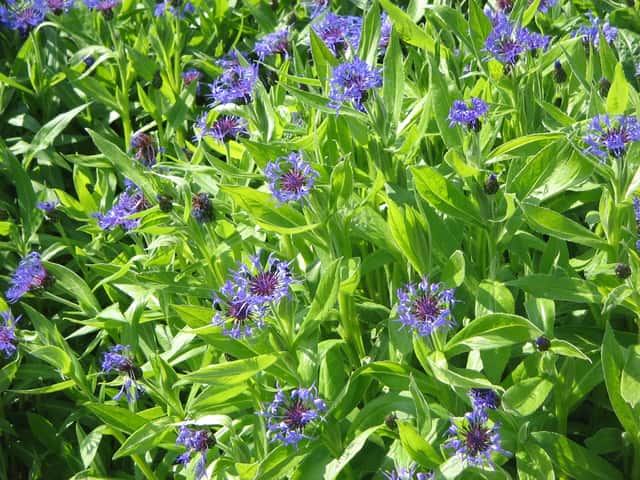
perennial cornflower (Centaurea montana) is a easy-care plant from the Asteraceae family. Centaurea montana, commonly known as Mountain Bluet or Perennial Cornflower, is a robust, clump-forming perennial. It features distinctive fringed, spider-like flower heads, most famously in a deep violet-blue, though cultivars exist in white and pink. Its lance-shaped leaves are covered in fine sil...
perennial cornflower grows up to 60cm, spread of 100cm, watering every 10 days, -20°C – 32°C, 30–50% humidity. It is not suitable for indoor environments and safe for pets.
Unlike many tropical plants, perennial cornflower tolerates watering mistakes. Best for beginners. Unlike many popular species, perennial cornflower is safe to keep around pets.
How to Care for perennial cornflower?
TLDR: perennial cornflower needs Bright indirect, watering every 10 days, and temperatures between -20-32°C with 30-50% humidity.
How Often Should You Water perennial cornflower?
Water regularly during the first growing season. Once established, it is quite drought-tolerant but flowers better with consistent moisture.
How Much Light Does perennial cornflower Need?
Thrives in full sun but appreciates some afternoon shade in very hot southern climates.
What Is the Best Soil for perennial cornflower?
Prefers loamy or chalky soil that is well-drained; avoids heavy clay that stays wet in winter.
What Pot Should You Use for perennial cornflower?
Best grown in the ground, but if containerized, use a large, deep pot with excellent drainage.
Care Schedule
Fertilize
Every 30 days
What Is perennial cornflower and Where Does It Come From?
Centaurea montana, commonly known as Mountain Bluet or Perennial Cornflower, is a robust, clump-forming perennial. It features distinctive fringed, spider-like flower heads, most famously in a deep violet-blue, though cultivars exist in white and pink. Its lance-shaped leaves are covered in fine silvery hairs when young, giving the foliage a soft, grey-green appearance. It is highly valued in cottage gardens for its hardiness and ability to attract pollinators.
How to Propagate perennial cornflower?
Root Division
- Divide every 3 years to maintain plant vigor.
- Keep the new divisions well-watered until established.
- 1 Dig up the clump
Carefully lift an established plant from the ground using a garden fork in early spring.
- 2 Separate the roots
Pull the root mass apart by hand or use a sharp knife to create smaller sections, ensuring each has several shoots and a healthy root system.
- 3 Replant
Immediately replant the divisions into their new locations and water thoroughly.
Materials needed:
Sowing Seeds
- Seeds often benefit from a period of cold (stratification).
- The plant will often self-seed freely if flowers are not removed.
- 1 Prepare the bed
Clear the soil of weeds and rake to a fine tilth.
- 2 Sow seeds
Sow seeds thinly on the surface and cover with a very light layer of soil.
- 3 Thin seedlings
Once seedlings are large enough to handle, thin them to 30cm apart.
Materials needed:
How Big Does perennial cornflower Grow?
TLDR: perennial cornflower can reach up to 60cm tall with Fast growth rate.
Max height
60cm
Spread
1.0m
Growth rate
Fast
Foliage
Deciduous
Plant Uses
Ornamental
Great for decoration
Medicinal
Medicinal properties
Medicinal Uses
- Historically used as an anti-inflammatory
- Used in traditional herbalism for eye washes to soothe irritation
Culinary Uses
- Edible flower petals used as a colorful garnish in salads
- Dried petals used in tea blends
Is your plant showing symptoms?
Click on the symptom to discover possible causes:
What Diseases Commonly Affect perennial cornflower?
TLDR: perennial cornflower is susceptible to 4 known diseases. Monitor regularly for early detection.
Powdery Mildew
Powdery mildew is a common fungal disease caused by various fungi species including Erysiphe, Podosphaera, Oïdium, and Leveillula. It affects over 10,000 plant species worldwide. The disease thrives in warm, dry climates with high humidity and appears as a distinctive white powdery coating on plant surfaces.
Aphids
Aphids are small, soft-bodied, pear-shaped insects (1/16 to 1/8 inch long) that feed by sucking nutrient-rich sap from plants. They reproduce rapidly and can quickly weaken plants, causing distorted growth and transmitting plant viruses. Aphids come in various colors including green, black, red, yellow, brown, and gray. They secrete honeydew, a sticky substance that attracts ants and encourages sooty mold growth.
Spider Mites
Spider mites are tiny arachnids (less than 1/20 inch long) related to spiders and ticks that feed on plant sap. They thrive in hot, dry conditions and can cause significant damage to ornamental and vegetable plants. During severe infestations, crop losses can reach 14% or higher as these pests disrupt vital plant processes including photosynthesis, carbon dioxide absorption, and transpiration.
Slugs and Snails
Slugs and snails are mollusks that feed on plant tissue, causing irregular holes in leaves and damage to young seedlings. They are most active at night and in moist conditions, leaving characteristic silvery slime trails. These pests can quickly devastate gardens, especially during wet seasons.
Meaning & Symbolism
Symbolizes hope, devotion, and delicacy.
Compare with similar plants
| Attribute | Difficulty | Light | Watering | Pet Safe |
|---|---|---|---|---|
| Field Maple | Easy | Bright indirect | 14d | ✓ |
| Silver Birch | Easy | Direct sun | 14d | ✓ |
| Cushion Bush | Easy | Direct sun | 14d | ✓ |
| Wild Lettuce | Medium | Direct sun | 7d | ⚠️ |





