Convolvulaceae
Skyblue Clustervine (Jacquemontia pentanthos): Complete Care Guide
Jacquemontia pentanthos
Easy to grow, requiring full sun and regular watering. Tolerates brief dry periods once established but cannot withstand prolonged waterlogging. Ideal for coastal gardens due to its salt spray tolerance.
Every 7 days
Direct sun
15° - 38°C
50% - 80%
Categories
What is Skyblue Clustervine?
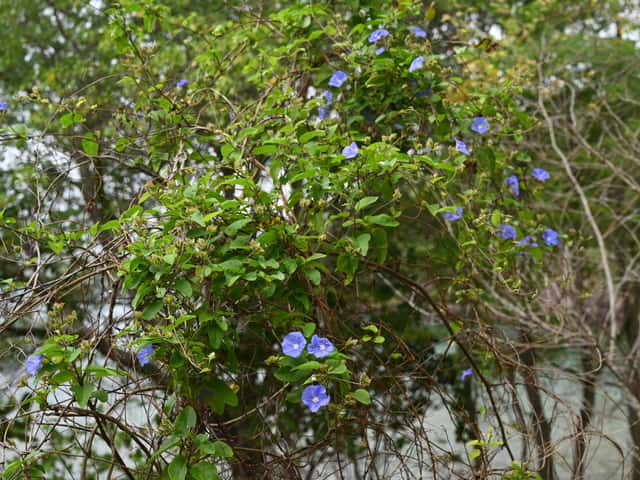
Skyblue Clustervine (Jacquemontia pentanthos) is a easy-care plant from the Convolvulaceae family. Skyblue Clustervine (Jacquemontia pentanthos) is an evergreen perennial vine from the Convolvulaceae family, native to Tropical Americas including Brazil. It produces an abundance of funnel-shaped, sky blue to pinkish-lavender flowers with white throats that open at dawn and close after dark. A fast...
Skyblue Clustervine grows up to 3.6m, with spread of 200cm, watering every 7 days, 15°C – 38°C, 50–80% humidity. It is not suitable for indoor environments and safe for pets.
Unlike many tropical plants, Skyblue Clustervine tolerates watering mistakes. Best for beginners. Unlike many popular species, Skyblue Clustervine is safe to keep around pets.
How to Care for Skyblue Clustervine?
TLDR: Skyblue Clustervine needs Direct sun, watering every 7 days, and temperatures between 15-38°C with 50-80% humidity.
How Often Should You Water Skyblue Clustervine?
Water every 7 days, keeping soil moist but well-drained. Once established, the plant tolerates brief dry spells. Avoid waterlogging as it can cause root rot.
How Much Light Does Skyblue Clustervine Need?
Grow in full sun (minimum 6 hours of direct light daily). The more sun it receives, the more it blooms. Tolerates light shade but with significantly reduced flowering.
What Is the Best Soil for Skyblue Clustervine?
Prefers sandy or calcareous soils with pH between 6.0 and 8.0 and good drainage. Add organic matter to enrich the substrate. Avoid heavy clay soils that retain water.
What Pot Should You Use for Skyblue Clustervine?
Ceramic or terracotta pots with drainage holes. For climbing, use larger containers (12+ inches) with trellis or support. In gardens, plant directly in the ground near fences or support structures.
Care Schedule
Fertilize
Every 30 days
What Is Skyblue Clustervine and Where Does It Come From?
Skyblue Clustervine (Jacquemontia pentanthos) is an evergreen perennial vine from the Convolvulaceae family, native to Tropical Americas including Brazil. It produces an abundance of funnel-shaped, sky blue to pinkish-lavender flowers with white throats that open at dawn and close after dark. A fast-growing vine highly valued for covering fences, pergolas, and trellises in tropical gardens.
How to Propagate Skyblue Clustervine?
Stem Cutting
Use clean, sharp tools to prevent disease. Change water every 3-4 days if propagating in water. Rooting is faster in warm climates.
- 1 Cut a healthy stem of 4-6 inches just below a node
- 2 Remove lower leaves, keeping 2-3 leaves at the top
- 3 Apply rooting hormone powder to the cut end
- 4 Plant in moist sandy substrate or place in water until rooted
- 5 Keep in indirect light until roots develop
Materials needed:
Seed Sowing
Scarification improves germination rates. Keep substrate moist but not waterlogged during germination.
- 1 Lightly scarify seeds with fine sandpaper
- 2 Soak seeds in warm water for 12-24 hours
- 3 Sow in moist, well-drained substrate 0.2 inches deep
- 4 Keep in a warm location (77-86°F) with indirect light
- 5 Transplant when seedlings reach 4 inches tall
Materials needed:
How Big Does Skyblue Clustervine Grow?
TLDR: Skyblue Clustervine can reach up to 3.6m tall with Fast growth rate.
Max height
3.6m
Spread
2.0m
Growth rate
Fast
Foliage
Evergreen
Plant Uses
Ornamental
Great for decoration
Is your plant showing symptoms?
Click on the symptom to discover possible causes:
What Diseases Commonly Affect Skyblue Clustervine?
TLDR: Skyblue Clustervine is susceptible to 4 known diseases. Monitor regularly for early detection.
Spider Mites
Spider mites are tiny arachnids (less than 1/20 inch long) related to spiders and ticks that feed on plant sap. They thrive in hot, dry conditions and can cause significant damage to ornamental and vegetable plants. During severe infestations, crop losses can reach 14% or higher as these pests disrupt vital plant processes including photosynthesis, carbon dioxide absorption, and transpiration.
Whiteflies
Whiteflies are small, soft-bodied, winged insects closely related to aphids and mealybugs. They are moth-like in appearance, about 1/16 inch long, triangular in shape, and gray-white in color. These sap-sucking pests feed on plant tissue, causing yellowing, stunted growth, and wilting. They also excrete honeydew, which attracts ants and promotes sooty mold growth. Whiteflies can transmit serious plant viruses.
Root Rot
Root rot is a serious fungal disease that affects the root system of plants, causing them to decay and die. It is primarily caused by overwatering, poor drainage, or soil-borne fungi such as Pythium, Phytophthora, Rhizoctonia, and Fusarium. The disease thrives in waterlogged conditions where roots are deprived of oxygen, making them susceptible to fungal infection.
Powdery Mildew
Powdery mildew is a common fungal disease caused by various fungi species including Erysiphe, Podosphaera, Oïdium, and Leveillula. It affects over 10,000 plant species worldwide. The disease thrives in warm, dry climates with high humidity and appears as a distinctive white powdery coating on plant surfaces.
Meaning & Symbolism
Symbolizes freedom, lightness, and the fleeting beauty of blue flowers that open at dawn, representing new beginnings and hope.
Fun Facts
Can produce more than 100 flowers in a single day during peak blooming
Flowers open at dawn and close after dark, like all members of the morning glory family
Although native to Tropical Americas, it has naturalized in parts of Asia and Pacific islands
Listed as an Endangered plant species in the state of Florida, USA
Frequently asked questions
How often should I water Skyblue Clustervine?
Does Skyblue Clustervine need full sun?
How do I propagate Skyblue Clustervine?
Can Skyblue Clustervine grow in containers?
Is Skyblue Clustervine drought tolerant?
Compare with similar plants
| Attribute | Difficulty | Light | Watering | Pet Safe |
|---|---|---|---|---|
| Peace Lily | Easy | Low light | 4d | ⚠️ |
| Swiss Cheese Plant | Easy | Partial shade | 10d | ⚠️ |
| Golden Pothos | Easy | Low light | 8d | ⚠️ |
| ZZ Plant | Easy | Low light | 18d | ⚠️ |