Boraginaceae
common comfrey: Medicinal Uses & Care Tips
Symphytum officinale
Comfrey is a low-maintenance plant that thrives in moist, fertile soil and full sun. It is extremely hardy and can be cut back several times a year to encourage fresh growth.
Every 6 days
Partial shade
-15° - 30°C
30% - 50%
Categories
What is common comfrey?
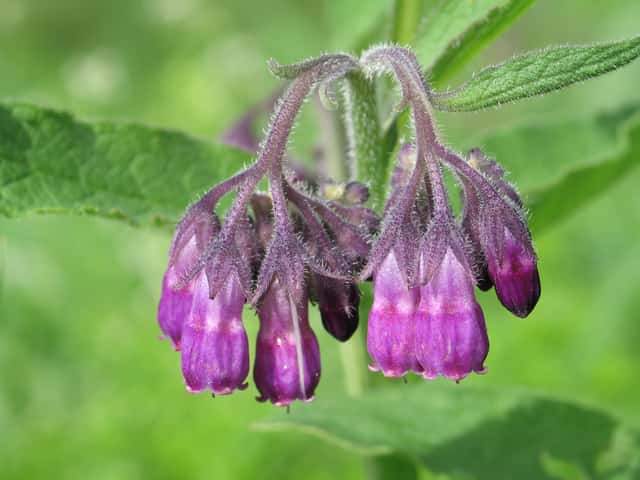
common comfrey (Symphytum officinale) is a easy-care plant from the Boraginaceae family. Symphytum officinale, commonly known as comfrey, is a robust perennial herb famous for its large, hairy, lanceolate leaves and clusters of bell-shaped flowers. It is a 'dynamic accumulator' with a deep taproot that mines minerals from the subsoil, making its foliage an excellent organic fertilizer a...
common comfrey grows up to 1.2m, spread of 60cm, watering every 6 days, -15°C – 30°C, 30–50% humidity. It is not suitable for indoor environments and not safe for pets.
Unlike many tropical plants, common comfrey tolerates watering mistakes. Best for beginners. Without precautions, ingestion can cause irritation in pets. Keep out of reach of cats and dogs.
How to Care for common comfrey?
TLDR: common comfrey needs Partial shade, watering every 6 days, and temperatures between -15-30°C with 30-50% humidity.
How Often Should You Water common comfrey?
Keep the soil consistently moist, especially during the first growing season or in high heat.
How Much Light Does common comfrey Need?
While it prefers full sun for maximum growth, it is quite tolerant of partial shade.
What Is the Best Soil for common comfrey?
Prefers heavy, moist, and nutrient-rich soils; it can even thrive in clay-heavy areas.
What Pot Should You Use for common comfrey?
Not recommended for containers due to its deep, invasive taproot; if necessary, use a very deep planter.
Care Schedule
Fertilize
Every 14 days
What Is common comfrey and Where Does It Come From?
Symphytum officinale, commonly known as comfrey, is a robust perennial herb famous for its large, hairy, lanceolate leaves and clusters of bell-shaped flowers. It is a 'dynamic accumulator' with a deep taproot that mines minerals from the subsoil, making its foliage an excellent organic fertilizer and compost activator.
How to Propagate common comfrey?
Root Cuttings
- Even a small fragment of root can grow into a new plant.
- Plant in a permanent location as it is difficult to remove once established.
- 1 Expose Roots
Dig up a portion of the root system of a mature plant.
- 2 Cut Root Segments
Cut the roots into 2-5 cm segments.
- 3 Plant Segments
Lay segments horizontally in soil about 5 cm deep and keep moist.
Materials needed:
Crown Division
- Water thoroughly after replanting to reduce transplant shock.
- 1 Lift the Plant
Dig up the entire crown of an established comfrey plant.
- 2 Divide the Crown
Use a spade to split the crown into several pieces, ensuring each has a growing point.
- 3 Replant
Replant the divisions immediately at the same depth they were previously growing.
Materials needed:
How Big Does common comfrey Grow?
TLDR: common comfrey can reach up to 1.2m tall with Fast growth rate.
Max height
1.2m
Spread
60cm
Growth rate
Fast
Foliage
Deciduous
Warning: Toxic Plant
This plant can be toxic if ingested. Keep out of reach of:
Plant Uses
Medicinal
Medicinal properties
Ornamental
Great for decoration
Medicinal Uses
- External poultice for bruises
- Topical treatment for sprains
- Support for bone fracture healing (external only)
Is your plant showing symptoms?
Click on the symptom to discover possible causes:
What Diseases Commonly Affect common comfrey?
TLDR: common comfrey is susceptible to 5 known diseases. Monitor regularly for early detection.
Powdery Mildew
Powdery mildew is a common fungal disease caused by various fungi species including Erysiphe, Podosphaera, Oïdium, and Leveillula. It affects over 10,000 plant species worldwide. The disease thrives in warm, dry climates with high humidity and appears as a distinctive white powdery coating on plant surfaces.
Rust
Rust is a common fungal disease caused by fungi in the order Pucciniales that affects a wide variety of plants. The disease gets its name from the characteristic orange, yellow, or reddish-brown pustules that appear on leaves, resembling metal rust. This obligate fungal parasite requires living plants to survive and can cause significant economic losses in agricultural crops.
Aphids
Aphids are small, soft-bodied, pear-shaped insects (1/16 to 1/8 inch long) that feed by sucking nutrient-rich sap from plants. They reproduce rapidly and can quickly weaken plants, causing distorted growth and transmitting plant viruses. Aphids come in various colors including green, black, red, yellow, brown, and gray. They secrete honeydew, a sticky substance that attracts ants and encourages sooty mold growth.
Slugs and Snails
Slugs and snails are mollusks that feed on plant tissue, causing irregular holes in leaves and damage to young seedlings. They are most active at night and in moist conditions, leaving characteristic silvery slime trails. These pests can quickly devastate gardens, especially during wet seasons.
Meaning & Symbolism
Symbolizes healing, protection, and the mending of broken bonds.
Compare with similar plants
| Attribute | Difficulty | Light | Watering | Pet Safe |
|---|---|---|---|---|
| Field Maple | Easy | Bright indirect | 14d | ✓ |
| Silver Birch | Easy | Direct sun | 14d | ✓ |
| Cushion Bush | Easy | Direct sun | 14d | ✓ |
| Peruvian peppertree | Easy | Direct sun | 14d | ⚠️ |