Myrtaceae
Dwarf Eugenia: Edible Plant
Eugenia mattosii
Requires high light levels and constantly moist soil, but without waterlogging. It benefits from regular pruning to maintain its compact shape.
Every 7 days
Direct sun
-3° - 35°C
40% - 70%
Categories
What is Dwarf Eugenia?
Dwarf Eugenia (Eugenia mattosii) is a easy-care plant from the Myrtaceae family. Eugenia mattosii, popularly known as the Dwarf Eugenia, is an evergreen shrub native to Brazil, belonging to the Myrtaceae family. It features dense, compact foliage with small, oval, glossy leaves that display reddish tones when young, turning dark green at maturity. During spring and summer, it pr...
Dwarf Eugenia grows up to 3.0m, spread of 150cm, watering every 7 days, -3°C – 35°C, 40–70% humidity. It is suitable for indoor environments and safe for pets.
Unlike many tropical plants, Dwarf Eugenia tolerates watering mistakes. Best for beginners. Unlike many popular species, Dwarf Eugenia is safe to keep around pets. Without adequate drainage, root rot can develop within 14 days.
How to Care for Dwarf Eugenia?
TLDR: Dwarf Eugenia needs Direct sun, watering every 7 days, and temperatures between -3-35°C with 40-70% humidity.
How Often Should You Water Dwarf Eugenia?
Watering should be frequent to keep the soil moist. Never allow the substrate to dry out completely, especially on hot days.
How Much Light Does Dwarf Eugenia Need?
It thrives best in full sun, which ensures denser and redder foliage. It tolerates partial shade, but may develop longer and sparser branches.
What Is the Best Soil for Dwarf Eugenia?
Use a mixture of potting soil, organic compost, and coarse sand to ensure nutrition and efficient drainage.
What Pot Should You Use for Dwarf Eugenia?
Ceramic or terracotta pots with drainage holes, ideal for maintaining moisture without water accumulation.
Care Schedule
Fertilize
Every 30 days
Repot
Every 730 days
What Is Dwarf Eugenia and Where Does It Come From?
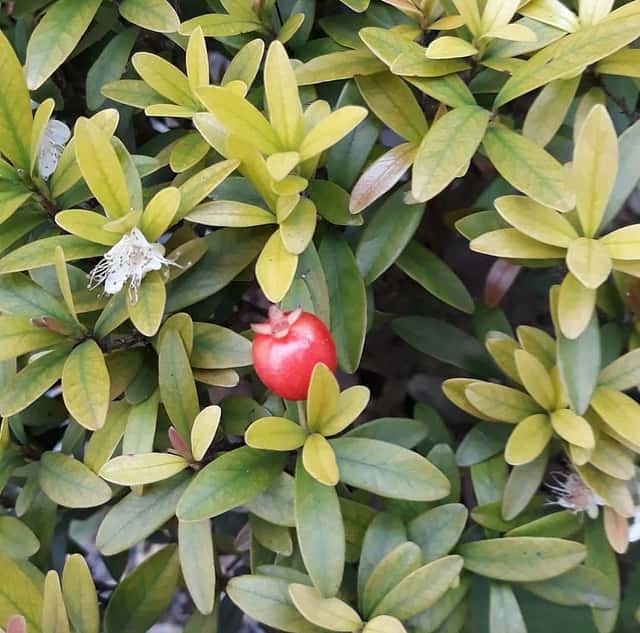
Eugenia mattosii, popularly known as the Dwarf Eugenia, is an evergreen shrub native to Brazil, belonging to the Myrtaceae family. It features dense, compact foliage with small, oval, glossy leaves that display reddish tones when young, turning dark green at maturity. During spring and summer, it produces delicate white flowers that give rise to small, globose, deep red fruits. These fruits are edible, with a slightly acidic flavor, and are highly attractive to birds. Due to its controlled growth and small leaves, it is one of the most valued species for the art of bonsai and for landscaping in small spaces.
How to Propagate Dwarf Eugenia?
Sowing
- Keep the substrate always moist and in a shaded spot until germination.
- 1 Harvesting
Harvest the fruits when they are fully ripe (dark red).
- 2 Cleaning
Remove the pulp and wash the seeds in running water.
- 3 Planting
Sow immediately in a substrate rich in organic matter, as the seeds lose viability quickly.
Materials needed:
Cuttings
- Cover with clear plastic to maintain humidity around the leaves.
- 1 Cutting
Cut semi-hardwood branches 10 to 15 cm long.
- 2 Preparation
Remove leaves from the bottom half and dip the base in rooting hormone.
- 3 Placement
Plant in a mixture of sand and peat, keeping it under high humidity.
Materials needed:
How Big Does Dwarf Eugenia Grow?
TLDR: Dwarf Eugenia can reach up to 3.0m tall with Slow growth rate.
Max height
3.0m
Spread
1.5m
Growth rate
Slow
Foliage
Evergreen
Plant Uses
Edible
Can be consumed
Ornamental
Great for decoration
Culinary Uses
- Fresh consumption
- Jams
- Liqueurs
- Dessert decoration
Is your plant showing symptoms?
Click on the symptom to discover possible causes:
What Diseases Commonly Affect Dwarf Eugenia?
TLDR: Dwarf Eugenia is susceptible to 14 known diseases. Monitor regularly for early detection.
Rust
Rust is a common fungal disease caused by fungi in the order Pucciniales that affects a wide variety of plants. The disease gets its name from the characteristic orange, yellow, or reddish-brown pustules that appear on leaves, resembling metal rust. This obligate fungal parasite requires living plants to survive and can cause significant economic losses in agricultural crops.
Anthracnose
Anthracnose is a fungal disease caused by fungi in the genus Colletotrichum that affects many plants, including vegetables, fruits, and trees. The disease thrives in cool, wet conditions, causing dark, sunken lesions on leaves, stems, flowers, and fruits.
Scale Insects
Scale insects are small sap-sucking pests that appear as brown, shell-like bumps on plant stems and leaves. There are over 25 species, divided into armored (hard) and unarmored (soft) scales. They feed by piercing plant tissue and extracting sap, which weakens the plant and can lead to yellowing, stunted growth, and even death if left untreated. They also excrete honeydew, which attracts ants and promotes sooty mold growth.
Whiteflies
Whiteflies are small, soft-bodied, winged insects closely related to aphids and mealybugs. They are moth-like in appearance, about 1/16 inch long, triangular in shape, and gray-white in color. These sap-sucking pests feed on plant tissue, causing yellowing, stunted growth, and wilting. They also excrete honeydew, which attracts ants and promotes sooty mold growth. Whiteflies can transmit serious plant viruses.
Meaning & Symbolism
It represents resilience and the sweetness of life, often being associated with protection and hospitality.
Compare with similar plants
| Attribute | Difficulty | Light | Watering | Pet Safe |
|---|---|---|---|---|
| Field Maple | Easy | Bright indirect | 14d | ✓ |
| Silver Birch | Easy | Direct sun | 14d | ✓ |
| Cushion Bush | Easy | Direct sun | 14d | ✓ |
| Peruvian peppertree | Easy | Direct sun | 14d | ⚠️ |





