Apocynaceae
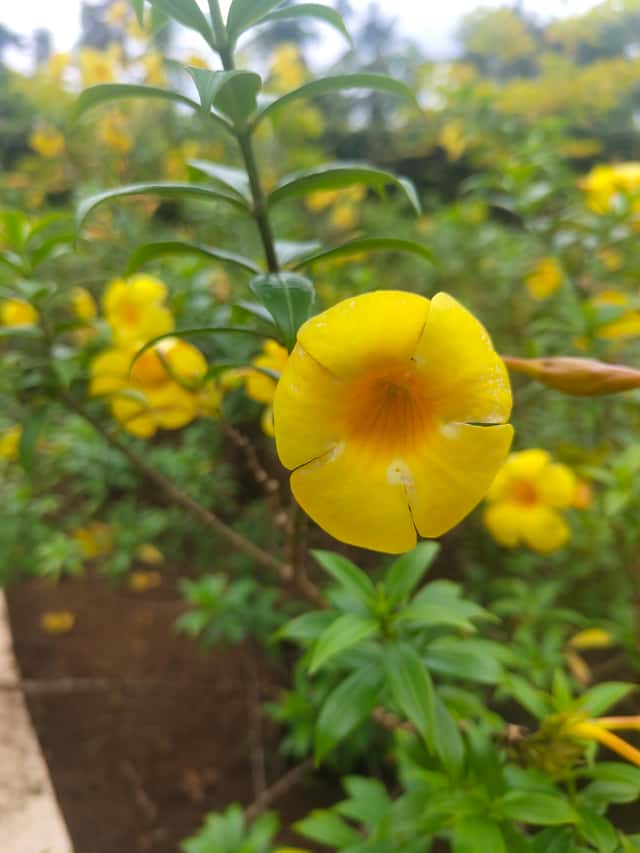
Golden Trumpet (Allamanda cathartica): The Dazzling Tropical Vine
Allamanda cathartica
Full sun plant requiring regular watering (every 3 days in summer), well-draining soil with pH 6–7.5, and quarterly fertilizing. Prune lightly after bloom cycles to encourage new growth. Frost-free conditions required. Keep away from children and pets — all parts are severely toxic.
Every 3 days
Direct sun
15° - 35°C
50% - 80%
Categories
What is Golden Trumpet?
Golden Trumpet (Allamanda cathartica) is a easy-care plant from the Apocynaceae family. Allamanda cathartica, commonly known as Golden Trumpet or Yellow Allamanda, is a fast-growing tropical vine native to Brazil, belonging to the Apocynaceae family. It is prized for its stunning golden-yellow, trumpet-shaped flowers that bloom nearly year-round in tropical climates. Widely used to cov...
Golden Trumpet grows up to 5.8m, spread of 180cm, watering every 3 days, 15°C – 35°C, 50–80% humidity. It is suitable for indoor environments and not safe for pets.
Unlike many tropical plants, Golden Trumpet tolerates watering mistakes. Best for beginners. Without precautions, ingestion can cause irritation in pets. Keep out of reach of cats and dogs. Without adequate drainage, root rot can develop within 7 days.
How to Care for Golden Trumpet?
TLDR: Golden Trumpet needs Direct sun, watering every 3 days, and temperatures between 15-35°C with 50-80% humidity.
How Often Should You Water Golden Trumpet?
Water every 2–3 days during warm months; reduce in winter. Allow soil to dry slightly between waterings. Ensure excellent drainage to prevent root rot.
How Much Light Does Golden Trumpet Need?
Requires full sun — at least 6 hours of direct sunlight daily for prolific blooming. In partial shade, flower production is significantly reduced.
What Is the Best Soil for Golden Trumpet?
Use rich, well-draining soil with pH 6.0–7.5. Amend with perlite or coarse sand. Avoid heavy clay or compacted soil that retains excess moisture.
What Pot Should You Use for Golden Trumpet?
Large ceramic or sturdy plastic pots with drainage holes. For vines, use containers at least 40 cm in diameter with a trellis or support structure.
Care Schedule
Fertilize
Every 90 days
Misting
Every 3 days
Repot
Every 365 days
What Is Golden Trumpet and Where Does It Come From?
Allamanda cathartica, commonly known as Golden Trumpet or Yellow Allamanda, is a fast-growing tropical vine native to Brazil, belonging to the Apocynaceae family. It is prized for its stunning golden-yellow, trumpet-shaped flowers that bloom nearly year-round in tropical climates. Widely used to cover pergolas, fences, and walls, it thrives in full sun with regular watering. WARNING: All parts of the plant are highly toxic, containing cardiac glycosides and irritating latex.
How to Propagate Golden Trumpet?
Stem Cutting
Always wear gloves when handling the plant as the latex sap causes skin irritation. Change water weekly if rooting in water.
- 1 Cut a healthy semi-hardwood stem of 10–15 cm just below a leaf node
- 2 Remove lower leaves, keeping only 2–3 at the top
- 3 Apply rooting hormone powder to the cut end
- 4 Plant in moist, well-draining substrate (mix of soil and perlite)
- 5 Keep in a warm location with indirect light and high humidity for 4–8 weeks
Materials needed:
Seed Propagation
Stem cuttings are strongly preferred as they are faster and more reliable. Seed germination is irregular.
- 1 Collect mature seeds from dry seed pods
- 2 Sow in moist, well-draining substrate at 1 cm depth
- 3 Maintain temperature of 24–28°C with high humidity
- 4 Await germination in 3–6 weeks
- 5 Transplant when seedlings reach 10 cm
Materials needed:
How Big Does Golden Trumpet Grow?
TLDR: Golden Trumpet can reach up to 5.8m tall with Fast growth rate.
Max height
5.8m
Spread
1.8m
Growth rate
Fast
Foliage
Evergreen
Warning: Toxic Plant
This plant can be toxic if ingested. Keep out of reach of:
Plant Uses
Ornamental
Great for decoration
Is your plant showing symptoms?
Click on the symptom to discover possible causes:
What Diseases Commonly Affect Golden Trumpet?
TLDR: Golden Trumpet is susceptible to 7 known diseases. Monitor regularly for early detection.
Root Rot
Root rot is a serious fungal disease that affects the root system of plants, causing them to decay and die. It is primarily caused by overwatering, poor drainage, or soil-borne fungi such as Pythium, Phytophthora, Rhizoctonia, and Fusarium. The disease thrives in waterlogged conditions where roots are deprived of oxygen, making them susceptible to fungal infection.
Powdery Mildew
Powdery mildew is a common fungal disease caused by various fungi species including Erysiphe, Podosphaera, Oïdium, and Leveillula. It affects over 10,000 plant species worldwide. The disease thrives in warm, dry climates with high humidity and appears as a distinctive white powdery coating on plant surfaces.
Leaf Spot
Leaf spot is a common fungal disease caused by various pathogens including Alternaria, Ascochyta, Colletotrichum, Septoria, and Venturia. It primarily affects leaves, causing discolored spots that can lead to premature leaf drop if left untreated.
Aphids
Aphids are small, soft-bodied, pear-shaped insects (1/16 to 1/8 inch long) that feed by sucking nutrient-rich sap from plants. They reproduce rapidly and can quickly weaken plants, causing distorted growth and transmitting plant viruses. Aphids come in various colors including green, black, red, yellow, brown, and gray. They secrete honeydew, a sticky substance that attracts ants and encourages sooty mold growth.
Meaning & Symbolism
Considered sacred in Indian culture; a symbol of tropical beauty and vitality. Widely used in tropical gardens as an ornamental statement plant.
Fun Facts
Golden Trumpet is native to Brazil and belongs to the Apocynaceae family, the same family as Oleander and Plumeria
Despite its toxicity, Allamanda extracts are used in the production of natural pesticides in Brazil
Its fragrant flowers attract hummingbirds, butterflies, and bees
In optimal tropical conditions, the plant can grow over 6 meters in a single season
Frequently asked questions
Does Golden Trumpet bloom all year?
Is Allamanda cathartica toxic to pets?
How often should I water my Golden Trumpet?
Can Golden Trumpet grow in a pot?
Why are my Golden Trumpet leaves turning yellow?
Compare with similar plants
| Attribute | Difficulty | Light | Watering | Pet Safe |
|---|---|---|---|---|
| Field Maple | Easy | Bright indirect | 14d | ✓ |
| Silver Birch | Easy | Direct sun | 14d | ✓ |
| Common Blanketflower | Easy | Direct sun | 10d | ✓ |
| Cushion Bush | Easy | Direct sun | 14d | ✓ |





