Asphodelaceae
Fairy Washboard: Low Water Needs
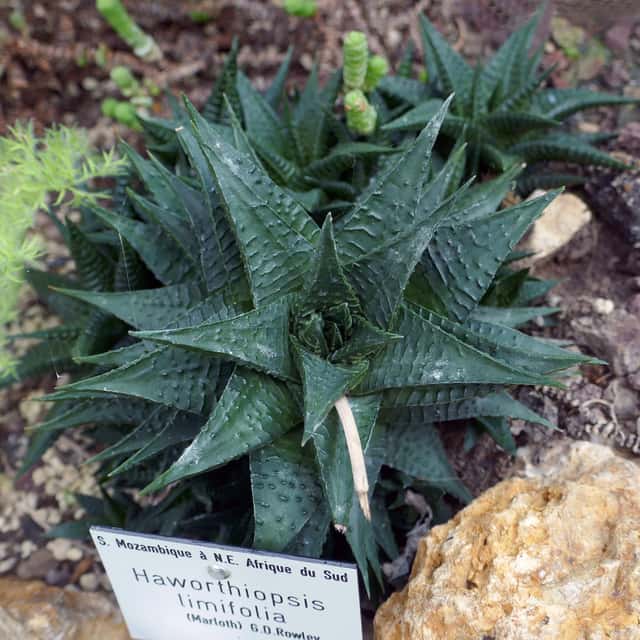
Haworthiopsis limifolia
Very low-maintenance plant. Requires bright indirect light and well-draining soil, with watering only when the substrate is completely dry.
Every 14 days
Bright indirect
10° - 27°C
30% - 50%
Categories
What is Fairy Washboard?
Fairy Washboard (Haworthiopsis limifolia) is a easy-care plant from the Asphodelaceae family. A fascinating and hardy succulent, characterized by its rigid triangular leaves arranged in a rosette. The most striking feature is the raised horizontal ridges on its dark green leaves, resembling an old-fashioned washboard or crocodile skin. It is a slow-growing plant, ideal for beginners due to i...
Fairy Washboard grows up to 15cm, spread of 20cm, watering every 14 days, 10°C – 27°C, 30–50% humidity. It is suitable for indoor environments and safe for pets.
Unlike many tropical plants, Fairy Washboard tolerates watering mistakes. Best for beginners. Unlike many popular species, Fairy Washboard is safe to keep around pets. Without adequate drainage, root rot can develop within 28 days.
How to Care for Fairy Washboard?
TLDR: Fairy Washboard needs Bright indirect, watering every 14 days, and temperatures between 10-27°C with 30-50% humidity.
How Often Should You Water Fairy Washboard?
Use the 'soak and dry' method. Water deeply until water flows from the drainage holes and only repeat when the soil is 100% dry. In winter, drastically reduce watering.
How Much Light Does Fairy Washboard Need?
While it tolerates shade, bright indirect light maintains the compact shape of the rosette. Avoid intense direct midday sun to prevent leaf burn.
What Is the Best Soil for Fairy Washboard?
Use a specific soil mix for cacti and succulents, or add coarse sand and perlite to regular soil to ensure fast drainage.
What Pot Should You Use for Fairy Washboard?
Terracotta or ceramic pots with drainage holes are ideal to help excess moisture evaporate.
Care Schedule
Fertilize
Every 60 days
Rotate
Every 90 days
Repot
Every 730 days
What Is Fairy Washboard and Where Does It Come From?
A fascinating and hardy succulent, characterized by its rigid triangular leaves arranged in a rosette. The most striking feature is the raised horizontal ridges on its dark green leaves, resembling an old-fashioned washboard or crocodile skin. It is a slow-growing plant, ideal for beginners due to its tolerance for neglect.
How to Propagate Fairy Washboard?
Offset Separation (Pups)
- Wait for the pup to reach at least one-third the size of the mother plant before separating.
- Use a sterilized knife if manual separation is difficult.
- 1 Identification
Locate the small pups (offsets) emerging at the base of the mother plant.
- 2 Removal
Gently remove the pup, ensuring it has some of its own roots attached.
- 3 Callousing
Let the pup rest in a dry place for 24 hours to allow the cut to callous over.
- 4 Planting
Plant in a new pot with succulent mix and wait a few days before watering lightly.
Materials needed:
How Big Does Fairy Washboard Grow?
TLDR: Fairy Washboard can reach up to 15cm tall with Slow growth rate.
Max height
15cm
Spread
20cm
Growth rate
Slow
Foliage
Evergreen
Plant Uses
Ornamental
Great for decoration
Is your plant showing symptoms?
Click on the symptom to discover possible causes:
What Diseases Commonly Affect Fairy Washboard?
TLDR: Fairy Washboard is susceptible to 9 known diseases. Monitor regularly for early detection.
Root Rot
Root rot is a serious fungal disease that affects the root system of plants, causing them to decay and die. It is primarily caused by overwatering, poor drainage, or soil-borne fungi such as Pythium, Phytophthora, Rhizoctonia, and Fusarium. The disease thrives in waterlogged conditions where roots are deprived of oxygen, making them susceptible to fungal infection.
Overwatering
Overwatering occurs when plants receive too much water, depriving roots of oxygen and causing root rot. This environmental stress is one of the most common causes of houseplant death, as waterlogged soil prevents roots from breathing and functioning properly.
Underwatering
Underwatering or drought stress is a physiological disorder that occurs when the amount of water a plant loses through transpiration exceeds the amount its roots can absorb from the soil. This leads to cellular dehydration and various visible symptoms that can compromise plant health and productivity.
Spider Mites
Spider mites are tiny arachnids (less than 1/20 inch long) related to spiders and ticks that feed on plant sap. They thrive in hot, dry conditions and can cause significant damage to ornamental and vegetable plants. During severe infestations, crop losses can reach 14% or higher as these pests disrupt vital plant processes including photosynthesis, carbon dioxide absorption, and transpiration.
Meaning & Symbolism
Represents resilience, protection, and the ability to thrive even in adverse conditions.
Compare with similar plants
| Attribute | Difficulty | Light | Watering | Pet Safe |
|---|---|---|---|---|
| Field Maple | Easy | Bright indirect | 14d | ✓ |
| Silver Birch | Easy | Direct sun | 14d | ✓ |
| Cushion Bush | Easy | Direct sun | 14d | ✓ |
| Peruvian peppertree | Easy | Direct sun | 14d | ⚠️ |





