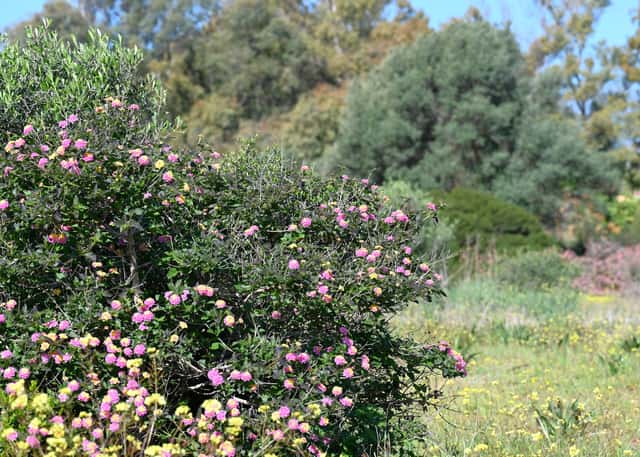
Verbenaceae
Lantana (Lantana × strigocamara) — Care Guide
Lantana × strigocamara
Lantana is an easy-care, sun-loving shrub that thrives with minimal attention once established. Plant in full sun, water moderately, and ensure excellent drainage. Drought-tolerant; avoid overwatering. Prune lightly to encourage reblooming and prevent legginess. Fertilize sparingly — too much nitrogen reduces flowering.
Every 7 days
Direct sun
5° - 38°C
40% - 70%
Categories
What is Lantana?
Lantana (Lantana × strigocamara) is a easy-care plant from the Verbenaceae family. Lantana × strigocamara is a vigorous garden hybrid between Lantana camara and L. strigocamara, naturalized widely across tropical and subtropical regions worldwide. This evergreen shrub produces dense clusters of small tubular flowers that famously change color as they mature — from yellow or orange...
Lantana grows up to 1.8m, spread of 150cm, watering every 7 days, 5°C – 38°C, 40–70% humidity. It is not suitable for indoor environments and not safe for pets.
Unlike many tropical plants, Lantana tolerates watering mistakes. Best for beginners. Without precautions, ingestion can cause irritation in pets. Keep out of reach of cats and dogs.
How to Care for Lantana?
TLDR: Lantana needs Direct sun, watering every 7 days, and temperatures between 5-38°C with 40-70% humidity.
How Often Should You Water Lantana?
Water every 7–10 days once established, allowing the soil to dry between waterings. During the first growing season, water more regularly to support root establishment. Never let water pool around the base — Lantana is highly susceptible to root rot in waterlogged conditions.
How Much Light Does Lantana Need?
Lantana requires full sun — at least 6 hours of direct sunlight daily. In partial shade, the plant becomes leggy and produces significantly fewer flowers. Place in the sunniest spot in your garden or on a south-facing patio.
What Is the Best Soil for Lantana?
Use well-draining soil, such as sandy loam or a general-purpose mix amended with perlite. Lantana tolerates poor soils and does not need rich substrate. Avoid heavy clay soils that retain moisture. Ideal pH is 6.0–8.0.
What Pot Should You Use for Lantana?
Terracotta or unglazed clay pots are ideal for container growing — they allow excess moisture to evaporate, preventing root rot. Choose a pot with large drainage holes. For ground planting, no pot is needed.
Care Schedule
Fertilize
Every 30 days
Repot
Every 365 days
What Is Lantana and Where Does It Come From?
Lantana × strigocamara is a vigorous garden hybrid between Lantana camara and L. strigocamara, naturalized widely across tropical and subtropical regions worldwide. This evergreen shrub produces dense clusters of small tubular flowers that famously change color as they mature — from yellow or orange to red or pink — creating a multicolored display on a single flower head. A sun-loving, drought-tolerant plant, it is a favorite for butterfly gardens, borders, and containers. It is often confused with its parent species Lantana camara, from which it differs in subtle morphological details. Note: all plant parts are toxic to humans, cats, dogs, and livestock.
How to Propagate Lantana?
Stem Cutting
Use clean, sharp scissors to prevent disease. Mist lightly until roots form but avoid soggy substrate.
- 1 Take a 10–15 cm stem cutting from a healthy, non-flowering shoot
- 2 Remove the lower leaves, leaving 2–3 pairs at the top
- 3 Dip the cut end in rooting hormone powder
- 4 Plant in moist, well-draining substrate or a mix of perlite and peat
- 5 Keep in a warm, bright location out of direct sun until rooted
- 6 Transplant to final position once roots are well established
Materials needed:
Seed Propagation
Note: Lantana × strigocamara is a hybrid and seeds may not breed true to the parent plant.
- 1 Collect ripe (dark purple/black) berries and extract seeds
- 2 Clean seeds and allow to dry for 24 hours
- 3 Sow on the surface of moist seed-raising mix
- 4 Cover lightly and maintain warmth (24–28°C)
- 5 Germination occurs in 2–4 weeks
- 6 Transplant seedlings when they have 2–3 true leaves
Materials needed:
How Big Does Lantana Grow?
TLDR: Lantana can reach up to 1.8m tall with Fast growth rate.
Max height
1.8m
Spread
1.5m
Growth rate
Fast
Foliage
Evergreen
Warning: Toxic Plant
This plant can be toxic if ingested. Keep out of reach of:
Plant Uses
Ornamental
Great for decoration
Ground Cover
Soil coverage
Is your plant showing symptoms?
Click on the symptom to discover possible causes:
What Diseases Commonly Affect Lantana?
TLDR: Lantana is susceptible to 9 known diseases. Monitor regularly for early detection.
Powdery Mildew
Powdery mildew is a common fungal disease caused by various fungi species including Erysiphe, Podosphaera, Oïdium, and Leveillula. It affects over 10,000 plant species worldwide. The disease thrives in warm, dry climates with high humidity and appears as a distinctive white powdery coating on plant surfaces.
Gray Mold (Botrytis Blight)
Gray mold, caused by the fungus Botrytis cinerea, is one of the most common fungal diseases in plants. It affects over 200 plant species, including ornamentals, vegetables, fruits, and houseplants. The disease thrives in cool, humid conditions with poor air circulation, causing grayish spots and soft rot on infected tissues.
Gray Mold (Botrytis Blight)
Gray mold, caused by the fungus Botrytis cinerea, is a widespread necrotrophic pathogen affecting over 1,400 plant species. It thrives in cool, humid conditions and attacks weakened or aging plant tissues, causing soft rot and characteristic gray fuzzy growth.
Root Rot
Root rot is a serious fungal disease that affects the root system of plants, causing them to decay and die. It is primarily caused by overwatering, poor drainage, or soil-borne fungi such as Pythium, Phytophthora, Rhizoctonia, and Fusarium. The disease thrives in waterlogged conditions where roots are deprived of oxygen, making them susceptible to fungal infection.
Meaning & Symbolism
Lantana symbolizes transformation and adaptability — its blooms literally change color as they mature, representing the beauty of change.
Fun Facts
Lantana flower clusters can contain up to 30 individual tiny flowers, all at different color stages simultaneously.
The color change in Lantana flowers is caused by chemical changes in anthocyanin pigments as the flower ages after pollination.
Lantana × strigocamara is a hybrid first formally described by botanist R.W. Sanders in 2012 to distinguish it from its parent Lantana camara.
Despite its beauty, Lantana is considered one of the world's 100 worst invasive species by the IUCN in many tropical regions.
Frequently asked questions
How often should I water Lantana?
Why is my Lantana not flowering?
Is Lantana toxic to pets?
How do I encourage Lantana to rebloom?
Is Lantana invasive?
Compare with similar plants
| Attribute | Difficulty | Light | Watering | Pet Safe |
|---|---|---|---|---|
| Field Maple | Easy | Bright indirect | 14d | ✓ |
| Silver Birch | Easy | Direct sun | 14d | ✓ |
| Cushion Bush | Easy | Direct sun | 14d | ✓ |
| Peruvian peppertree | Easy | Direct sun | 14d | ⚠️ |





