Asteraceae
Marguerite Daisy (Argyranthemum frutescens): Complete Care Guide
Argyranthemum frutescens
An easy-care plant that thrives in full sun with moderate, consistent watering. Requires well-draining, fertile soil. Regular deadheading and light pruning after flowering cycles encourage prolific reblooming and maintain a compact, attractive shape.
Every 7 days
Direct sun
4° - 28°C
40% - 70%
Categories
What is Marguerite Daisy?
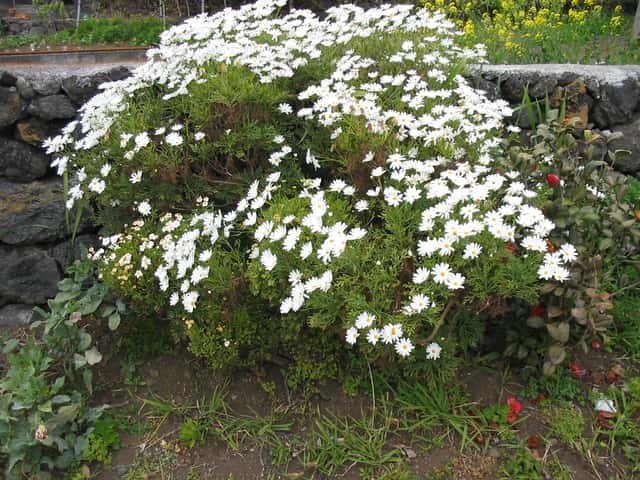
Marguerite Daisy (Argyranthemum frutescens) is a easy-care plant from the Asteraceae family. Marguerite Daisy (Argyranthemum frutescens) is a perennial shrub native to the Canary Islands, Spain. Celebrated for its cheerful daisy-like flowers with white, yellow, or pink petals surrounding bright yellow centers, this ornamental plant brings abundant color to gardens, balconies, and containers...
Marguerite Daisy grows up to 1.0m, spread of 60cm, watering every 7 days, 4°C – 28°C, 40–70% humidity. It is not suitable for indoor environments and not safe for pets.
Unlike many tropical plants, Marguerite Daisy tolerates watering mistakes. Best for beginners. Without precautions, ingestion can cause irritation in pets. Keep out of reach of cats and dogs.
How to Care for Marguerite Daisy?
TLDR: Marguerite Daisy needs Direct sun, watering every 7 days, and temperatures between 4-28°C with 40-70% humidity.
How Often Should You Water Marguerite Daisy?
Water once a week, allowing the top inch of soil to dry between waterings. In hot summer months, increase frequency to every 3-4 days. Always water at the base to avoid wetting foliage, which can lead to fungal diseases. Never let the plant sit in waterlogged soil.
How Much Light Does Marguerite Daisy Need?
Place in full sun with at least 6 hours of direct sunlight daily. In extremely hot climates, provide afternoon shade to prevent heat stress and leaf scorch. Adequate sunlight is essential for prolific flowering and vibrant bloom colors.
What Is the Best Soil for Marguerite Daisy?
Use fertile, well-draining soil with a pH between 6.0 and 7.5. Amend with compost or well-rotted organic matter to improve fertility. Add perlite or coarse sand to enhance drainage. Avoid heavy clay soils that retain excessive moisture.
What Pot Should You Use for Marguerite Daisy?
Terracotta or ceramic pots with adequate drainage holes work best. Choose a medium-sized container (8-12 inches in diameter) that allows some root room without retaining excess moisture. Elevated garden beds are ideal for outdoor planting.
Care Schedule
Fertilize
Every 30 days
Repot
Every 365 days
What Is Marguerite Daisy and Where Does It Come From?
Marguerite Daisy (Argyranthemum frutescens) is a perennial shrub native to the Canary Islands, Spain. Celebrated for its cheerful daisy-like flowers with white, yellow, or pink petals surrounding bright yellow centers, this ornamental plant brings abundant color to gardens, balconies, and containers throughout spring, summer, and fall.
How to Propagate Marguerite Daisy?
Stem Cutting
Take cuttings in spring or summer for best results. Use clean, sharp scissors to prevent disease transmission. If rooting in water, change it every 2-3 days to prevent bacterial growth.
- 1 Cut a healthy stem 3-4 inches long with 2-3 leaves
- 2 Remove lower leaves and dip the cut end in rooting hormone powder
- 3 Plant in moist, well-draining potting mix or place in water
- 4 Keep in bright indirect light and mist lightly to maintain humidity
- 5 Transplant to a larger pot once roots reach 1 inch in length
Materials needed:
How Big Does Marguerite Daisy Grow?
TLDR: Marguerite Daisy can reach up to 1.0m tall with Medium growth rate.
Max height
1.0m
Spread
60cm
Growth rate
Medium
Foliage
Evergreen
Warning: Toxic Plant
This plant can be toxic if ingested. Keep out of reach of:
Plant Uses
Ornamental
Great for decoration
Is your plant showing symptoms?
Click on the symptom to discover possible causes:
What Diseases Commonly Affect Marguerite Daisy?
TLDR: Marguerite Daisy is susceptible to 9 known diseases. Monitor regularly for early detection.
Root Rot
Root rot is a serious fungal disease that affects the root system of plants, causing them to decay and die. It is primarily caused by overwatering, poor drainage, or soil-borne fungi such as Pythium, Phytophthora, Rhizoctonia, and Fusarium. The disease thrives in waterlogged conditions where roots are deprived of oxygen, making them susceptible to fungal infection.
Powdery Mildew
Powdery mildew is a common fungal disease caused by various fungi species including Erysiphe, Podosphaera, Oïdium, and Leveillula. It affects over 10,000 plant species worldwide. The disease thrives in warm, dry climates with high humidity and appears as a distinctive white powdery coating on plant surfaces.
Aphids
Aphids are small, soft-bodied, pear-shaped insects (1/16 to 1/8 inch long) that feed by sucking nutrient-rich sap from plants. They reproduce rapidly and can quickly weaken plants, causing distorted growth and transmitting plant viruses. Aphids come in various colors including green, black, red, yellow, brown, and gray. They secrete honeydew, a sticky substance that attracts ants and encourages sooty mold growth.
Spider Mites
Spider mites are tiny arachnids (less than 1/20 inch long) related to spiders and ticks that feed on plant sap. They thrive in hot, dry conditions and can cause significant damage to ornamental and vegetable plants. During severe infestations, crop losses can reach 14% or higher as these pests disrupt vital plant processes including photosynthesis, carbon dioxide absorption, and transpiration.
Meaning & Symbolism
Joy, innocence, and pure love. Associated with freshness and the natural beauty of the Canary Islands, symbolizing simplicity and renewal.
Fun Facts
Native to the Canary Islands, the Marguerite Daisy was introduced to European gardens in the 17th century and quickly became a classic feature of Mediterranean-style landscapes.
The genus name Argyranthemum comes from the Greek words for "silver" and "flower," a nod to the plant's shimmering white petals.
Unlike many flowering plants, Marguerite Daisy can bloom almost continuously year-round in mild temperate climates, making it exceptional value for garden color.
Its flowers are highly attractive to pollinators, including bees and butterflies, making it an excellent choice for wildlife-friendly gardens.
Frequently asked questions
How often should I water my Marguerite Daisy?
Is Marguerite Daisy toxic to pets?
Why is my Marguerite Daisy not blooming?
How do I prune my Marguerite Daisy?
Can Marguerite Daisy be grown indoors?
Compare with similar plants
| Attribute | Difficulty | Light | Watering | Pet Safe |
|---|---|---|---|---|
| Field Maple | Easy | Bright indirect | 14d | ✓ |
| Silver Birch | Easy | Direct sun | 14d | ✓ |
| Common Blanketflower | Easy | Direct sun | 10d | ✓ |
| Cushion Bush | Easy | Direct sun | 14d | ✓ |





