Bromeliaceae
Nakedstem Bromeliad (Aechmea nudicaulis): Complete Care Guide
Aechmea nudicaulis
The Nakedstem Bromeliad is one of the easiest bromeliads to grow indoors or outdoors. It thrives in bright indirect light and appreciates moderate to high humidity. The key watering technique is filling its central rosette tank with water — keep it filled and flush it every 1–2 weeks to prevent stagnation. Use rainwater or distilled water to avoid fluoride and chlorine damage. The potting medium should be fast-draining. Feed monthly with a dilute liquid fertilizer applied to the foliage. Growth is slow and the plant is very forgiving.
Every 7 days
Partial shade
10° - 32°C
60% - 80%
Categories
What is Nakedstem Bromeliad?
Nakedstem Bromeliad (Aechmea nudicaulis) is a easy-care plant from the Bromeliaceae family. Aechmea nudicaulis, commonly known as the Nakedstem Bromeliad or Naked-stemmed Living Vase, is a stunning epiphytic and terrestrial bromeliad native to Brazil's Atlantic Forest, with distribution extending through the Caribbean and northern South America. It forms a rosette of stiff, dark green, str...
Nakedstem Bromeliad grows up to 70cm, spread of 60cm, watering every 7 days, 10°C – 32°C, 60–80% humidity. It is suitable for indoor environments and safe for pets.
Unlike many tropical plants, Nakedstem Bromeliad tolerates watering mistakes. Best for beginners. Unlike many popular species, Nakedstem Bromeliad is safe to keep around pets. Without adequate drainage, root rot can develop within 14 days.
How to Care for Nakedstem Bromeliad?
TLDR: Nakedstem Bromeliad needs Partial shade, watering every 7 days, and temperatures between 10-32°C with 60-80% humidity.
How Often Should You Water Nakedstem Bromeliad?
Fill the central cup (the tank formed by the rosette) with water at all times, flushing and refreshing it every 7–14 days to prevent bacterial growth and mosquito breeding. Always use rainwater, distilled, or filtered water — tap water's fluoride and chlorine will cause brown leaf tips and discoloration over time. Water the potting mix only when it has dried out completely. Never let the plant sit in standing water at the base.
How Much Light Does Nakedstem Bromeliad Need?
Thrives in bright, indirect light or dappled shade. It can tolerate a few hours of gentle morning sun, but avoid harsh afternoon direct sun which scorches the leaves. Indoors, place near an east- or north-facing window. The plant also adapts well to fluorescent or grow lights, making it excellent for offices and low-light interiors.
What Is the Best Soil for Nakedstem Bromeliad?
Use a fast-draining, coarse potting mix — a blend of bromeliad mix, perlite, and coarse bark works excellently. As an epiphyte by nature, its roots need excellent aeration. Avoid any soil that retains moisture. Shallow pots with drainage holes are ideal, as the root system is small.
What Pot Should You Use for Nakedstem Bromeliad?
Terracotta or ceramic pots are ideal as they allow root aeration and prevent overwatering. Plastic pots also work well for moisture retention. Choose a small pot — the root system is compact and the plant prefers to be slightly snug. Always ensure drainage holes are present.
Care Schedule
Fertilize
Every 30 days
Misting
Every 14 days
Repot
Every 730 days
What Is Nakedstem Bromeliad and Where Does It Come From?
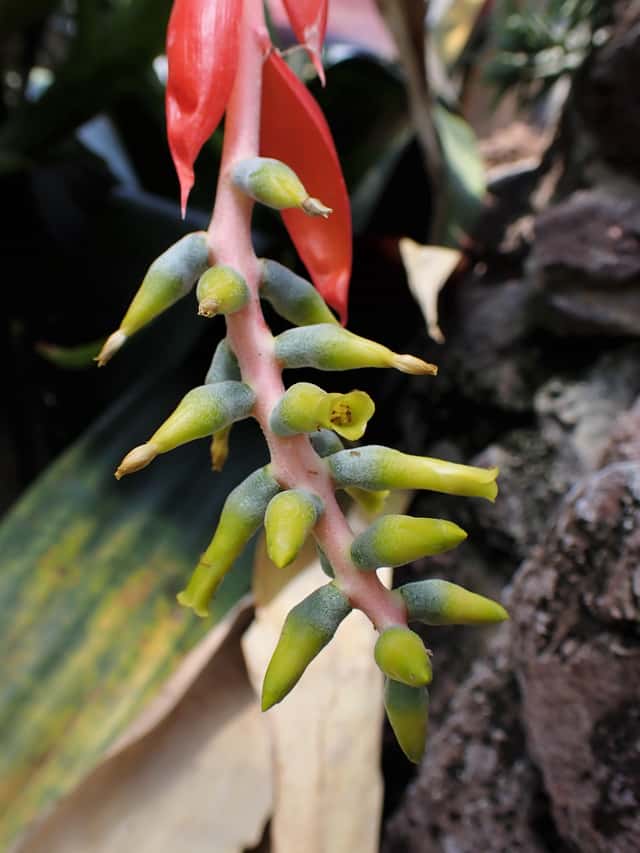
Aechmea nudicaulis, commonly known as the Nakedstem Bromeliad or Naked-stemmed Living Vase, is a stunning epiphytic and terrestrial bromeliad native to Brazil's Atlantic Forest, with distribution extending through the Caribbean and northern South America. It forms a rosette of stiff, dark green, strap-like leaves with serrated margins, from which emerges a striking inflorescence: a bright red spike bearing greenish-yellow flowers tipped with blue-purple, appearing in summer through fall. The plant is prized for its architectural beauty, low maintenance requirements, and resilience. After flowering — a once-in-a-lifetime event — the mother plant produces offsets (pups) that carry on the colony. Its central tank collects rainwater, creating a vital microhabitat for wildlife in its native forest.
How to Propagate Nakedstem Bromeliad?
Pup Division
The mother plant typically produces 2–4 pups after flowering. Do not rush separation — larger pups root more successfully. Keep the pup's central cup lightly filled with water from the start.
- 1 Wait until the pup reaches at least one-third the size of the mother plant
- 2 Use a sterilized sharp knife or pruning shears to sever the pup at its base
- 3 Allow the cut end to callous for a few hours before potting
- 4 Plant the pup in a small pot with fast-draining bromeliad mix
- 5 Place in bright indirect light and maintain moderate humidity until established
Materials needed:
How Big Does Nakedstem Bromeliad Grow?
TLDR: Nakedstem Bromeliad can reach up to 70cm tall with Slow growth rate.
Max height
70cm
Spread
60cm
Growth rate
Slow
Foliage
Evergreen
Plant Uses
Ornamental
Great for decoration
Culinary Uses
- The ripe fruits of Aechmea nudicaulis are edible with a sweet, honey-like flavor — a little-known curiosity of this native bromeliad.
Is your plant showing symptoms?
Click on the symptom to discover possible causes:
What Diseases Commonly Affect Nakedstem Bromeliad?
TLDR: Nakedstem Bromeliad is susceptible to 7 known diseases. Monitor regularly for early detection.
Scale Insects
Scale insects are small sap-sucking pests that appear as brown, shell-like bumps on plant stems and leaves. There are over 25 species, divided into armored (hard) and unarmored (soft) scales. They feed by piercing plant tissue and extracting sap, which weakens the plant and can lead to yellowing, stunted growth, and even death if left untreated. They also excrete honeydew, which attracts ants and promotes sooty mold growth.
Mealybugs
Mealybugs are small, soft-bodied insects covered with a white, waxy, cottony material. They are common pests of houseplants and outdoor plants in mild climates. These sap-sucking insects feed on plant tissue, causing damage, stunted growth, and can lead to plant death if left untreated. They produce sticky honeydew which attracts sooty mold.
Root Rot
Root rot is a serious fungal disease that affects the root system of plants, causing them to decay and die. It is primarily caused by overwatering, poor drainage, or soil-borne fungi such as Pythium, Phytophthora, Rhizoctonia, and Fusarium. The disease thrives in waterlogged conditions where roots are deprived of oxygen, making them susceptible to fungal infection.
Crown Rot
Crown rot is a serious fungal disease that attacks the crown (base) of the plant where the stem meets the soil. It is caused by various fungal pathogens including Phytophthora, Fusarium, and Rhizoctonia. The disease thrives in waterlogged conditions and can quickly spread to kill the entire plant if not addressed promptly.
Meaning & Symbolism
In its native Brazil, the bromeliad is a symbol of the Atlantic Forest's rich biodiversity. Its tank habit — collecting rainwater and organic matter — represents nature's ingenuity in resource use.
Fun Facts
Aechmea nudicaulis is a tank bromeliad — its rosette collects rainwater, creating a tiny aquatic habitat in the forest canopy that shelters frogs, insects, and microorganisms.
The plant flowers only once in its life, then slowly dies while producing 2–4 offsets (pups) to carry on the colony.
Its species name "nudicaulis" is Latin for "naked stem," referring to the bare flowering spike that emerges from the center of the rosette.
Native to the Atlantic Forest, one of the world's most biodiverse and threatened biomes, Aechmea nudicaulis plays a role in supporting local wildlife as both shelter and food source.
Frequently asked questions
How do I water a Nakedstem Bromeliad?
Can Aechmea nudicaulis grow indoors?
How often does it flower?
Is Aechmea nudicaulis toxic to pets?
Why are the leaf tips turning brown?
Compare with similar plants
| Attribute | Difficulty | Light | Watering | Pet Safe |
|---|---|---|---|---|
| Field Maple | Easy | Bright indirect | 14d | ✓ |
| Silver Birch | Easy | Direct sun | 14d | ✓ |
| Common Blanketflower | Easy | Direct sun | 10d | ✓ |
| Cushion Bush | Easy | Direct sun | 14d | ✓ |





