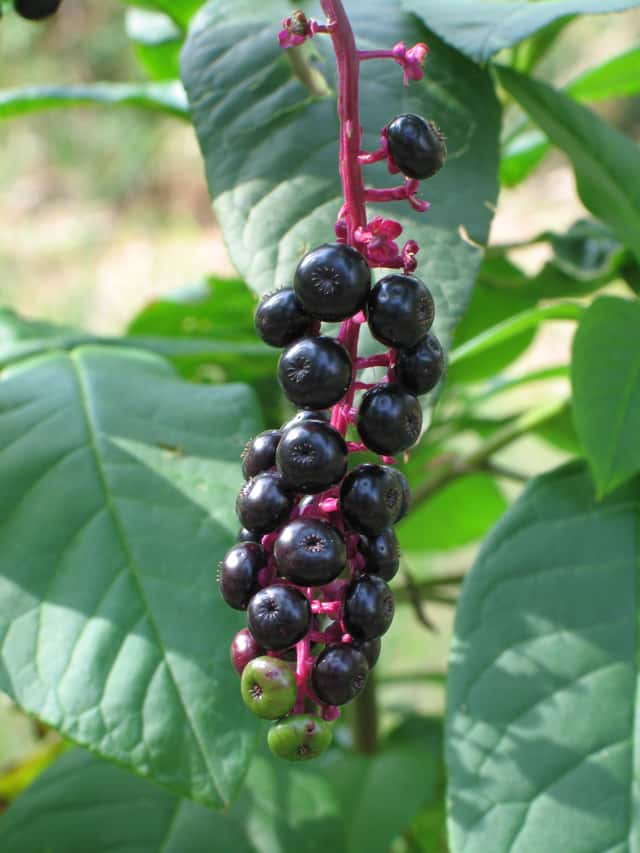
Phytolaccaceae
Pokeweed (Phytolacca): Care Guide for a Beautifully Dangerous Genus
Phytolacca
Grow in full sun to partial shade in moist, well-drained soil. Water every 7-10 days. Fertilize every 60 days during spring and summer. Prune every 90 days to control aggressive spread. WARNING: Wear gloves when handling — all parts are severely toxic to humans, cats, and dogs.
Every 8 days
Bright indirect
-15° - 38°C
40% - 70%
Categories
What is Pokeweed (genus)?
Pokeweed (genus) (Phytolacca) is a easy-care plant from the Phytolaccaceae family. Phytolacca is a genus of approximately 25 species of perennial herbs, shrubs, and trees native to tropical and temperate regions worldwide. The most notable species are Phytolacca americana (American pokeweed), a vigorous weedy perennial of eastern North America, and Phytolacca dioica (ombú), the ic...
Pokeweed (genus) grows up to 3.0m, spread of 150cm, watering every 8 days, -15°C – 38°C, 40–70% humidity. It is not suitable for indoor environments and not safe for pets.
Unlike many tropical plants, Pokeweed (genus) tolerates watering mistakes. Best for beginners. Without precautions, ingestion can cause irritation in pets. Keep out of reach of cats and dogs.
How to Care for Pokeweed (genus)?
TLDR: Pokeweed (genus) needs Bright indirect, watering every 8 days, and temperatures between -15-38°C with 40-70% humidity.
How Often Should You Water Pokeweed (genus)?
Water every 7-10 days, allowing soil to dry slightly between waterings. During drought, increase frequency. Avoid waterlogging — the taproot is prone to rot in saturated soil.
How Much Light Does Pokeweed (genus) Need?
Thrives in full sun (6+ hours/day) but tolerates partial shade. In deep shade, growth becomes leggy and flowering is reduced.
What Is the Best Soil for Pokeweed (genus)?
Prefers fertile, loamy, well-drained soil. Tolerates sandy, clay, and loamy soils. Ideal pH 5.5-7.5. Amend with compost for best results.
What Pot Should You Use for Pokeweed (genus)?
Not suitable for containers. This is a large outdoor plant with deep taproots reaching 3m tall. Garden or landscape planting is required.
Care Schedule
Fertilize
Every 60 days
What Is Pokeweed (genus) and Where Does It Come From?
Phytolacca is a genus of approximately 25 species of perennial herbs, shrubs, and trees native to tropical and temperate regions worldwide. The most notable species are Phytolacca americana (American pokeweed), a vigorous weedy perennial of eastern North America, and Phytolacca dioica (ombú), the iconic giant tree-herb of the Argentine pampas. All species are extremely toxic — every part contains saponins and phytolaccatoxin, with berries being particularly dangerous.
How to Propagate Pokeweed (genus)?
Seed propagation
Always wear gloves — berry pulp is toxic. Cold stratification for 30 days improves germination rate.
- 1 Collect ripe seeds from dark purple berries in autumn
- 2 Wear gloves and wash seeds to remove toxic pulp
- 3 Sow 1 cm deep in moist seed-starting mix
- 4 Keep warm (20-25°C) and consistently moist
- 5 Transplant seedlings when 10 cm tall
Materials needed:
Root division
Use gloves and sterile tools. Roots are highly toxic — wash hands thoroughly after handling.
- 1 Dig up the taproot in early spring
- 2 Divide into sections, each with at least one bud
- 3 Allow cut sections to dry for one day
- 4 Plant in moist, well-drained soil
Materials needed:
How Big Does Pokeweed (genus) Grow?
TLDR: Pokeweed (genus) can reach up to 3.0m tall with Fast growth rate.
Max height
3.0m
Spread
1.5m
Growth rate
Fast
Foliage
Deciduous
Warning: Toxic Plant
This plant can be toxic if ingested. Keep out of reach of:
Plant Uses
Ornamental
Great for decoration
Medicinal
Medicinal properties
Medicinal Uses
- Historically used in folk medicine for arthritis and lymphatic conditions — internal use is dangerous and not recommended
- The protein PAP (pokeweed antiviral protein) is researched as a potential antiviral and anticancer agent
Culinary Uses
- Young shoots are edible after boiling in multiple changes of water — improper preparation can be fatal
Is your plant showing symptoms?
Click on the symptom to discover possible causes:
What Diseases Commonly Affect Pokeweed (genus)?
TLDR: Pokeweed (genus) is susceptible to 4 known diseases. Monitor regularly for early detection.
Leaf Spot
Leaf spot is a common fungal disease caused by various pathogens including Alternaria, Ascochyta, Colletotrichum, Septoria, and Venturia. It primarily affects leaves, causing discolored spots that can lead to premature leaf drop if left untreated.
Root Rot
Root rot is a serious fungal disease that affects the root system of plants, causing them to decay and die. It is primarily caused by overwatering, poor drainage, or soil-borne fungi such as Pythium, Phytophthora, Rhizoctonia, and Fusarium. The disease thrives in waterlogged conditions where roots are deprived of oxygen, making them susceptible to fungal infection.
Aphids
Aphids are small, soft-bodied, pear-shaped insects (1/16 to 1/8 inch long) that feed by sucking nutrient-rich sap from plants. They reproduce rapidly and can quickly weaken plants, causing distorted growth and transmitting plant viruses. Aphids come in various colors including green, black, red, yellow, brown, and gray. They secrete honeydew, a sticky substance that attracts ants and encourages sooty mold growth.
Mosaic Virus
Mosaic virus is a group of plant viruses that cause mottled, patchy patterns on leaves and can affect a wide variety of plants. The virus creates characteristic yellow, white, and green mosaic patterns, often accompanied by stunted growth and deformed plant parts. This highly contagious disease spreads rapidly through insect vectors and contaminated tools.
Meaning & Symbolism
The ombú (P. dioica) is a national symbol of the Argentine pampas, embodying solitude and resilience. In Native American tradition, pokeweed held ritual significance, though its extreme toxicity demanded careful handling.
Fun Facts
American pokeweed (P. americana) can grow 2-3 meters in a single growing season from a perennial taproot
Pokeweed berry juice was used as ink and to forge documents in colonial America, and even to adulterate wine
The ombú (P. dioica) is technically not a tree — it is a giant herb with a succulent trunk that stores up to 80% water
Pokeweed antiviral protein (PAP) extracted from Phytolacca americana is being researched against HIV and other viruses
Frequently asked questions
Is Phytolacca toxic to pets?
How often should I water Phytolacca?
Can Phytolacca be grown in a pot?
How do I stop it from taking over my garden?
What are the most common diseases?
Compare with similar plants
| Attribute | Difficulty | Light | Watering | Pet Safe |
|---|---|---|---|---|
| Field Maple | Easy | Bright indirect | 14d | ✓ |
| Silver Birch | Easy | Direct sun | 14d | ✓ |
| Cushion Bush | Easy | Direct sun | 14d | ✓ |
| Peruvian peppertree | Easy | Direct sun | 14d | ⚠️ |





