Crassulaceae
Tree Aeonium (Aeonium arboreum)
Aeonium arboreum
Low-maintenance succulent that thrives in full sun with infrequent watering. Highly drought-tolerant and frost-sensitive. Perfect for Mediterranean gardens, coastal landscapes, and bright interiors.
Every 14 days
Direct sun
10° - 30°C
30% - 60%
Categories
What is Tree Aeonium?
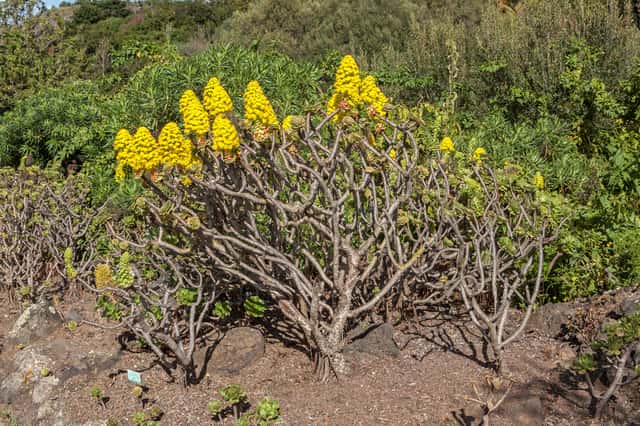
Tree Aeonium (Aeonium arboreum) is a easy-care plant from the Crassulaceae family. Aeonium arboreum is a woody-stemmed succulent native to the Canary Islands and North Africa, renowned for its striking rosettes of fleshy leaves atop branching stems. The dark-purple cultivar 'Schwarzkopf' (also spelled 'Zwartkop') is one of the most popular ornamental succulents worldwide.
Tree Aeonium grows up to 90cm, spread of 60cm, watering every 14 days, 10°C – 30°C, 30–60% humidity. It is suitable for indoor environments and safe for pets.
Unlike many tropical plants, Tree Aeonium tolerates watering mistakes. Best for beginners. Unlike many popular species, Tree Aeonium is safe to keep around pets. Without adequate drainage, root rot can develop within 28 days.
How to Care for Tree Aeonium?
TLDR: Tree Aeonium needs Direct sun, watering every 14 days, and temperatures between 10-30°C with 30-60% humidity.
How Often Should You Water Tree Aeonium?
Water every 10-14 days during the growing season (fall through spring). Reduce to once a month in summer when the plant goes dormant. Always allow soil to dry completely between waterings — overwatering is the most common cause of death.
How Much Light Does Tree Aeonium Need?
Place in a location receiving at least 6 hours of direct sunlight daily. South or west-facing windows are ideal indoors. Insufficient light causes etiolation (stretching) and loss of color intensity, especially in dark-leaved cultivars.
What Is the Best Soil for Tree Aeonium?
Use a fast-draining cactus and succulent mix. Amend with perlite or coarse sand at a 2:1 ratio. Always use pots with drainage holes — waterlogged soil quickly leads to root rot.
What Pot Should You Use for Tree Aeonium?
Terracotta or ceramic pot with a drainage hole. Avoid plastic pots that retain too much moisture.
Care Schedule
Fertilize
Every 30 days
Repot
Every 730 days
What Is Tree Aeonium and Where Does It Come From?
Aeonium arboreum is a woody-stemmed succulent native to the Canary Islands and North Africa, renowned for its striking rosettes of fleshy leaves atop branching stems. The dark-purple cultivar 'Schwarzkopf' (also spelled 'Zwartkop') is one of the most popular ornamental succulents worldwide.
How to Propagate Tree Aeonium?
Stem Cutting
Always use a clean, sharp blade. Do not water immediately after planting — let the wound callus to prevent rot.
- 1 Cut a healthy stem with a rosette, 8-10 cm long
- 2 Allow the cut end to callus in a dry spot for 2-3 days
- 3 Plant in slightly moist succulent mix
- 4 Wait 3-4 weeks before watering to allow rooting
Materials needed:
Offset Division
Offsets with established roots have the highest success rate.
- 1 Identify offsets (pups) at the base of the plant
- 2 Gently separate, preserving any roots
- 3 Plant in individual pot with well-draining mix
Materials needed:
How Big Does Tree Aeonium Grow?
TLDR: Tree Aeonium can reach up to 90cm tall with Slow growth rate.
Max height
90cm
Spread
60cm
Growth rate
Slow
Foliage
Evergreen
Plant Uses
Ornamental
Great for decoration
Is your plant showing symptoms?
Click on the symptom to discover possible causes:
What Diseases Commonly Affect Tree Aeonium?
TLDR: Tree Aeonium is susceptible to 10 known diseases. Monitor regularly for early detection.
Root Rot
Root rot is a serious fungal disease that affects the root system of plants, causing them to decay and die. It is primarily caused by overwatering, poor drainage, or soil-borne fungi such as Pythium, Phytophthora, Rhizoctonia, and Fusarium. The disease thrives in waterlogged conditions where roots are deprived of oxygen, making them susceptible to fungal infection.
Overwatering
Overwatering occurs when plants receive too much water, depriving roots of oxygen and causing root rot. This environmental stress is one of the most common causes of houseplant death, as waterlogged soil prevents roots from breathing and functioning properly.
Mealybugs
Mealybugs are small, soft-bodied insects covered with a white, waxy, cottony material. They are common pests of houseplants and outdoor plants in mild climates. These sap-sucking insects feed on plant tissue, causing damage, stunted growth, and can lead to plant death if left untreated. They produce sticky honeydew which attracts sooty mold.
Powdery Mildew
Powdery mildew is a common fungal disease caused by various fungi species including Erysiphe, Podosphaera, Oïdium, and Leveillula. It affects over 10,000 plant species worldwide. The disease thrives in warm, dry climates with high humidity and appears as a distinctive white powdery coating on plant surfaces.
Meaning & Symbolism
Embodies resilience and tenacity, thriving in the rugged volcanic landscapes and salt-sprayed cliffs of the Canary Islands.
Fun Facts
Native to the Canary Islands, where it grows naturally on coastal cliffs and volcanic slopes.
The Schwarzkopf cultivar has leaves so dark purple they appear almost black — the color intensifies with more direct sunlight.
Unlike most succulents, Aeonium grows actively in winter and goes dormant in summer.
Aeonium arboreum can live for many years and reach up to 90 cm in height in ideal conditions.
Frequently asked questions
How often should I water Tree Aeonium?
Why are my Aeonium leaves dropping?
How much sun does Tree Aeonium need?
Is Tree Aeonium toxic to pets?
What is the difference between Aeonium arboreum and Schwarzkopf?
Compare with similar plants
| Attribute | Difficulty | Light | Watering | Pet Safe |
|---|---|---|---|---|
| Field Maple | Easy | Bright indirect | 14d | ✓ |
| Silver Birch | Easy | Direct sun | 14d | ✓ |
| Cushion Bush | Easy | Direct sun | 14d | ✓ |
| Peruvian peppertree | Easy | Direct sun | 14d | ⚠️ |