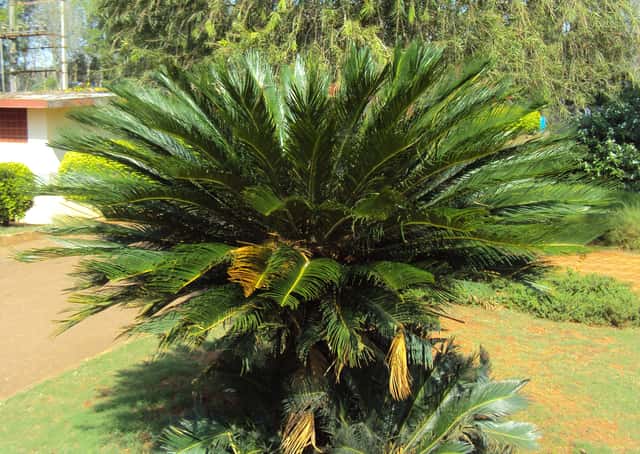
Cycadaceae
Sago Palm Care Guide
Cycas revoluta
Sago Palms are low-maintenance plants that thrive on neglect. Water sparingly every 1-2 weeks when the top soil dries out, provide bright indirect light, and use well-draining slightly acidic soil. Extremely slow-growing, producing just one flush of new leaves per year. Highly toxic to pets and children.
Every 14 days
Bright indirect
-9° - 43°C
40% - 60%
Categories
What is Sago Palm?
Sago Palm (Cycas revoluta) is a easy-care plant from the Cycadaceae family. Cycas revoluta, commonly known as the Sago Palm, is not actually a palm but one of the oldest living seed plants on Earth — a true living fossil. Native to southern Japan, this slow-growing cycad features a stout trunk crowned with a rosette of stiff, dark green, glossy pinnate leaves. Despite its p...
Sago Palm grows up to 3.0m, spread of 180cm, watering every 14 days, -9°C – 43°C, 40–60% humidity. It is suitable for indoor environments and not safe for pets.
Unlike many tropical plants, Sago Palm tolerates watering mistakes. Best for beginners. Without precautions, ingestion can cause irritation in pets. Keep out of reach of cats and dogs. Without adequate drainage, root rot can develop within 28 days.
How to Care for Sago Palm?
TLDR: Sago Palm needs Bright indirect, watering every 14 days, and temperatures between -9-43°C with 40-60% humidity.
How Often Should You Water Sago Palm?
Allow the top 2-3 inches of soil to dry completely before watering. In winter, reduce watering significantly. Overwatering is the primary killer — these cycads are drought-tolerant and prefer dry conditions over soggy roots.
How Much Light Does Sago Palm Need?
Provide bright indirect light or filtered sunlight. Can tolerate some direct morning sun but avoid harsh afternoon sun which may scorch the leaves. A south or east-facing window is ideal indoors.
What Is the Best Soil for Sago Palm?
Use a well-draining, slightly acidic mix (pH 5.5-6.5). A blend of sandy loam with perlite or coarse sand works best. Good drainage is essential to prevent root rot.
What Pot Should You Use for Sago Palm?
Use a heavy terracotta or ceramic pot with drainage holes. The weight helps stabilize the top-heavy plant, and the porous material allows soil to dry between waterings.
Care Schedule
Fertilize
Every 30 days
Repot
Every 730 days
What Is Sago Palm and Where Does It Come From?
Cycas revoluta, commonly known as the Sago Palm, is not actually a palm but one of the oldest living seed plants on Earth — a true living fossil. Native to southern Japan, this slow-growing cycad features a stout trunk crowned with a rosette of stiff, dark green, glossy pinnate leaves. Despite its prehistoric origins, it thrives as a popular ornamental plant both indoors and in warm-climate gardens.
How to Propagate Sago Palm?
Offset division
Choose pups that have developed their own small root system for best success. Do not overwater during rooting.
- 1 Identify pups at least 4 inches in size at the base of the mother plant
- 2 Carefully separate the offset using a clean sharp knife
- 3 Allow the cut to callus for 24-48 hours in a dry shaded area
- 4 Plant in a well-draining sandy mix and water lightly
- 5 Keep in warm bright indirect light until new growth appears
Materials needed:
Seed propagation
Use only fresh seeds as viability decreases rapidly. Patience is key — germination is extremely slow.
- 1 Soak fresh seeds in warm water for 24-48 hours
- 2 Plant seeds halfway into moist perlite or sand mix
- 3 Maintain temperature of 70-80°F (21-27°C)
- 4 Keep consistently moist but not waterlogged
- 5 Wait 1-3 months for germination
Materials needed:
How Big Does Sago Palm Grow?
TLDR: Sago Palm can reach up to 3.0m tall with Slow growth rate.
Max height
3.0m
Spread
1.8m
Growth rate
Slow
Foliage
Evergreen
Warning: Toxic Plant
This plant can be toxic if ingested. Keep out of reach of:
Plant Uses
Ornamental
Great for decoration
Is your plant showing symptoms?
Click on the symptom to discover possible causes:
What Diseases Commonly Affect Sago Palm?
TLDR: Sago Palm is susceptible to 10 known diseases. Monitor regularly for early detection.
Root Rot
Root rot is a serious fungal disease that affects the root system of plants, causing them to decay and die. It is primarily caused by overwatering, poor drainage, or soil-borne fungi such as Pythium, Phytophthora, Rhizoctonia, and Fusarium. The disease thrives in waterlogged conditions where roots are deprived of oxygen, making them susceptible to fungal infection.
Phytophthora Root Rot
Disease caused by fungus-like organisms (oomycetes) that live in soil and can survive for years. It affects roots, stem, and crown of plants, being especially severe in waterlogged or poorly drained soils. It is the second most common cause of root rot in trees and shrubs.
Crown Rot
Crown rot is a serious fungal disease that attacks the crown (base) of the plant where the stem meets the soil. It is caused by various fungal pathogens including Phytophthora, Fusarium, and Rhizoctonia. The disease thrives in waterlogged conditions and can quickly spread to kill the entire plant if not addressed promptly.
Scale Insects
Scale insects are small sap-sucking pests that appear as brown, shell-like bumps on plant stems and leaves. There are over 25 species, divided into armored (hard) and unarmored (soft) scales. They feed by piercing plant tissue and extracting sap, which weakens the plant and can lead to yellowing, stunted growth, and even death if left untreated. They also excrete honeydew, which attracts ants and promotes sooty mold growth.
Meaning & Symbolism
Longevity, resilience, and perseverance — often called a living fossil dating back over 200 million years to the age of dinosaurs.
Fun Facts
Cycas revoluta is a living fossil — its lineage dates back over 200 million years to the Mesozoic era, predating most flowering plants
Despite being called a palm, the Sago Palm is actually a cycad, more closely related to conifers and ginkgo trees
A mature Sago Palm can take 15 years or more to produce its first cone, and male and female cones appear on separate plants
In Japan, the starchy pith of the trunk was historically processed as a famine food, though it requires extensive preparation to remove toxins