Crassulaceae
Stalked Aeonium: Complete Care Guide
Aeonium undulatum
An easy-care succulent that prefers direct sun or partial shade, infrequent watering allowing soil to dry completely, and sandy well-draining soil. Drought tolerant and pest resistant.
Every 10 days
Bright indirect
5° - 30°C
30% - 60%
Categories
What is Stalked Aeonium?
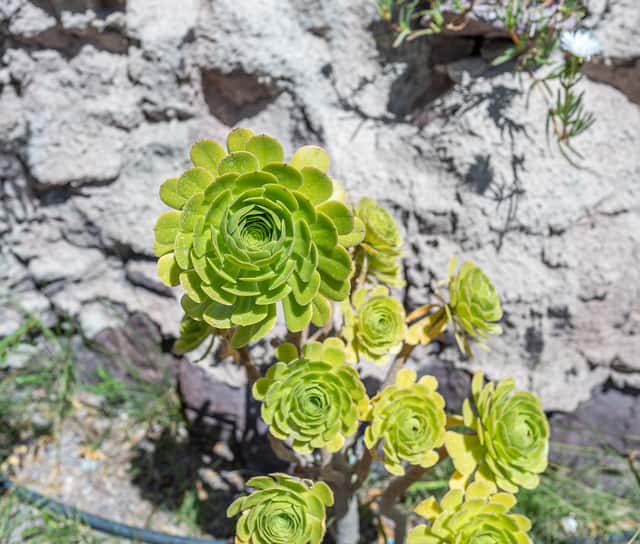
Stalked Aeonium (Aeonium undulatum) is a easy-care plant from the Crassulaceae family. Aeonium undulatum is a striking succulent subshrub native to the Canary Islands, specifically Gran Canaria. Known for its large rosettes of bright, glossy, wavy-edged green leaves, it can grow over 2 meters tall on a single unbranched stem, making it one of the tallest species in the Aeonium genus....
Stalked Aeonium grows up to 2.0m, spread of 30cm, watering every 10 days, 5°C – 30°C, 30–60% humidity. It is suitable for indoor environments and safe for pets.
Unlike many tropical plants, Stalked Aeonium tolerates watering mistakes. Best for beginners. Unlike many popular species, Stalked Aeonium is safe to keep around pets. Without adequate drainage, root rot can develop within 20 days.
How to Care for Stalked Aeonium?
TLDR: Stalked Aeonium needs Bright indirect, watering every 10 days, and temperatures between 5-30°C with 30-60% humidity.
How Often Should You Water Stalked Aeonium?
Water only when the soil is completely dry, approximately every 10-14 days. Reduce watering significantly in summer when the plant enters dormancy. Never allow water to sit in the saucer.
How Much Light Does Stalked Aeonium Need?
Prefers at least 4 hours of direct sunlight daily. Indoors, place near south or west-facing windows. Can tolerate partial shade but grows best with abundant light.
What Is the Best Soil for Stalked Aeonium?
Use sandy, well-draining soil such as a cactus mix with added perlite. Avoid moisture-retentive substrates. A good mix is 50% potting soil with 50% coarse sand.
What Pot Should You Use for Stalked Aeonium?
Terracotta or ceramic pot with drainage holes that allows excess moisture to evaporate. Avoid plastic pots that retain water.
Care Schedule
Fertilize
Every 30 days
Repot
Every 730 days
What Is Stalked Aeonium and Where Does It Come From?
Aeonium undulatum is a striking succulent subshrub native to the Canary Islands, specifically Gran Canaria. Known for its large rosettes of bright, glossy, wavy-edged green leaves, it can grow over 2 meters tall on a single unbranched stem, making it one of the tallest species in the Aeonium genus. It is monocarpic, producing stunning pyramidal panicles of yellow star-shaped flowers after approximately 5 years.
How to Propagate Stalked Aeonium?
Stem cutting
Use clean, sharp tools. Do not water until you see signs of new growth.
- 1 Cut a healthy stem with a rosette on top
- 2 Let it dry for 2-3 days to callus over
- 3 Plant in slightly moist sandy soil
- 4 Keep in indirect light until rooted
Materials needed:
Offset division
Offsets with their own roots have the highest success rate.
- 1 Identify lateral offsets at the base of the plant
- 2 Carefully separate with roots attached
- 3 Plant directly in sandy soil
- 4 Water lightly after one week
Materials needed:
How Big Does Stalked Aeonium Grow?
TLDR: Stalked Aeonium can reach up to 2.0m tall with Slow growth rate.
Max height
2.0m
Spread
30cm
Growth rate
Slow
Foliage
Evergreen
Plant Uses
Ornamental
Great for decoration
Is your plant showing symptoms?
Click on the symptom to discover possible causes:
What Diseases Commonly Affect Stalked Aeonium?
TLDR: Stalked Aeonium is susceptible to 8 known diseases. Monitor regularly for early detection.
Root Rot
Root rot is a serious fungal disease that affects the root system of plants, causing them to decay and die. It is primarily caused by overwatering, poor drainage, or soil-borne fungi such as Pythium, Phytophthora, Rhizoctonia, and Fusarium. The disease thrives in waterlogged conditions where roots are deprived of oxygen, making them susceptible to fungal infection.
Mealybugs
Mealybugs are small, soft-bodied insects covered with a white, waxy, cottony material. They are common pests of houseplants and outdoor plants in mild climates. These sap-sucking insects feed on plant tissue, causing damage, stunted growth, and can lead to plant death if left untreated. They produce sticky honeydew which attracts sooty mold.
Spider Mites
Spider mites are tiny arachnids (less than 1/20 inch long) related to spiders and ticks that feed on plant sap. They thrive in hot, dry conditions and can cause significant damage to ornamental and vegetable plants. During severe infestations, crop losses can reach 14% or higher as these pests disrupt vital plant processes including photosynthesis, carbon dioxide absorption, and transpiration.
Scale Insects
Scale insects are small sap-sucking pests that appear as brown, shell-like bumps on plant stems and leaves. There are over 25 species, divided into armored (hard) and unarmored (soft) scales. They feed by piercing plant tissue and extracting sap, which weakens the plant and can lead to yellowing, stunted growth, and even death if left untreated. They also excrete honeydew, which attracts ants and promotes sooty mold growth.
Meaning & Symbolism
Resilience, longevity, and adaptability in harsh environments
Fun Facts
Can grow over 2 meters tall, making it one of the largest Aeoniums in the world
It is endemic to Gran Canaria in the Canary Islands and does not naturally occur anywhere else
It is monocarpic: it flowers only once after about 5 years and then the rosette dies
The name "undulatum" comes from Latin meaning "wavy", referring to its leaf shape