Acanthaceae
Bush Clockvine (Thunbergia erecta): Complete Care Guide
Thunbergia erecta
Bush Clockvine thrives in full sun with well-draining soil. Water every 10 days and allow the soil to partially dry between waterings. Fertilize monthly during the growing season and prune lightly after flowering to maintain shape.
Every 10 days
Direct sun
10° - 32°C
50% - 80%
Categories
What is Bush Clockvine?
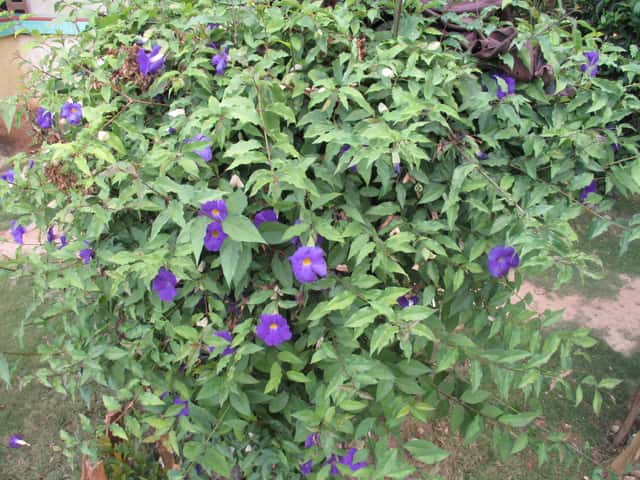
Bush Clockvine (Thunbergia erecta) is a easy-care plant from the Acanthaceae family. Thunbergia erecta, commonly known as Bush Clockvine or King's Mantle, is a fast-growing evergreen shrub native to West Africa. It produces stunning deep purple to blue tubular flowers with creamy yellow throats throughout summer and fall, making it a prized ornamental in tropical and subtropical gar...
Bush Clockvine grows up to 2.5m, spread of 240cm, watering every 10 days, 10°C – 32°C, 50–80% humidity. It is not suitable for indoor environments and safe for pets.
Unlike many tropical plants, Bush Clockvine tolerates watering mistakes. Best for beginners. Unlike many popular species, Bush Clockvine is safe to keep around pets.
How to Care for Bush Clockvine?
TLDR: Bush Clockvine needs Direct sun, watering every 10 days, and temperatures between 10-32°C with 50-80% humidity.
How Often Should You Water Bush Clockvine?
Water every 10 days, allowing the top inch of soil to dry out between waterings. Once established, this plant is quite drought tolerant. Avoid waterlogging, which can cause root rot.
How Much Light Does Bush Clockvine Need?
Provide full sun to partial shade — ideally 6+ hours of direct sunlight per day. A south or west-facing position is ideal. The more sun it receives, the more profusely it will bloom.
What Is the Best Soil for Bush Clockvine?
Use well-draining soil enriched with organic matter. A mix of garden soil, compost, and perlite works well. Avoid heavy clay that retains excess moisture. pH between 6.0 and 7.0 is ideal.
What Pot Should You Use for Bush Clockvine?
Plant in medium to large terracotta or ceramic pots with drainage holes. Outdoors, plant directly in the ground in tropical climates. Use containers only in cooler regions where overwintering is needed.
Care Schedule
Fertilize
Every 30 days
What Is Bush Clockvine and Where Does It Come From?
Thunbergia erecta, commonly known as Bush Clockvine or King's Mantle, is a fast-growing evergreen shrub native to West Africa. It produces stunning deep purple to blue tubular flowers with creamy yellow throats throughout summer and fall, making it a prized ornamental in tropical and subtropical gardens.
How to Propagate Bush Clockvine?
Stem Cutting
Take cuttings in spring or early summer for best results. Maintain warmth (above 20°C) for faster rooting.
- 1 Cut a healthy semi-woody stem with 3-4 leaf nodes
- 2 Remove lower leaves and dip the cut end in rooting hormone
- 3 Plant in a moist, well-draining potting mix
- 4 Cover with a plastic bag or dome to retain humidity
- 5 Place in bright indirect light and keep soil moist until rooted
Materials needed:
Ground Layering
Ground layering is very reliable for Thunbergia erecta and requires minimal intervention.
- 1 Select a long flexible stem and bend it to ground level
- 2 Make a small wound on the underside of the stem
- 3 Pin the wounded area to the soil with a U-shaped peg
- 4 Keep the area moist until roots develop
- 5 Sever from parent plant once well rooted
Materials needed:
How Big Does Bush Clockvine Grow?
TLDR: Bush Clockvine can reach up to 2.5m tall with Fast growth rate.
Max height
2.5m
Spread
2.4m
Growth rate
Fast
Foliage
Evergreen
Plant Uses
Ornamental
Great for decoration
Is your plant showing symptoms?
Click on the symptom to discover possible causes:
What Diseases Commonly Affect Bush Clockvine?
TLDR: Bush Clockvine is susceptible to 8 known diseases. Monitor regularly for early detection.
Powdery Mildew
Powdery mildew is a common fungal disease caused by various fungi species including Erysiphe, Podosphaera, Oïdium, and Leveillula. It affects over 10,000 plant species worldwide. The disease thrives in warm, dry climates with high humidity and appears as a distinctive white powdery coating on plant surfaces.
Alternaria Leaf Spot
Alternaria leaf spot is a common fungal disease caused by Alternaria solani and Alternaria alternata that affects a wide range of plants including tomatoes, potatoes, brassicas, and ornamentals. The disease thrives in warm, humid conditions and can cause significant crop damage if left untreated. Spores overwinter on plant debris and can attach to seeds, making complete elimination difficult.
Root Rot
Root rot is a serious fungal disease that affects the root system of plants, causing them to decay and die. It is primarily caused by overwatering, poor drainage, or soil-borne fungi such as Pythium, Phytophthora, Rhizoctonia, and Fusarium. The disease thrives in waterlogged conditions where roots are deprived of oxygen, making them susceptible to fungal infection.
Root-Knot Nematodes
Root-knot nematodes (Meloidogyne species) are microscopic roundworms that parasitize plant roots, causing characteristic galls or knots. These soil-borne pests are among the most economically damaging plant pathogens worldwide, affecting a wide range of ornamental and edible plants. The nematodes inject enzymes into root cells, causing abnormal swelling and disrupting water and nutrient uptake.
Meaning & Symbolism
In many cultures, the deep purple flowers of Bush Clockvine symbolize royalty, dignity, and admiration. In its native West Africa, the plant is also associated with endurance and vitality.
Fun Facts
Thunbergia erecta can grow up to 8 feet tall in ideal tropical conditions, creating a stunning natural hedge
Its purple flowers are slightly fragrant, especially in the morning
Despite being called a 'vine' in its common name, it is actually a sprawling shrub, not a true climber
In its native West Africa, it is used in traditional hedging and garden borders
Frequently asked questions
How often should I water Bush Clockvine?
Does Bush Clockvine need full sun?
Is Bush Clockvine toxic to pets?
When does Bush Clockvine flower?
Can I grow Bush Clockvine in a pot?
Compare with similar plants
| Attribute | Difficulty | Light | Watering | Pet Safe |
|---|---|---|---|---|
| Field Maple | Easy | Bright indirect | 14d | ✓ |
| Silver Birch | Easy | Direct sun | 14d | ✓ |
| Common Blanketflower | Easy | Direct sun | 10d | ✓ |
| Cushion Bush | Easy | Direct sun | 14d | ✓ |





