Asteraceae
Mouse-ear hawkweed: Full Sun Plant
Pilosella officinarum
An extremely hardy and low-maintenance plant, ideal for sunny areas and poor soils where other plants struggle to grow.
Every 14 days
Direct sun
-20° - 35°C
30% - 70%
Categories
What is Mouse-ear hawkweed?
Mouse-ear hawkweed (Pilosella officinarum) is a easy-care plant from the Asteraceae family. Pilosella officinarum, commonly known as mouse-ear hawkweed, is a perennial herbaceous plant native to Europe and northern Asia. It forms basal rosettes of green leaves covered in distinct white hairs, which help conserve moisture. The plant spreads via creeping stolons, creating a dense mat. Its br...
Mouse-ear hawkweed grows up to 20cm, spread of 30cm, watering every 14 days, -20°C – 35°C, 30–70% humidity. It is not suitable for indoor environments and safe for pets.
Unlike many tropical plants, Mouse-ear hawkweed tolerates watering mistakes. Best for beginners. Unlike many popular species, Mouse-ear hawkweed is safe to keep around pets.
How to Care for Mouse-ear hawkweed?
TLDR: Mouse-ear hawkweed needs Direct sun, watering every 14 days, and temperatures between -20-35°C with 30-70% humidity.
How Often Should You Water Mouse-ear hawkweed?
Water only when the soil is completely dry. The plant is very sensitive to overwatering and root rot.
How Much Light Does Mouse-ear hawkweed Need?
Requires full sun for at least 6 hours daily to bloom and prevent the plant from becoming leggy or etiolated.
What Is the Best Soil for Mouse-ear hawkweed?
Prefers dry, sandy, or stony soils. Avoid soils too rich in nitrogen, which encourage foliage growth at the expense of flowers.
What Pot Should You Use for Mouse-ear hawkweed?
If grown in pots, use wide and shallow containers to allow for stolon expansion, with efficient drainage holes.
Care Schedule
Fertilize
Every 60 days
What Is Mouse-ear hawkweed and Where Does It Come From?
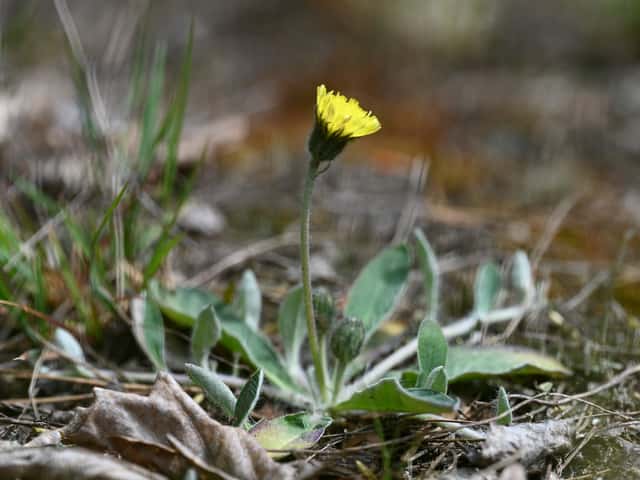
Pilosella officinarum, commonly known as mouse-ear hawkweed, is a perennial herbaceous plant native to Europe and northern Asia. It forms basal rosettes of green leaves covered in distinct white hairs, which help conserve moisture. The plant spreads via creeping stolons, creating a dense mat. Its bright yellow flowers resemble small dandelions and emerge on single, upright stems.
How to Propagate Mouse-ear hawkweed?
Stolon Division
- Keep the soil slightly moist only for the first few weeks after division.
- 1 Identification
Locate the new rosettes forming at the ends of the stolons (creeping stems).
- 2 Separation
Cut the stolon connecting the new rosette to the mother plant using clean shears.
- 3 Planting
Plant the new rosette directly in the soil or in a new pot, keeping the base of the rosette at surface level.
Materials needed:
Sowing
- Germination is more effective if the seeds undergo a period of cold stratification before planting.
- 1 Preparation
Prepare a seedbed with sandy, well-drained soil.
- 2 Sowing
Scatter the seeds over the surface, pressing lightly without covering them completely, as they need light to germinate.
- 3 Maintenance
Keep the area moist with a spray bottle until the seedlings are established.
Materials needed:
How Big Does Mouse-ear hawkweed Grow?
TLDR: Mouse-ear hawkweed can reach up to 20cm tall with Fast growth rate.
Max height
20cm
Spread
30cm
Growth rate
Fast
Foliage
Deciduous
Plant Uses
Medicinal
Medicinal properties
Ornamental
Great for decoration
Medicinal Uses
- Diuretic action
- Treatment of coughs and bronchitis
- Astringent properties
- Aid in wound healing
Is your plant showing symptoms?
Click on the symptom to discover possible causes:
What Diseases Commonly Affect Mouse-ear hawkweed?
TLDR: Mouse-ear hawkweed is susceptible to 8 known diseases. Monitor regularly for early detection.
Rust
Rust is a common fungal disease caused by fungi in the order Pucciniales that affects a wide variety of plants. The disease gets its name from the characteristic orange, yellow, or reddish-brown pustules that appear on leaves, resembling metal rust. This obligate fungal parasite requires living plants to survive and can cause significant economic losses in agricultural crops.
Powdery Mildew
Powdery mildew is a common fungal disease caused by various fungi species including Erysiphe, Podosphaera, Oïdium, and Leveillula. It affects over 10,000 plant species worldwide. The disease thrives in warm, dry climates with high humidity and appears as a distinctive white powdery coating on plant surfaces.
Aphids
Aphids are small, soft-bodied, pear-shaped insects (1/16 to 1/8 inch long) that feed by sucking nutrient-rich sap from plants. They reproduce rapidly and can quickly weaken plants, causing distorted growth and transmitting plant viruses. Aphids come in various colors including green, black, red, yellow, brown, and gray. They secrete honeydew, a sticky substance that attracts ants and encourages sooty mold growth.
Caterpillars
Caterpillars are the larval stage of moths and butterflies that feed voraciously on plant foliage, stems, flowers, and fruits. Common species include cabbage loopers, tomato hornworms, armyworms, and cutworms. These pests can cause extensive damage by consuming large amounts of plant tissue in a short time. They vary in size from small (1/4 inch) to large (5 inches), with colors ranging from green to brown, often featuring stripes or spots. Caterpillars are highly mobile and can quickly spread throughout gardens, making them one of the most destructive common pests.
Meaning & Symbolism
In folklore, it was used to symbolize keen vision, as it was believed that hawks used it to clear their eyesight.
Compare with similar plants
| Attribute | Difficulty | Light | Watering | Pet Safe |
|---|---|---|---|---|
| Field Maple | Easy | Bright indirect | 14d | ✓ |
| Silver Birch | Easy | Direct sun | 14d | ✓ |
| Cushion Bush | Easy | Direct sun | 14d | ✓ |
| Wild Lettuce | Medium | Direct sun | 7d | ⚠️ |





