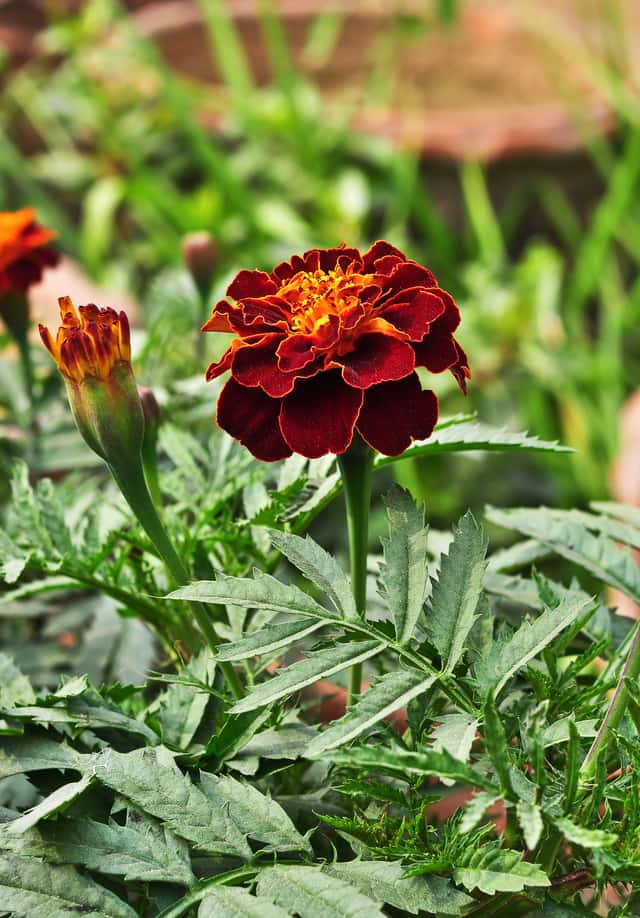
Asteraceae
French marigold: Full Sun Plant
Tagetes patula
French marigolds are low-maintenance annuals that thrive in full sun and well-drained soil. Regular deadheading of spent flowers is necessary to encourage continuous blooming until the first frost.
Every 6 days
Direct sun
10° - 35°C
40% - 70%
Categories
What is French marigold?
French marigold (Tagetes patula) is a easy-care plant from the Asteraceae family. Tagetes patula, commonly known as the French marigold, is a compact annual flowering plant in the daisy family. It features deeply divided, fern-like green foliage and produces a profusion of multi-layered flower heads in vibrant shades of yellow, orange, and mahogany. Native to Mexico and Guatemala...
French marigold grows up to 30cm, spread of 23cm, watering every 6 days, 10°C – 35°C, 40–70% humidity. It is not suitable for indoor environments and not safe for pets.
Unlike many tropical plants, French marigold tolerates watering mistakes. Best for beginners. Without precautions, ingestion can cause irritation in pets. Keep out of reach of cats and dogs.
How to Care for French marigold?
TLDR: French marigold needs Direct sun, watering every 6 days, and temperatures between 10-35°C with 40-70% humidity.
How Often Should You Water French marigold?
Water at the base of the plant to keep the foliage dry, as wet leaves are prone to powdery mildew and botrytis.
How Much Light Does French marigold Need?
Requires at least 6 to 8 hours of direct sunlight daily. Insufficient light leads to leggy growth and fewer flowers.
What Is the Best Soil for French marigold?
Thrives in moderately fertile, well-draining soil. Avoid high-nitrogen fertilizers which promote foliage over flowers.
What Pot Should You Use for French marigold?
A standard terracotta pot with excellent drainage to prevent root rot.
Care Schedule
Fertilize
Every 30 days
What Is French marigold and Where Does It Come From?
Tagetes patula, commonly known as the French marigold, is a compact annual flowering plant in the daisy family. It features deeply divided, fern-like green foliage and produces a profusion of multi-layered flower heads in vibrant shades of yellow, orange, and mahogany. Native to Mexico and Guatemala, it is highly valued by gardeners for its ability to repel soil pests like nematodes and its long-lasting summer display.
How to Propagate French marigold?
Seed Sowing
- Start seeds indoors 6-8 weeks before the last frost for earlier blooms.
- 1 Sowing
Sow seeds 1/4 inch deep in moist seed-starting mix.
- 2 Warmth
Keep the soil temperature between 21-24 degrees Celsius for optimal germination.
- 3 Thinning
Thin seedlings to 8-10 inches apart once they have two sets of true leaves.
Materials needed:
Stem Cuttings
- Keep the cutting in a humid environment by covering it with a plastic bag.
- 1 Cutting
Take a 4-inch cutting from a healthy, non-flowering stem.
- 2 Preparation
Remove the lower leaves and dip the end in rooting hormone if desired.
- 3 Planting
Insert the cutting into a moist mix of perlite and peat moss.
Materials needed:
How Big Does French marigold Grow?
TLDR: French marigold can reach up to 30cm tall with Fast growth rate.
Max height
30cm
Spread
23cm
Growth rate
Fast
Foliage
Deciduous
Warning: Toxic Plant
This plant can be toxic if ingested. Keep out of reach of:
Plant Uses
Ornamental
Great for decoration
Medicinal
Medicinal properties
Medicinal Uses
- Topical treatment for skin inflammation
- Digestive aid
- Antiseptic wash
Culinary Uses
- Salad garnish
- Natural food coloring
- Petal infusion for herbal tea
Is your plant showing symptoms?
Click on the symptom to discover possible causes:
What Diseases Commonly Affect French marigold?
TLDR: French marigold is susceptible to 18 known diseases. Monitor regularly for early detection.
Powdery Mildew
Powdery mildew is a common fungal disease caused by various fungi species including Erysiphe, Podosphaera, Oïdium, and Leveillula. It affects over 10,000 plant species worldwide. The disease thrives in warm, dry climates with high humidity and appears as a distinctive white powdery coating on plant surfaces.
Root Rot
Root rot is a serious fungal disease that affects the root system of plants, causing them to decay and die. It is primarily caused by overwatering, poor drainage, or soil-borne fungi such as Pythium, Phytophthora, Rhizoctonia, and Fusarium. The disease thrives in waterlogged conditions where roots are deprived of oxygen, making them susceptible to fungal infection.
Gray Mold (Botrytis Blight)
Gray mold, caused by the fungus Botrytis cinerea, is one of the most common fungal diseases in plants. It affects over 200 plant species, including ornamentals, vegetables, fruits, and houseplants. The disease thrives in cool, humid conditions with poor air circulation, causing grayish spots and soft rot on infected tissues.
Fusarium Wilt
Fusarium wilt is a serious fungal disease caused by the soil-borne fungus Fusarium oxysporum. The fungus invades roots and blocks the water-conducting vessels (xylem) of the plant, causing progressive wilting and eventual death. Host-specific forms of the pathogen exist that attack different plant species.
Meaning & Symbolism
Marigolds are often associated with the sun, creativity, and passion. In many cultures, they represent the light that guides spirits.
Compare with similar plants
| Attribute | Difficulty | Light | Watering | Pet Safe |
|---|---|---|---|---|
| Field Maple | Easy | Bright indirect | 14d | ✓ |
| Silver Birch | Easy | Direct sun | 14d | ✓ |
| Common Blanketflower | Easy | Direct sun | 10d | ✓ |
| Cushion Bush | Easy | Direct sun | 14d | ✓ |





