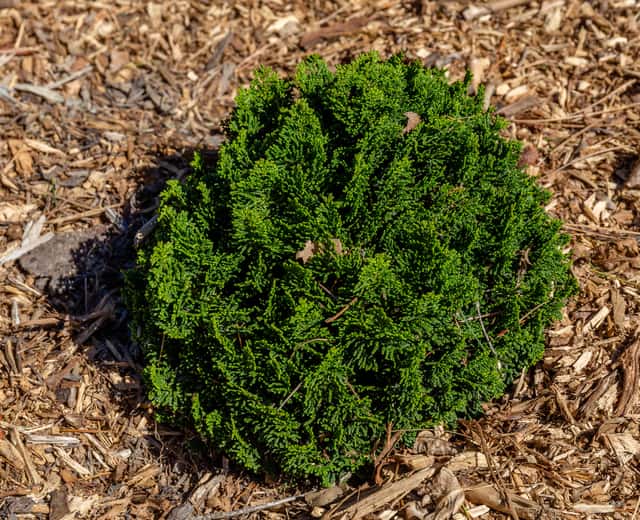
Cupressaceae
Hinoki Cypress (Chamaecyparis obtusa): The Sacred Japanese Conifer
Chamaecyparis obtusa
Plant in full sun to partial shade in well-draining, slightly acidic soil. Water when the top layer of soil begins to dry. Fertilize monthly during the growing season. Prune regularly to maintain shape and promote air circulation through inner foliage.
Every 7 days
Bright indirect
-20° - 35°C
50% - 80%
Categories
What is Hinoki Cypress?
Hinoki Cypress (Chamaecyparis obtusa) is a easy-care plant from the Cupressaceae family. Chamaecyparis obtusa, commonly known as Hinoki Cypress, is an evergreen conifer native to central and southern Japan. It features elegant, dark-green scale-like foliage with a slow, pyramidal growth habit. Widely used in Japanese Zen gardens, bonsai, and ornamental landscaping, it can reach over 20...
Hinoki Cypress grows up to 21.0m, spread of 600cm, watering every 7 days, -20°C – 35°C, 50–80% humidity. It is not suitable for indoor environments and safe for pets.
Unlike many tropical plants, Hinoki Cypress tolerates watering mistakes. Best for beginners. Unlike many popular species, Hinoki Cypress is safe to keep around pets.
How to Care for Hinoki Cypress?
TLDR: Hinoki Cypress needs Bright indirect, watering every 7 days, and temperatures between -20-35°C with 50-80% humidity.
How Often Should You Water Hinoki Cypress?
Water deeply when the top third of soil feels dry, approximately every 7 days in summer. Reduce in winter but never let the root ball completely dry out. Use low-lime water when possible.
How Much Light Does Hinoki Cypress Need?
Requires full sun to partial shade with at least 4–6 hours of direct sunlight daily. Shield from hot, dry winds that can scorch the foliage.
What Is the Best Soil for Hinoki Cypress?
Prefers well-draining, slightly acidic soil (pH 5.5–6.5). Amend with perlite or coarse sand for drainage. Avoid compacted or lime-rich soils.
What Pot Should You Use for Hinoki Cypress?
Terracotta pot or container with adequate drainage holes. For bonsai, use a shallow ceramic pot.
Care Schedule
Fertilize
Every 28 days
What Is Hinoki Cypress and Where Does It Come From?
Chamaecyparis obtusa, commonly known as Hinoki Cypress, is an evergreen conifer native to central and southern Japan. It features elegant, dark-green scale-like foliage with a slow, pyramidal growth habit. Widely used in Japanese Zen gardens, bonsai, and ornamental landscaping, it can reach over 20 meters in the wild but remains compact in cultivation.
How to Propagate Hinoki Cypress?
Semi-hardwood stem cutting
Keep substrate slightly moist but never waterlogged. Cover with a clear plastic bag to maintain humidity.
- 1 Take a semi-hardwood cutting 10–15 cm long in late spring
- 2 Remove leaves from the lower half of the cutting
- 3 Dip the base in rooting hormone powder
- 4 Plant in equal parts peat and perlite
- 5 Keep in indirect light with high humidity
- 6 Allow 6–10 weeks for roots to develop
Materials needed:
How Big Does Hinoki Cypress Grow?
TLDR: Hinoki Cypress can reach up to 21.0m tall with Slow growth rate.
Max height
21.0m
Spread
6.0m
Growth rate
Slow
Foliage
Evergreen
Plant Uses
Ornamental
Great for decoration
Is your plant showing symptoms?
Click on the symptom to discover possible causes:
What Diseases Commonly Affect Hinoki Cypress?
TLDR: Hinoki Cypress is susceptible to 8 known diseases. Monitor regularly for early detection.
Root Rot
Root rot is a serious fungal disease that affects the root system of plants, causing them to decay and die. It is primarily caused by overwatering, poor drainage, or soil-borne fungi such as Pythium, Phytophthora, Rhizoctonia, and Fusarium. The disease thrives in waterlogged conditions where roots are deprived of oxygen, making them susceptible to fungal infection.
Spider Mites
Spider mites are tiny arachnids (less than 1/20 inch long) related to spiders and ticks that feed on plant sap. They thrive in hot, dry conditions and can cause significant damage to ornamental and vegetable plants. During severe infestations, crop losses can reach 14% or higher as these pests disrupt vital plant processes including photosynthesis, carbon dioxide absorption, and transpiration.
Aphids
Aphids are small, soft-bodied, pear-shaped insects (1/16 to 1/8 inch long) that feed by sucking nutrient-rich sap from plants. They reproduce rapidly and can quickly weaken plants, causing distorted growth and transmitting plant viruses. Aphids come in various colors including green, black, red, yellow, brown, and gray. They secrete honeydew, a sticky substance that attracts ants and encourages sooty mold growth.
Scale Insects
Scale insects are small sap-sucking pests that appear as brown, shell-like bumps on plant stems and leaves. There are over 25 species, divided into armored (hard) and unarmored (soft) scales. They feed by piercing plant tissue and extracting sap, which weakens the plant and can lead to yellowing, stunted growth, and even death if left untreated. They also excrete honeydew, which attracts ants and promotes sooty mold growth.
Meaning & Symbolism
In Japan, hinoki is a sacred tree symbolizing longevity, purity, and spirituality. It is traditionally planted at Shinto and Buddhist temples.
Fun Facts
Hinoki wood has been used for centuries to build Shinto shrines in Japan, including the famous Ise Grand Shrine.
The distinctive aroma of hinoki wood is used in essential oils and traditional Japanese hinoki baths (hinoki-buro).
Hinoki Cypress is one of the most prized species in Japanese bonsai art, with specimens living for centuries in miniature form.
In ideal conditions in the wild, Chamaecyparis obtusa can exceed 35 meters in height and live for over 1,000 years.
Frequently asked questions
How often should I water my Hinoki Cypress?
Is Hinoki Cypress toxic to pets?
Can Hinoki Cypress grow indoors?
How fast does Hinoki Cypress grow?
What are common problems with Hinoki Cypress?
Compare with similar plants
| Attribute | Difficulty | Light | Watering | Pet Safe |
|---|---|---|---|---|
| Field Maple | Easy | Bright indirect | 14d | ✓ |
| Silver Birch | Easy | Direct sun | 14d | ✓ |
| Common Blanketflower | Easy | Direct sun | 10d | ✓ |
| Cushion Bush | Easy | Direct sun | 14d | ✓ |





