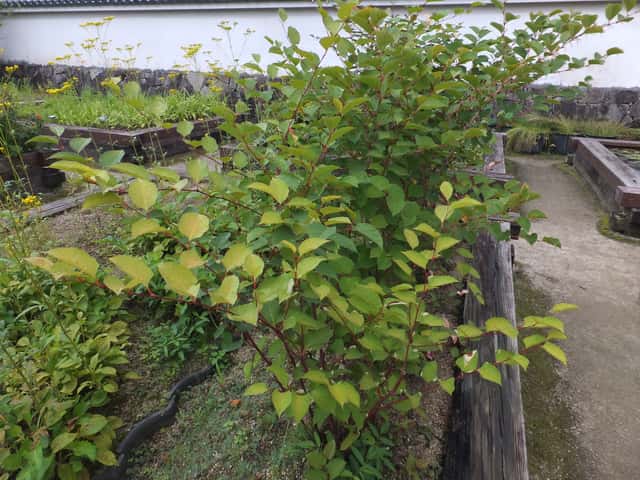
Polygonaceae
Japanese Knotweed (Reynoutria japonica)
Reynoutria japonica
Extremely hardy and fast-growing. Tolerates poor soils, partial shade, drought, and a wide pH range. In most Western countries it is classified as a noxious weed and planting it in the wild is illegal. Active management is required to prevent spread — rhizome fragments as small as a fingernail can regenerate into a full plant.
Every 7 days
Bright indirect
-20° - 35°C
30% - 70%
Categories
What is Japanese Knotweed?
Japanese Knotweed (Reynoutria japonica) is a easy-care plant from the Polygonaceae family. Reynoutria japonica, commonly known as Japanese Knotweed, is a highly invasive perennial herbaceous plant native to East Asia. Classified as one of the world's worst invasive species by the IUCN, it forms dense thickets reaching 3 meters tall that outcompete native vegetation and cause significant s...
Japanese Knotweed grows up to 3.0m, spread of 600cm, watering every 7 days, -20°C – 35°C, 30–70% humidity. It is not suitable for indoor environments and safe for pets.
Unlike many tropical plants, Japanese Knotweed tolerates watering mistakes. Best for beginners. Unlike many popular species, Japanese Knotweed is safe to keep around pets.
How to Care for Japanese Knotweed?
TLDR: Japanese Knotweed needs Bright indirect, watering every 7 days, and temperatures between -20-35°C with 30-70% humidity.
How Often Should You Water Japanese Knotweed?
Water weekly during dry periods. Highly drought-tolerant once established. Avoid waterlogged soils which can promote root rot in compacted conditions.
How Much Light Does Japanese Knotweed Need?
Grows best in full sun but tolerates partial shade. Higher light exposure leads to more vigorous growth. Can survive in deep shade but growth slows significantly.
What Is the Best Soil for Japanese Knotweed?
Adapts to almost any soil type. pH tolerance of 3.0–8.5. Prefers moist, loamy soils. Avoid permanently waterlogged conditions.
What Pot Should You Use for Japanese Knotweed?
Not recommended for containers — the rhizome system can crack pots and planters. In gardens, use deep physical root barriers to contain lateral spread.
What Is Japanese Knotweed and Where Does It Come From?
Reynoutria japonica, commonly known as Japanese Knotweed, is a highly invasive perennial herbaceous plant native to East Asia. Classified as one of the world's worst invasive species by the IUCN, it forms dense thickets reaching 3 meters tall that outcompete native vegetation and cause significant structural damage to buildings, roads, and drainage systems through its aggressive rhizome network.
How to Propagate Japanese Knotweed?
Rhizome Division
Wear gloves and use clean tools. Any rhizome fragment can regenerate — dispose of all material responsibly, never in compost or natural areas.
- 1 Excavate and separate a rhizome fragment of at least 5 cm
- 2 Plant the fragment 5-10 cm deep in prepared soil
- 3 Water lightly and keep moist until established
Materials needed:
Stem Cutting
Keep substrate moist but not waterlogged.
- 1 Cut a stem with 2-3 visible nodes
- 2 Remove lower leaves
- 3 Place in water or moist substrate until roots form
Materials needed:
How Big Does Japanese Knotweed Grow?
TLDR: Japanese Knotweed can reach up to 3.0m tall with Fast growth rate.
Max height
3.0m
Spread
6.0m
Growth rate
Fast
Foliage
Deciduous
Plant Uses
Ornamental
Great for decoration
Medicinal
Medicinal properties
Edible
Can be consumed
Medicinal Uses
- Rhizome used in Traditional Chinese and Japanese Medicine for inflammation, cardiovascular conditions, and skin disorders
- Contains resveratrol, a potent antioxidant studied for cardiovascular and anti-cancer properties
Culinary Uses
- Young spring shoots are edible with a tart rhubarb-like flavor
- Can be eaten raw, cooked, or used in jams and chutneys
Is your plant showing symptoms?
Click on the symptom to discover possible causes:
What Diseases Commonly Affect Japanese Knotweed?
TLDR: Japanese Knotweed is susceptible to 3 known diseases. Monitor regularly for early detection.
Leaf Spot
Leaf spot is a common fungal disease caused by various pathogens including Alternaria, Ascochyta, Colletotrichum, Septoria, and Venturia. It primarily affects leaves, causing discolored spots that can lead to premature leaf drop if left untreated.
Root Rot
Root rot is a serious fungal disease that affects the root system of plants, causing them to decay and die. It is primarily caused by overwatering, poor drainage, or soil-borne fungi such as Pythium, Phytophthora, Rhizoctonia, and Fusarium. The disease thrives in waterlogged conditions where roots are deprived of oxygen, making them susceptible to fungal infection.
Aphids
Aphids are small, soft-bodied, pear-shaped insects (1/16 to 1/8 inch long) that feed by sucking nutrient-rich sap from plants. They reproduce rapidly and can quickly weaken plants, causing distorted growth and transmitting plant viruses. Aphids come in various colors including green, black, red, yellow, brown, and gray. They secrete honeydew, a sticky substance that attracts ants and encourages sooty mold growth.
Meaning & Symbolism
Symbolizes resilience, relentless persistence, and vitality in the face of adversity.
Fun Facts
Listed among the 100 worst invasive species in the world by the IUCN Global Invasive Species Database
Rhizomes can penetrate 3 meters deep and crack building foundations and concrete
In the UK, its presence on a property can prevent mortgage approval and significantly reduce property value
It was introduced to Europe in the 19th century as an ornamental garden plant and fodder crop
Frequently asked questions
Why is Japanese Knotweed so dangerous?
How do you control Japanese Knotweed?
Is Japanese Knotweed toxic to pets?
Are the shoots edible?
How tall does Japanese Knotweed grow?
Compare with similar plants
| Attribute | Difficulty | Light | Watering | Pet Safe |
|---|---|---|---|---|
| Field Maple | Easy | Bright indirect | 14d | ✓ |
| Silver Birch | Easy | Direct sun | 14d | ✓ |
| Common Blanketflower | Easy | Direct sun | 10d | ✓ |
| Cushion Bush | Easy | Direct sun | 14d | ✓ |





