Fabaceae
Royal Poinciana: Full Sun Plant
Delonix regia
Requires full sun and ample space to develop. It is a tropical tree that does not tolerate frost and prefers well-drained soils.
Every 10 days
Direct sun
10° - 35°C
50% - 80%
Categories
What is Royal Poinciana?
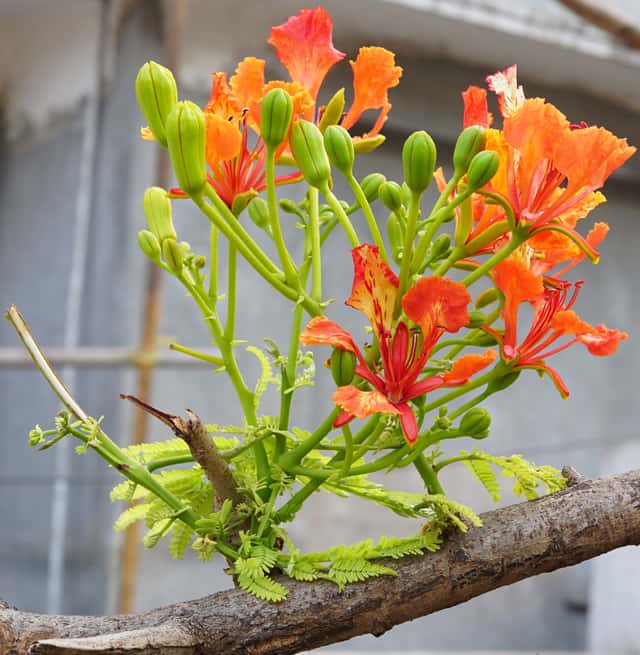
Royal Poinciana (Delonix regia) is a easy-care plant from the Fabaceae family. The Royal Poinciana is considered one of the most beautiful trees in the world. Native to Madagascar, it stands out for its massive umbrella-shaped canopy and its exuberant flowering in shades of red and orange. Its leaves are finely pinnate, giving the tree a light texture even when not in bloom.
Royal Poinciana grows up to 12.0m, spread of 1800cm, watering every 10 days, 10°C – 35°C, 50–80% humidity. It is not suitable for indoor environments and safe for pets.
Unlike many tropical plants, Royal Poinciana tolerates watering mistakes. Best for beginners. Unlike many popular species, Royal Poinciana is safe to keep around pets.
How to Care for Royal Poinciana?
TLDR: Royal Poinciana needs Direct sun, watering every 10 days, and temperatures between 10-35°C with 50-80% humidity.
How Often Should You Water Royal Poinciana?
Water young seedlings abundantly. Mature trees are drought-resistant but appreciate occasional watering during prolonged dry spells.
How Much Light Does Royal Poinciana Need?
This tree requires constant full sun for healthy flowering; shaded locations will result in few flowers and leggy growth.
What Is the Best Soil for Royal Poinciana?
Prefers sandy or slightly loamy soils, but drainage is the most critical factor to prevent root rot.
What Pot Should You Use for Royal Poinciana?
Not recommended for long-term container growth; it should be planted in the ground due to its aggressive root system and large size.
Care Schedule
Fertilize
Every 90 days
What Is Royal Poinciana and Where Does It Come From?
The Royal Poinciana is considered one of the most beautiful trees in the world. Native to Madagascar, it stands out for its massive umbrella-shaped canopy and its exuberant flowering in shades of red and orange. Its leaves are finely pinnate, giving the tree a light texture even when not in bloom.
How to Propagate Royal Poinciana?
Sowing
- The soaking water should be warm, not boiling.
- Use deep seedling bags to allow for initial root growth.
- 1 Scarification
Lightly sand the seed coat or make a small nick to break dormancy.
- 2 Hydration
Soak the seeds in warm water for 24 hours before planting.
- 3 Planting
Sow in fertile soil and maintain constant moisture until germination.
Materials needed:
Stem Cuttings
- Keep cuttings protected from direct sun until they sprout.
- The success rate is significantly lower than with seeds.
- 1 Cutting
Take semi-hardwood cuttings about 12 inches (30cm) long.
- 2 Hormone
Apply rooting powder to the base of the cutting.
- 3 Planting
Keep in a very sandy substrate and under high environmental humidity.
Materials needed:
How Big Does Royal Poinciana Grow?
TLDR: Royal Poinciana can reach up to 12.0m tall with Fast growth rate.
Max height
12.0m
Spread
18.0m
Growth rate
Fast
Foliage
Deciduous
Plant Uses
Ornamental
Great for decoration
Medicinal
Medicinal properties
Is your plant showing symptoms?
Click on the symptom to discover possible causes:
What Diseases Commonly Affect Royal Poinciana?
TLDR: Royal Poinciana is susceptible to 8 known diseases. Monitor regularly for early detection.
Root Rot
Root rot is a serious fungal disease that affects the root system of plants, causing them to decay and die. It is primarily caused by overwatering, poor drainage, or soil-borne fungi such as Pythium, Phytophthora, Rhizoctonia, and Fusarium. The disease thrives in waterlogged conditions where roots are deprived of oxygen, making them susceptible to fungal infection.
Leaf Spot
Leaf spot is a common fungal disease caused by various pathogens including Alternaria, Ascochyta, Colletotrichum, Septoria, and Venturia. It primarily affects leaves, causing discolored spots that can lead to premature leaf drop if left untreated.
Scale Insects
Scale insects are small sap-sucking pests that appear as brown, shell-like bumps on plant stems and leaves. There are over 25 species, divided into armored (hard) and unarmored (soft) scales. They feed by piercing plant tissue and extracting sap, which weakens the plant and can lead to yellowing, stunted growth, and even death if left untreated. They also excrete honeydew, which attracts ants and promotes sooty mold growth.
Mealybugs
Mealybugs are small, soft-bodied insects covered with a white, waxy, cottony material. They are common pests of houseplants and outdoor plants in mild climates. These sap-sucking insects feed on plant tissue, causing damage, stunted growth, and can lead to plant death if left untreated. They produce sticky honeydew which attracts sooty mold.
Meaning & Symbolism
Symbolizes glory, nature's ostentation, and the arrival of tropical heat.
Compare with similar plants
| Attribute | Difficulty | Light | Watering | Pet Safe |
|---|---|---|---|---|
| Field Maple | Easy | Bright indirect | 14d | ✓ |
| Silver Birch | Easy | Direct sun | 14d | ✓ |
| Common Blanketflower | Easy | Direct sun | 10d | ✓ |
| Cushion Bush | Easy | Direct sun | 14d | ✓ |





