Asparagaceae
How to Care for the Snake Plant (Dracaena trifasciata)
Dracaena trifasciata
One of the easiest houseplants you can own. Thrives on neglect — water sparingly every 2–3 weeks in summer, monthly or less in winter. Tolerates low light but grows best in bright indirect light. Virtually impossible to kill if you avoid overwatering. Perfect for beginners and frequent travelers.
Every 14 days
Partial shade
10° - 27°C
30% - 50%
Categories
What is Snake Plant?
Snake Plant (Dracaena trifasciata) is a easy-care plant from the Asparagaceae family. Dracaena trifasciata, commonly known as the Snake Plant or Mother-in-Law's Tongue, is an evergreen succulent perennial native to tropical West Africa, from Nigeria eastward to the Congo. Formerly classified as Sansevieria trifasciata and reclassified to the genus Dracaena in 2017 following molecular...
Snake Plant grows up to 1.2m, spread of 60cm, watering every 14 days, 10°C – 27°C, 30–50% humidity. It is suitable for indoor environments and not safe for pets.
Unlike many tropical plants, Snake Plant tolerates watering mistakes. Best for beginners. Without precautions, ingestion can cause irritation in pets. Keep out of reach of cats and dogs. Without adequate drainage, root rot can develop within 28 days.
How to Care for Snake Plant?
TLDR: Snake Plant needs Partial shade, watering every 14 days, and temperatures between 10-27°C with 30-50% humidity.
How Often Should You Water Snake Plant?
Allow the soil to dry out completely between waterings — test 5 cm deep before watering. In the growing season (spring/summer), water every 14–21 days. In winter, reduce to once every 4–6 weeks. Always empty the saucer — never let roots sit in standing water.
How Much Light Does Snake Plant Need?
Adapts to nearly any light condition, from dim corners to bright indirect light near windows. Bright indirect light (150–300 foot-candles) produces the fastest growth and most vibrant coloration. Avoid prolonged intense direct sunlight, which causes irreversible bleaching and leaf scorch.
What Is the Best Soil for Snake Plant?
Use a well-draining cactus or succulent mix, or combine standard potting soil with perlite (50:50 ratio). Ideal pH is 6.0–8.0. Good drainage is the single most important factor — soggy soil causes root rot rapidly. Unglazed terracotta pots enhance moisture evaporation.
What Pot Should You Use for Snake Plant?
Unglazed terracotta pots are ideal — their porous walls allow soil to dry faster, significantly reducing root rot risk. Always choose a pot with at least one drainage hole. Select a pot only 1–2 inches larger than the current root ball to prevent waterlogging in excess soil.
Care Schedule
Fertilize
Every 30 days
Rotate
Every 90 days
Repot
Every 1825 days
What Is Snake Plant and Where Does It Come From?
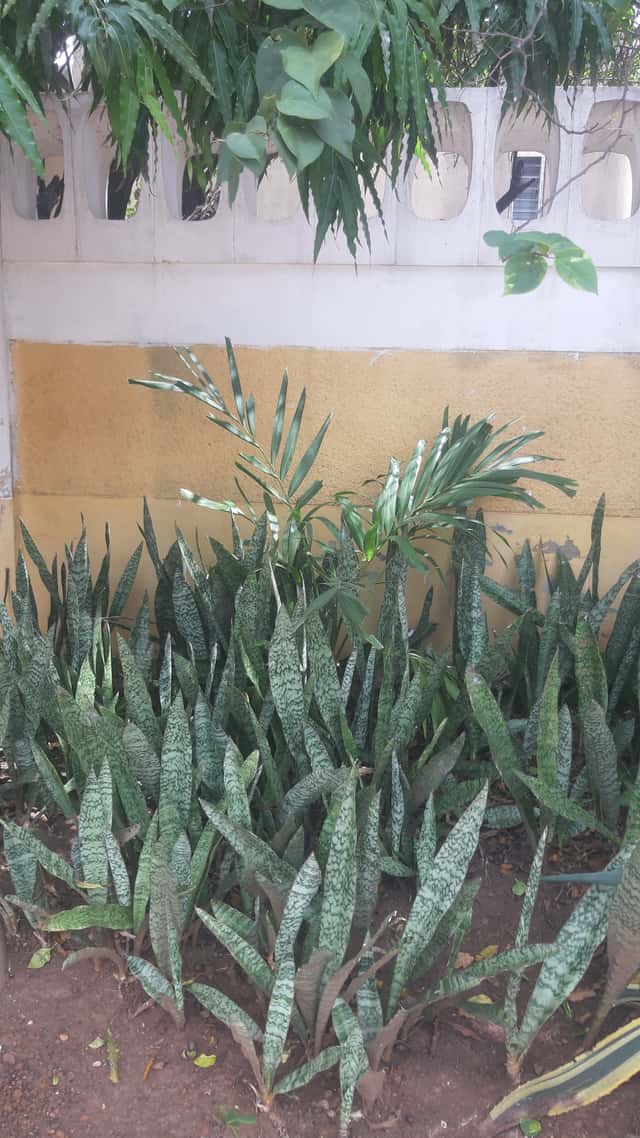
Dracaena trifasciata, commonly known as the Snake Plant or Mother-in-Law's Tongue, is an evergreen succulent perennial native to tropical West Africa, from Nigeria eastward to the Congo. Formerly classified as Sansevieria trifasciata and reclassified to the genus Dracaena in 2017 following molecular analysis, it is celebrated worldwide for its architectural upright leaves with distinctive gray-green cross-banding and bright yellow margins in variegated cultivars like 'Laurentii'. One of the most resilient houseplants in existence, it thrives under neglect and makes an ideal choice for beginners, offices, and low-light spaces.
How to Propagate Snake Plant?
Leaf cutting
Important: leaf cuttings from variegated cultivars (e.g., Laurentii) will revert to all-green plants. To preserve variegation, use division instead.
- 1 Cut a healthy leaf at the base using clean, sterilized scissors
- 2 Divide the leaf into 5–8 cm sections, marking the bottom of each section
- 3 Allow cuttings to callous for 1–2 days in open air
- 4 Insert sections bottom-end down into slightly moist cactus mix
- 5 Place in bright indirect light and water minimally
- 6 Roots develop in 4–8 weeks; small rosettes emerge from the base
Materials needed:
Rhizome division
Division is the preferred method when propagating variegated varieties, as it preserves all color patterns. Best performed during spring repotting.
- 1 Remove the plant from its pot and shake off excess soil
- 2 Identify offshoots (pups) connected to the main rhizome
- 3 Cut through the rhizome with a clean, sharp knife, ensuring each division has roots
- 4 Allow cut surfaces to dry for a few hours
- 5 Plant each division in individual pots with well-draining mix
- 6 Wait 1–2 weeks before first watering
Materials needed:
How Big Does Snake Plant Grow?
TLDR: Snake Plant can reach up to 1.2m tall with Slow growth rate.
Max height
1.2m
Spread
60cm
Growth rate
Slow
Foliage
Evergreen
Warning: Toxic Plant
This plant can be toxic if ingested. Keep out of reach of:
Plant Uses
Ornamental
Great for decoration
Air Purifying
Improves air quality
Is your plant showing symptoms?
Click on the symptom to discover possible causes:
What Diseases Commonly Affect Snake Plant?
TLDR: Snake Plant is susceptible to 11 known diseases. Monitor regularly for early detection.
Root Rot
Root rot is a serious fungal disease that affects the root system of plants, causing them to decay and die. It is primarily caused by overwatering, poor drainage, or soil-borne fungi such as Pythium, Phytophthora, Rhizoctonia, and Fusarium. The disease thrives in waterlogged conditions where roots are deprived of oxygen, making them susceptible to fungal infection.
Southern Blight
Southern blight is a devastating soilborne fungal disease caused by Athelia rolfsii (formerly Sclerotium rolfsii), affecting over 500 plant species including vegetables, ornamentals, and fruit crops. The fungus survives in soil through resting structures called sclerotia that resemble mustard seeds and can remain viable for years.
Anthracnose
Anthracnose is a fungal disease caused by fungi in the genus Colletotrichum that affects many plants, including vegetables, fruits, and trees. The disease thrives in cool, wet conditions, causing dark, sunken lesions on leaves, stems, flowers, and fruits.
Powdery Mildew
Powdery mildew is a common fungal disease caused by various fungi species including Erysiphe, Podosphaera, Oïdium, and Leveillula. It affects over 10,000 plant species worldwide. The disease thrives in warm, dry climates with high humidity and appears as a distinctive white powdery coating on plant surfaces.
Meaning & Symbolism
In West African tradition, the snake plant is believed to ward off evil spirits and attract good luck. In Feng Shui practice, it is placed near home entrances to create a protective energy field and attract positive chi. It symbolizes resilience, persistence, and enduring strength.
Fun Facts
The snake plant was reclassified from the genus Sansevieria to Dracaena in 2017 after DNA analysis confirmed they belong to the same evolutionary clade.
Its leaves were historically used in West Africa to make bowstring hemp — strong, durable fibers for bows, ropes, and baskets.
Unlike most plants, the snake plant uses CAM photosynthesis, absorbing CO2 and releasing oxygen at night — making it a popular choice for bedrooms.
NASA's 1989 Clean Air Study listed it among the top air-purifying houseplants, capable of removing formaldehyde, benzene, and xylene from indoor air.
Frequently asked questions
How often should I water my snake plant?
Is the snake plant toxic to cats and dogs?
What is the difference between Dracaena trifasciata and Sansevieria trifasciata?
Why are the tips of my snake plant's leaves turning brown?
Can a snake plant survive in a room with no windows?
Compare with similar plants
| Attribute | Difficulty | Light | Watering | Pet Safe |
|---|---|---|---|---|
| Field Maple | Easy | Bright indirect | 14d | ✓ |
| Silver Birch | Easy | Direct sun | 14d | ✓ |
| Common Blanketflower | Easy | Direct sun | 10d | ✓ |
| Cushion Bush | Easy | Direct sun | 14d | ✓ |





