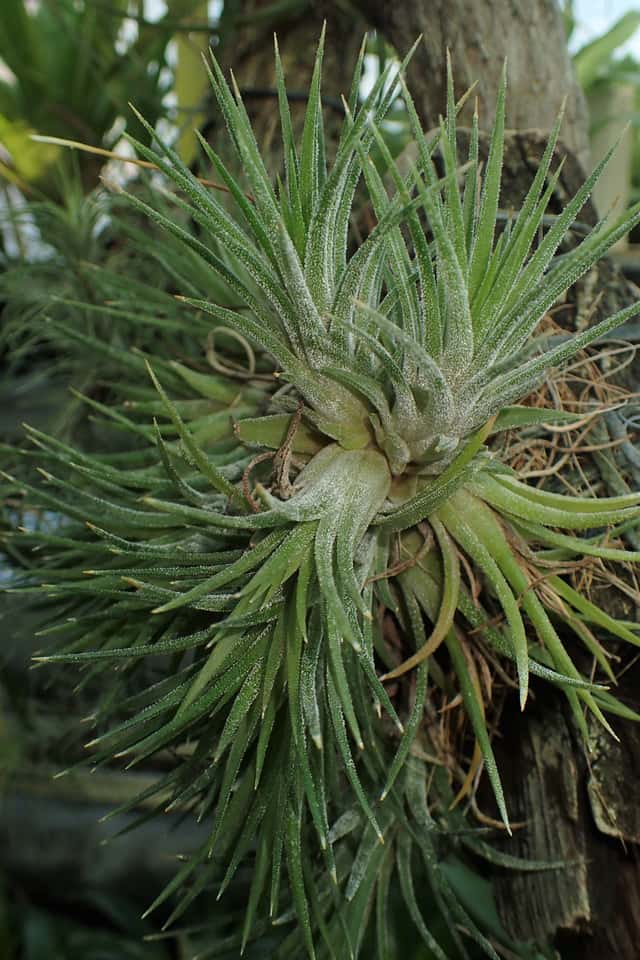
Bromeliaceae
Air Plant — The Plant That Grows Without Soil
Tillandsia
Soak in water for 20–30 minutes once a week and allow to dry completely in a well-ventilated spot within 4 hours. Prefers bright indirect light and good air circulation. Fertilize monthly with bromeliad fertilizer diluted to 1/4 strength.
Every 7 days
Partial shade
10° - 32°C
50% - 70%
Categories
What is Air Plant?
Air Plant (Tillandsia) is a easy-care plant from the Bromeliaceae family. Tillandsia is a genus of approximately 650 epiphytic plants in the Bromeliaceae family, native from the southern United States to Argentina. They require no soil, instead absorbing water and nutrients directly through their leaves via specialized structures called trichomes. Famous species include T...
Air Plant grows up to 2.1m, spread of 60cm, watering every 7 days, 10°C – 32°C, 50–70% humidity. It is suitable for indoor environments and safe for pets.
Unlike many tropical plants, Air Plant tolerates watering mistakes. Best for beginners. Unlike many popular species, Air Plant is safe to keep around pets. Without adequate drainage, root rot can develop within 14 days.
How to Care for Air Plant?
TLDR: Air Plant needs Partial shade, watering every 7 days, and temperatures between 10-32°C with 50-70% humidity.
How Often Should You Water Air Plant?
Submerge your air plant in filtered or rainwater for 20–30 minutes once a week. Afterward, shake off excess water, flip upside down, and let it dry completely before returning it to its display. Never allow water to pool at the base of the leaves.
How Much Light Does Air Plant Need?
Place in bright, indirect light about 1–3 meters from a window. Avoid harsh midday sun which can cause leaf burn. Fluorescent or LED grow lights work well in dimmer environments.
What Is the Best Soil for Air Plant?
No soil or substrate needed. If mounting, use non-toxic adhesive, plastic-coated wire, or fishing line. Never use copper wire — it is toxic to Tillandsia.
What Pot Should You Use for Air Plant?
Mount on wood, stone, glass, or ceramic. Open glass terrariums work excellently. Avoid sealed containers without ventilation and never use pots with soil.
Care Schedule
Fertilize
Every 30 days
Misting
Every 3 days
What Is Air Plant and Where Does It Come From?
Tillandsia is a genus of approximately 650 epiphytic plants in the Bromeliaceae family, native from the southern United States to Argentina. They require no soil, instead absorbing water and nutrients directly through their leaves via specialized structures called trichomes. Famous species include T. ionantha, T. xerographica, and Spanish Moss (T. usneoides).
How to Propagate Air Plant?
Pup Division
Pups naturally appear after the mother plant blooms. Keep both well-hydrated during the separation period.
- 1 Wait until the pup reaches 1/3 the size of the mother plant
- 2 Gently pull apart the pup by hand or with clean scissors
- 3 Let the base callus for a few hours before placing in its new spot
Materials needed:
Seed Propagation
Seed propagation is slow and challenging. Pup division is far more reliable for home growers.
- 1 Harvest ripe seeds after flowering
- 2 Scatter seeds on damp sphagnum moss
- 3 Maintain 70-80% humidity until germination
Materials needed:
How Big Does Air Plant Grow?
TLDR: Air Plant can reach up to 2.1m tall with Medium growth rate.
Max height
2.1m
Spread
60cm
Growth rate
Medium
Foliage
Evergreen
Plant Uses
Ornamental
Great for decoration
Air Purifying
Improves air quality
Is your plant showing symptoms?
Click on the symptom to discover possible causes:
What Diseases Commonly Affect Air Plant?
TLDR: Air Plant is susceptible to 11 known diseases. Monitor regularly for early detection.
Root Rot
Root rot is a serious fungal disease that affects the root system of plants, causing them to decay and die. It is primarily caused by overwatering, poor drainage, or soil-borne fungi such as Pythium, Phytophthora, Rhizoctonia, and Fusarium. The disease thrives in waterlogged conditions where roots are deprived of oxygen, making them susceptible to fungal infection.
Crown Rot
Crown rot is a serious fungal disease that attacks the crown (base) of the plant where the stem meets the soil. It is caused by various fungal pathogens including Phytophthora, Fusarium, and Rhizoctonia. The disease thrives in waterlogged conditions and can quickly spread to kill the entire plant if not addressed promptly.
Overwatering
Overwatering occurs when plants receive too much water, depriving roots of oxygen and causing root rot. This environmental stress is one of the most common causes of houseplant death, as waterlogged soil prevents roots from breathing and functioning properly.
Low Humidity Stress
Low humidity stress occurs when indoor air becomes too dry, causing plants to lose moisture faster than they can absorb it through their roots. This is especially common during winter heating periods, near radiators and heating vents, or in air-conditioned spaces. Tropical plants are particularly susceptible to low humidity damage.
Meaning & Symbolism
A symbol of freedom and resilience, the Tillandsia represents the ability to thrive without dependency — floating free and flourishing wherever it lands.
Fun Facts
Tillandsia can live for over 20 years under ideal conditions
The genus includes about 650 species, including the iconic Spanish Moss (T. usneoides)
Air plant roots serve only for anchoring — all nutrient absorption happens through the leaves
T. ionantha is one of the most widely cultivated species in the world
Frequently asked questions
How often should I water my air plant?
Do air plants need soil?
Are air plants toxic to cats and dogs?
Why are my air plant leaves curling?
Will my air plant flower?
Compare with similar plants
| Attribute | Difficulty | Light | Watering | Pet Safe |
|---|---|---|---|---|
| Field Maple | Easy | Bright indirect | 14d | ✓ |
| Silver Birch | Easy | Direct sun | 14d | ✓ |
| Common Blanketflower | Easy | Direct sun | 10d | ✓ |
| Cushion Bush | Easy | Direct sun | 14d | ✓ |





