Is LeafSnap Worth It? The Plant ID App Reviewed (and the Best Alternative)
There are actually two apps named LeafSnap, and you probably have the second one. Here is what independent tests revealed, whether you can use it for free, and when it is time to switch.
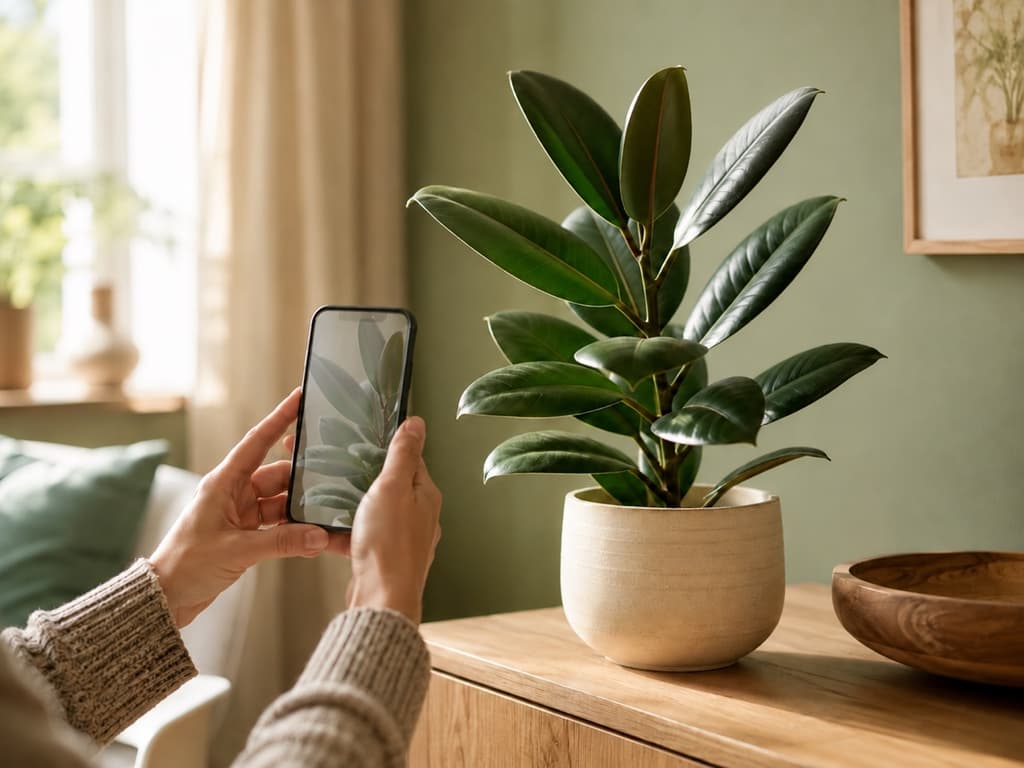
The LeafSnap plant identification app is one of the first results you will see when searching for a way to identify a plant from a photo. Before you download it, there are two things you should know that app store descriptions won't tell you: there are two completely different apps with this name, and the high accuracy advertised on the store page is not what free users actually get.
The short version: LeafSnap identifies plants from photos quickly and has a straightforward interface. In an independent test from 2022, it even ranked first among five popular apps. However, it has three major drawbacks: heavy ads on the free plan, three different official numbers for the size of its plant database, and the fact that its most accurate identification engine is locked behind a paywall.
First Things First: There Are Two Apps Named LeafSnap
This is a common source of confusion, leading many people to install one app thinking they downloaded the other.
Original LeafSnap | Plant Identifier: LeafSnap | |
|---|---|---|
Creators | Columbia University, University of Maryland, and Smithsonian Institution | Appixi Company Limited |
Launched | May 2011 | November 2019 |
Coverage | Trees of the Northeastern US and Canada, identified by leaf shape | Plants, flowers, mushrooms, and insects |
Model | Free academic research project | Free with ads, premium features requiring a subscription |
Current Status | No longer available on the App Store | This is the one you can download today |
The original was born as an electronic field guide from an academic consortium, featuring high-resolution images of leaves, flowers, fruits, seeds, and bark (Smithsonian Insider, May 2011). It no longer exists in the App Store: a search for "leafsnap" in the US store returns 14 results, and none of them are it.
The domain for the original project, leafsnap.com, is still online and still features the historical text about Columbia, Maryland, and the Smithsonian on its homepage. However, right below that paragraph, you will now find articles like "10 Workouts For Abs In 2025" and "How To Get Rid Of Neck Fat?". The navigation menu has sections for Fitness, General Health, and Men's Health. The domain has been repurposed as a weight-loss content site (verified on August 22, 2026).
In short, the LeafSnap you find in the app stores today is the commercial app developed by Appixi, launched on November 17, 2019. That is the app we are reviewing here.
What LeafSnap Does Well
It delivers on its core promise without any unnecessary complications: you take a photo, and it gives you a name in seconds. The interface is clean, featuring categories to explore and basic care guides.
And it has an independent test in its favor. In a 2022 comparison with six British wild plants, LeafSnap came in first among five apps, with 5 out of 6 points, ahead of PictureThis (4.9), PlantNet (4.3), Seek (1.1), and PlantSnap (0.7). The author highlighted that it correctly identified the most distinct species on the first try and came close on the difficult ones (Common by Nature, May 2022).
That test only used six plants, and the author referred to it as a casual Friday exercise. It is too small of a sample size to serve as a definitive verdict.
What Independent Tests Measured
Here is what exists in terms of published measurements, with dates and links. Each line is a different study, with a different flora, sample, and method.
Source | What tested | Result |
|---|---|---|
Long et al., 2023, Clinical Toxicology 61(7) | 16 species from the American Midwest, 4 apps (LeafSnap, PictureThis, Pl@ntNet, and PlantSnap) | An average of 76% accuracy for genus (95% CI 73–79) and 58% for species (95% CI 55–62), ranging from 94% to 34% depending on the app |
6 British wild plants, 5 apps | LeafSnap in first, 5 out of 6 points | |
user test with multiple testers | LeafSnap is left out of the recommendations due to accidental subscription and because it does not save the photo on the phone | |
LeafSnap's App Store and Google Play | material from the app itself | "98% accuracy" |
Three warnings about this table.
You cannot directly compare accuracy across different studies. The flora, samples, and criteria are completely different in each study, so saying one app is "more accurate" because it scored higher in a different test is a false comparison. You can only compare the rankings within each individual test.
The individual score for LeafSnap was not specified in the 2023 study abstract. The publicly available summary lists the average of the four apps combined and the extreme scores, rather than the specific breakdown for each app. We know it was one of the four tested, and the group average for species accuracy was 58%.
None of these studies tested common houseplants. All of them focused on trees and wild plants. If you are trying to identify a monstera in your living room, these numbers are simply the best available proxy, not a direct measure of houseplant performance. As far as we can find, there are no published accuracy tests specifically for houseplants.
Finally, the 98% accuracy claimed in the app stores does not come from any peer-reviewed, public study. It is a marketing figure, not a scientific statistic.
Where LeafSnap Falls Short
Here are four specific user complaints, backed by evidence.
The official numbers do not match up. The App Store and Google Play descriptions advertise a database of "400,000+ species". Meanwhile, the leafsnap.app homepage claims the app identifies "more than 32,000 taxa". To make things more confusing, the app's own website page about using the free version lists "access to a database of over 80,000 species" as a premium benefit. These are three wildly different numbers published simultaneously in official materials for the exact same app.
The best identification engine is paywalled. On that same page, under the premium benefits, it lists "advanced identification for more accurate results". This means the high accuracy advertised on the app store is not what free users actually experience. This page was published in September 2021 and remains active online.
Ads interrupt you before you see your plant. In the free version, the app requests permission to track your activity, asks to send notifications, and displays full-screen ads. The plant list itself is also cluttered with video ads. The app itself advertises the removal of these ads as a primary reason to upgrade to the paid tier.
The photos you take are not saved to your phone. This was a major point of frustration for the Wirecutter testers in July 2025. One reviewer noted that this was an automatic dealbreaker because you have to close the app and take the photo again with your native camera to save it. The same review highlighted the risk of accidental subscriptions and described the user interface as unintuitive.
None of this makes LeafSnap a bad app, but it certainly promises more accuracy on its store page than it delivers for free.
Is LeafSnap Free?
Yes, but only partially. You can use the app without paying, but you will have to navigate frequent ads to identify your plants. According to the app's own documentation, upgrading to the paid plan removes ads, unlocks plant disease diagnosis, enables mushroom and insect identification, provides a watering calculator, and grants access to the advanced identification engine for more accurate results.
Free options are not hard to find in this category. Bloom offers a free tier with 2 free identifications per month and a watering schedule, while PlantNet is completely free, funded entirely by French public research institutions. Subscription prices vary by region and can change without notice, so always check your local app store for current pricing.
Bloom: When You Need Answers That Go Beyond Just a Name
Bloom is our own app, so feel free to read this section with a healthy dose of skepticism and check it out on the App Store for yourself.
The Bloom app solves a different problem than LeafSnap. While it also identifies plants from photos, the real value of the product begins after the identification. Every plant you identify is added to your personal collection, which automatically generates a care schedule, calculates the exact water requirements in milliliters, alerts you to pet toxicity, and diagnoses plant diseases from photos.
The identification runs on Plant.id, by Kindwise, which reports a 93% accuracy rate verified by independent universities. This number is the accuracy of the recognition engine, measured in a controlled test, and not a rating of the entire app in your kitchen.
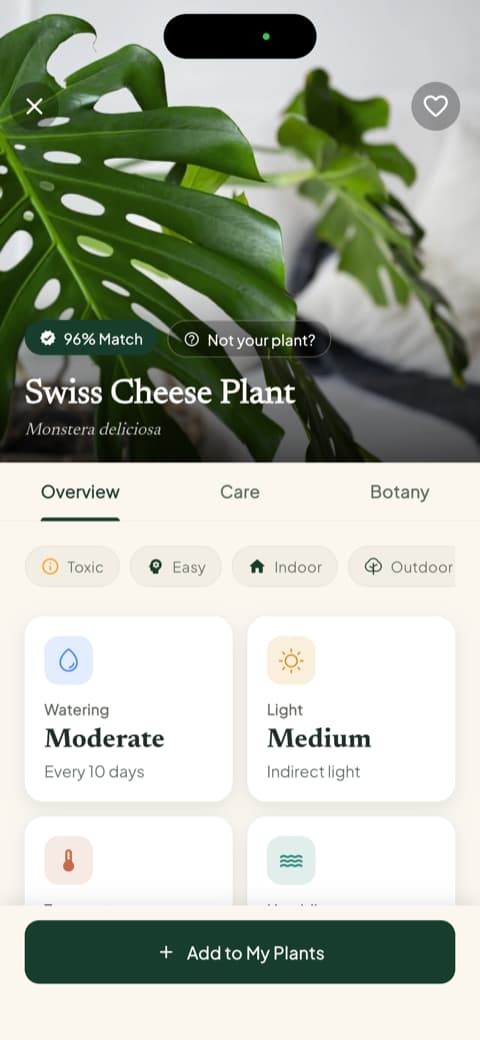
When you open the app, you are taken straight to your saved plants, showing their photos, health status, and any pending care tasks. There are no social feeds or ads cluttering your screen.
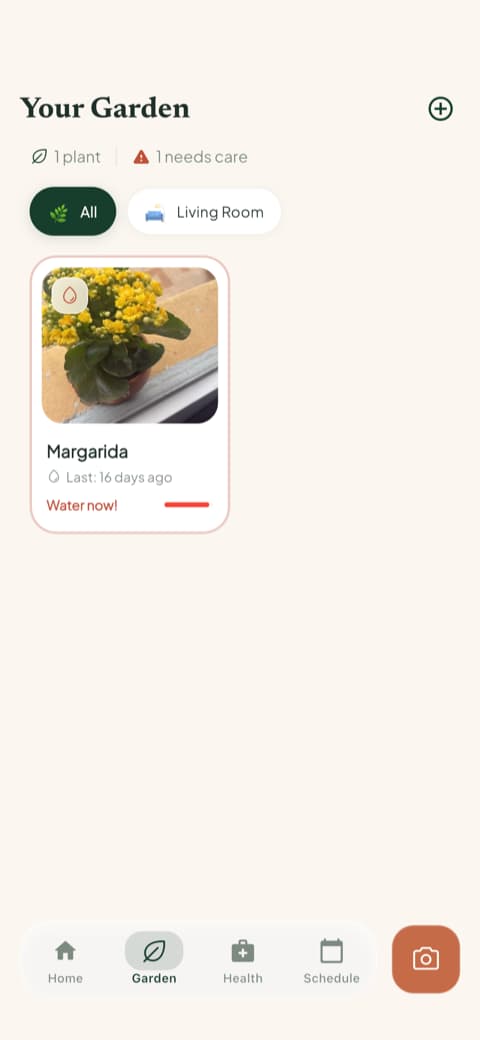
The quick actions menu houses your daily plant care tools: photo-based disease diagnosis, a room light meter, toxicity checks, and a weed identifier.
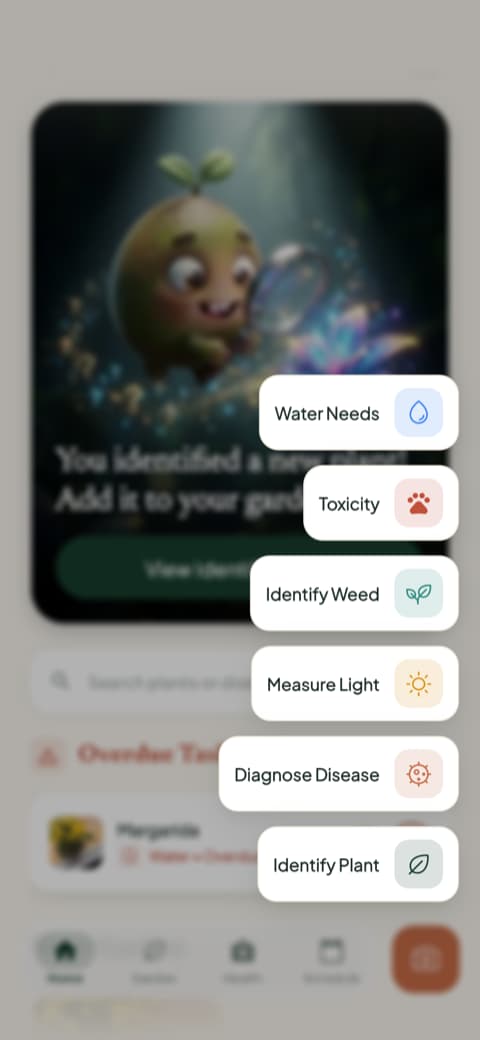
The free tier includes 2 identifications per month and the watering schedule. Unlimited identifications and photo disease diagnosis require a subscription. Bloom is currently available exclusively for iPhone.
Cats, Dogs, and Kids: What an App Can Actually Tell You
For every plant you identify, Bloom immediately shows whether it is toxic to cats, dogs, or children directly on the plant's profile page.
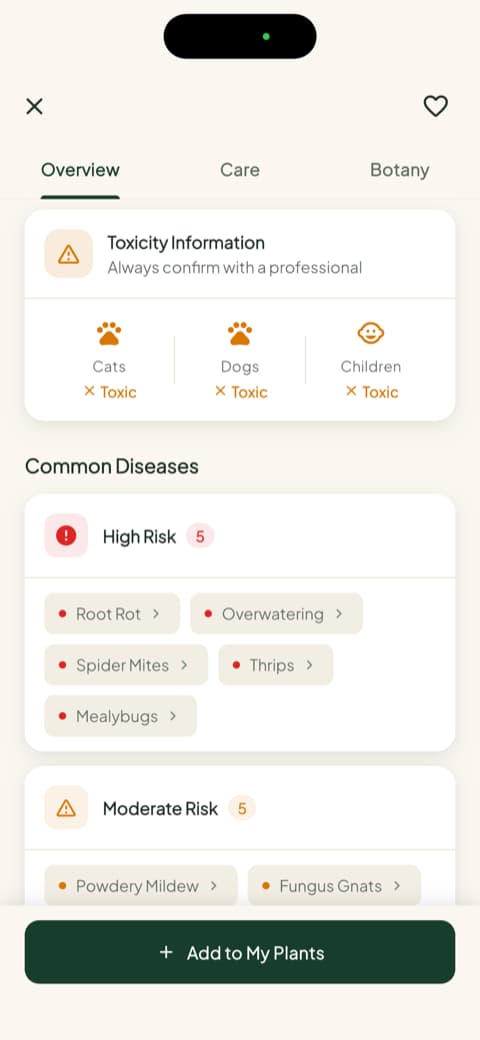
In the study published in Clinical Toxicology in 2023, five out of eleven potentially toxic species were identified as edible by at least one of the four tested apps. The authors' conclusion is direct: at the moment, apps cannot be used to safely identify edible plants (Long et al., 2023).
You should always treat toxicity warnings in any app as an initial safety filter, never as a definitive medical guarantee. If you have pets or small children, verify the species with a reliable botanical source before deciding where to place your plant. This verification is especially important for common houseplants, where safety classifications can vary.
Watering in Milliliters, Not Guesswork
Overwatering is a far more common killer of houseplants than underwatering. Every plant you add to Bloom receives a health score and a recommended watering volume, calculated specifically for that species, its pot size, and the lighting of the room it is in.
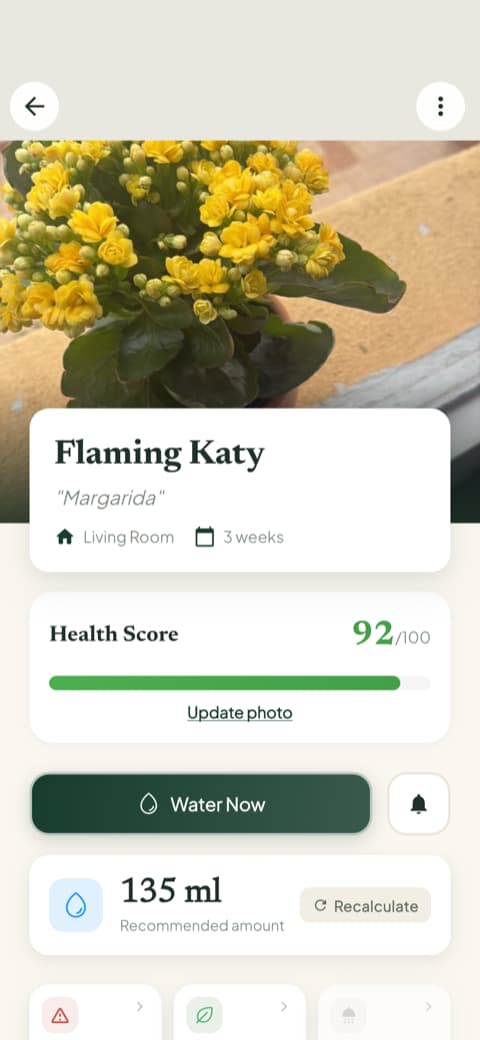
The care schedule organizes your overdue tasks, today's chores, and upcoming needs all on a single screen.
LeafSnap vs. Bloom: Side-by-Side Comparison
LeafSnap (Appixi) | Bloom | |
|---|---|---|
Identifies by photo | Yes | Yes, powered by Plant.id |
After identification features | Care guides locked behind paywall | Collection, care schedule, and watering in milliliters |
Photo-based disease diagnosis | Premium feature | Premium feature |
Pet toxicity warnings | Premium feature | Included on every plant profile |
Ads in the free version | Yes, including full-screen video ads | No ads |
Free tier | Yes, ad-supported | Yes, includes 2 identifications per month and care schedule |
App Store rating | 4.45 with 6,791 reviews | 4.75 with 1,049 reviews |
Supported platforms | iOS and Android | iOS only |
The ratings in the last two rows are our own measurement, taken on August 22, 2026, across the same 30 App Store storefronts and using the same method for both apps: the sum of the ratings from each storefront and a weighted average based on them. The rating that appears in the US storefront alone is not the global rating of the app, and that is the one that almost every comparison copies. On Google Play, LeafSnap has a 4.4 rating with 13.8 thousand reviews and more than 5 million downloads.
If you are actively choosing between these two options, you can read our direct comparison: LeafSnap ou Bloom, lado a lado. For a broader look at the market, check out our guide on os melhores apps para identificar plantas. If you are looking to replace a different subscription app, we also have an article on the best alternativa ao PictureThis.
Frequently Asked Questions
Is LeafSnap a good app?
It is a capable identification tool with an easy-to-use interface. In an independent 2022 test using six British wild plants, it placed first among five competitors. Its main downsides are the heavy ads in the free version, inconsistent official database numbers, and the fact that its most accurate identification engine is locked behind a subscription.
Is LeafSnap free to use?
Yes, you can use it for free with ads. According to the developer's materials, upgrading to the paid plan removes ads and unlocks disease diagnosis, mushroom and insect identification, and the advanced identification engine for more precise results. Subscription pricing varies by country, so check your local app store for details.
Which plant identification app is the most accurate?
Accuracy depends entirely on the specific plant and the study. In a 2023 study testing 16 North American species, the tested apps averaged a 58% accuracy rate for species identification, with individual scores ranging from 34% to 94%. In a smaller 2022 test of six British plants, LeafSnap came out on top. You cannot directly compare results across different studies.
Can I rely on an app to know if a plant is toxic to my cat?
Not on its own. In a 2023 study published in Clinical Toxicology, five out of eleven toxic plant species were incorrectly identified as edible by at least one of the four apps tested. Always treat app alerts as a preliminary check, and verify the species with a trusted botanical reference before letting your pet near it.
Does the Smithsonian LeafSnap app still exist?
No, not as a functional mobile app. The original academic LeafSnap app, developed in 2011 by Columbia, the University of Maryland, and the Smithsonian, has been removed from the App Store. While the project's website remains online for historical purposes, it now hosts weight-loss articles. The LeafSnap app currently on the store is a commercial product launched by Appixi in 2019.
The Verdict
If you just want to find the name of a plant you saw on a walk every once in a while, and you do not mind closing full-screen ads, LeafSnap is a solid, free tool for the job. Just take the 98% accuracy claim with a grain of salt, as it is a marketing number and the developer reserves its advanced identification engine for paying subscribers.
If you want to care for plants in your home and need more than just a name, you need an app that keeps working after the photo is taken. You will want a care schedule, precise watering volumes, toxicity alerts, and a diagnostic tool for when leaves start looking unhealthy. That is exactly what Bloom is built for, and you can try the free version to see if it fits your routine.
Bloom is currently available exclusively for iPhone.
Related articles
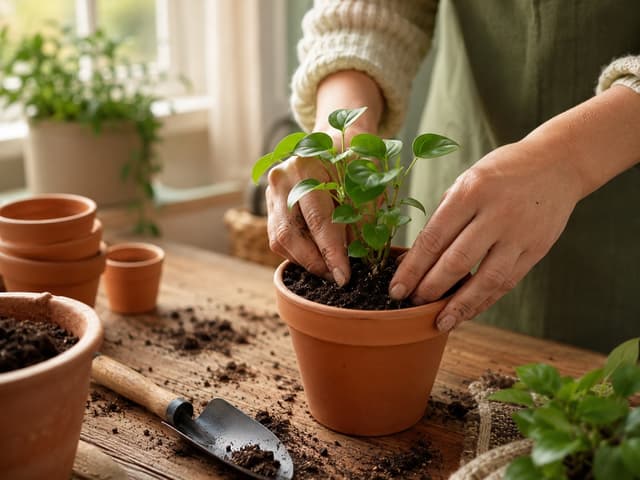
The 6 Best Plant Apps for Beginners
New to plants and worried you'll kill them? Here are the six best plant apps for beginners, tested for how easy they make identifying and caring for your first plants.
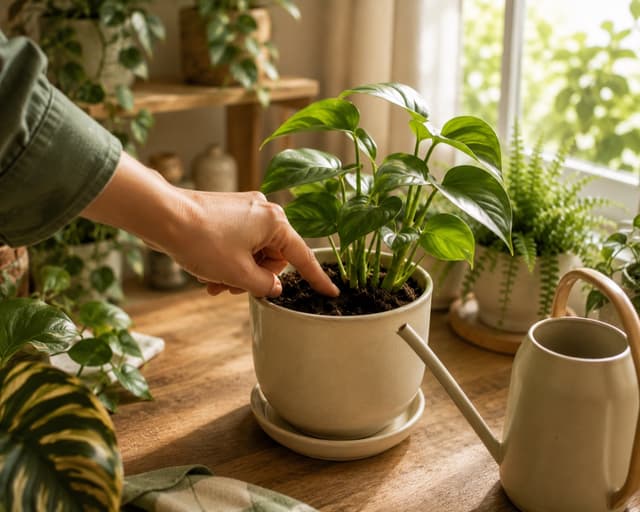
The 5 Best Apps to Remember to Water Your Plants
Always forgetting to water your plants? Here are the 5 best apps that remember for you, tested for smart reminders that actually fit your routine.
The 7 Best Apps for People Who Always Kill Their Plants
If your plants keep dying no matter how hard you try, these 7 apps were made for you. Here are the ones that actually help keep a plant alive.