Asphodelaceae
Tree Aloe: Full Sun Plant
Aloidendron
Tree aloes are low-maintenance succulents best grown outdoors in full sun with excellent drainage. Water sparingly — monthly in winter, and every 2–3 weeks during the growing season. They are highly drought-tolerant once established and resent waterlogged soil. Protect young plants from frost.
Every 21 days
Direct sun
4° - 38°C
20% - 60%
Categories
What is Tree Aloe?
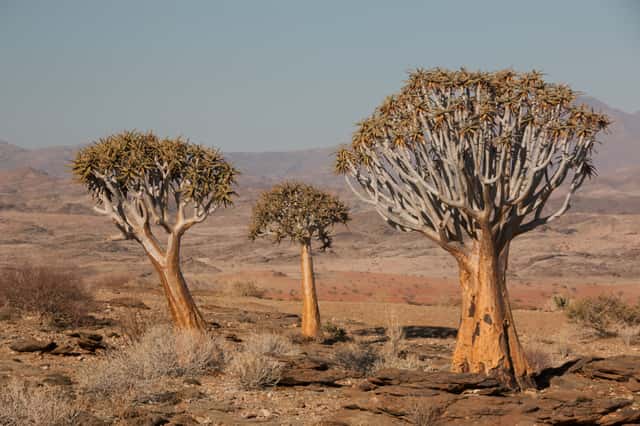
Tree Aloe (Aloidendron) is a easy-care plant from the Asphodelaceae family. Aloidendron is a genus of spectacular arborescent (tree-forming) succulents native to southern and eastern Africa, belonging to the family Asphodelaceae. The genus comprises six accepted species, including the iconic Quiver Tree (A. dichotomum) and the Giant Tree Aloe (A. barberae), Africa's largest...
Tree Aloe grows up to 20.0m, spread of 600cm, watering every 21 days, 4°C – 38°C, 20–60% humidity. It is not suitable for indoor environments and not safe for pets.
Unlike many tropical plants, Tree Aloe tolerates watering mistakes. Best for beginners. Without precautions, ingestion can cause irritation in pets. Keep out of reach of cats and dogs.
How to Care for Tree Aloe?
TLDR: Tree Aloe needs Direct sun, watering every 21 days, and temperatures between 4-38°C with 20-60% humidity.
How Often Should You Water Tree Aloe?
Water deeply but infrequently. During the growing season (spring–summer), water every 2–3 weeks; reduce to once monthly or less in winter. Always allow the soil to dry out completely between waterings. Never let roots sit in standing water.
How Much Light Does Tree Aloe Need?
Tree aloes need maximum sunlight — at least 6–8 hours of direct sun per day. They will languish and fail to flower without strong, unobstructed light. Plant in an open, south- or west-facing position away from shade structures.
What Is the Best Soil for Tree Aloe?
Plant in very well-draining, sandy or gritty soil. A mix of native sandy loam with added coarse grit or pumice works well. Avoid clay or water-retentive soils, which cause root rot. In containers, use a dedicated cactus and succulent potting mix.
What Pot Should You Use for Tree Aloe?
Large terracotta or concrete pot with drainage holes; or plant directly in the ground. Containers must have generous drainage to prevent root rot.
Care Schedule
Fertilize
Every 90 days
What Is Tree Aloe and Where Does It Come From?
Aloidendron is a genus of spectacular arborescent (tree-forming) succulents native to southern and eastern Africa, belonging to the family Asphodelaceae. The genus comprises six accepted species, including the iconic Quiver Tree (A. dichotomum) and the Giant Tree Aloe (A. barberae), Africa's largest succulent tree reaching up to 20 metres tall. These majestic plants develop thick, fibrous trunks topped with dense rosettes of blue-green or bright-green succulent leaves, producing dramatic tubular flower spikes in shades of yellow, pink, orange, or red during late autumn and winter. Long-lived and drought-adapted, tree aloes are celebrated as focal specimens in xeriscape, Mediterranean, and South African-style gardens.
How Big Does Tree Aloe Grow?
TLDR: Tree Aloe can reach up to 20.0m tall with Slow growth rate.
Max height
20.0m
Spread
6.0m
Growth rate
Slow
Foliage
Evergreen
Warning: Toxic Plant
This plant can be toxic if ingested. Keep out of reach of:
Plant Uses
Ornamental
Great for decoration
Is your plant showing symptoms?
Click on the symptom to discover possible causes:
What Diseases Commonly Affect Tree Aloe?
TLDR: Tree Aloe is susceptible to 7 known diseases. Monitor regularly for early detection.
Root Rot
Root rot is a serious fungal disease that affects the root system of plants, causing them to decay and die. It is primarily caused by overwatering, poor drainage, or soil-borne fungi such as Pythium, Phytophthora, Rhizoctonia, and Fusarium. The disease thrives in waterlogged conditions where roots are deprived of oxygen, making them susceptible to fungal infection.
Scale Insects
Scale insects are small sap-sucking pests that appear as brown, shell-like bumps on plant stems and leaves. There are over 25 species, divided into armored (hard) and unarmored (soft) scales. They feed by piercing plant tissue and extracting sap, which weakens the plant and can lead to yellowing, stunted growth, and even death if left untreated. They also excrete honeydew, which attracts ants and promotes sooty mold growth.
Aphids
Aphids are small, soft-bodied, pear-shaped insects (1/16 to 1/8 inch long) that feed by sucking nutrient-rich sap from plants. They reproduce rapidly and can quickly weaken plants, causing distorted growth and transmitting plant viruses. Aphids come in various colors including green, black, red, yellow, brown, and gray. They secrete honeydew, a sticky substance that attracts ants and encourages sooty mold growth.
Mealybugs
Mealybugs are small, soft-bodied insects covered with a white, waxy, cottony material. They are common pests of houseplants and outdoor plants in mild climates. These sap-sucking insects feed on plant tissue, causing damage, stunted growth, and can lead to plant death if left untreated. They produce sticky honeydew which attracts sooty mold.
Fun Facts
Aloidendron barberae is Africa's largest succulent tree, capable of growing to 20 metres tall with a trunk over 1 metre in diameter.
The Quiver Tree (A. dichotomum) gets its name from the San people of southern Africa, who historically hollowed out its branches to make quivers for their arrows.
Quiver trees are estimated to live between 100 and 145 years in the wild.
Tree aloes are important nectar sources for sunbirds, sugarbirds, and bees during winter when few other flowers are available.
Aloidendron was separated from the genus Aloe in 2014, when molecular studies confirmed that arborescent tree aloes form a distinct evolutionary lineage.
Frequently asked questions
How fast do tree aloes grow?
Can I grow Aloidendron in a pot?
Are tree aloes frost hardy?
Do tree aloes need much water?
Compare with similar plants
| Attribute | Difficulty | Light | Watering | Pet Safe |
|---|---|---|---|---|
| Field Maple | Easy | Bright indirect | 14d | ✓ |
| Silver Birch | Easy | Direct sun | 14d | ✓ |
| Cushion Bush | Easy | Direct sun | 14d | ✓ |
| Peruvian peppertree | Easy | Direct sun | 14d | ⚠️ |