Solanaceae
Angel's Trumpet (Brugmansia): Care & Growing Guide
Brugmansia
Plant in a sunny to partly shaded location with rich, well-draining soil. Water frequently, keeping soil evenly moist but never waterlogged. Fertilize weekly during the growing season. Grows well in large containers. Always wear GLOVES when handling — all parts are HIGHLY TOXIC.
Every 3 days
Direct sun
10° - 32°C
50% - 70%
Categories
What is Angel's Trumpet?
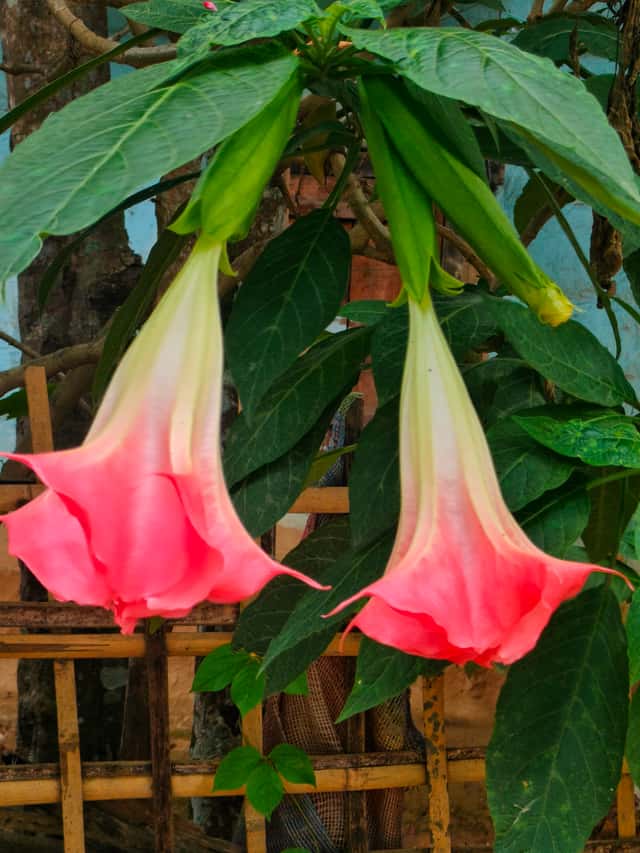
Angel's Trumpet (Brugmansia) is a medium-care plant from the Solanaceae family. Brugmansia is a genus of tropical shrubs and small trees in the Solanaceae family, native to the Andean regions of South America (Ecuador, Colombia, Peru, Bolivia, Chile). Renowned for its spectacular, pendulous trumpet-shaped flowers up to 50 cm long with an intoxicating fragrance that intensifies...
Angel's Trumpet grows up to 6.0m, spread of 300cm, watering every 3 days, 10°C – 32°C, 50–70% humidity. It is suitable for indoor environments and not safe for pets.
Without precautions, ingestion can cause irritation in pets. Keep out of reach of cats and dogs. Without adequate drainage, root rot can develop within 7 days.
How to Care for Angel's Trumpet?
TLDR: Angel's Trumpet needs Direct sun, watering every 3 days, and temperatures between 10-32°C with 50-70% humidity.
How Often Should You Water Angel's Trumpet?
Water every 2–4 days during summer; in hot weather, daily watering may be needed. Drooping leaves signal thirst. Reduce watering significantly in winter if the plant goes dormant. Never allow water to pool at the roots.
How Much Light Does Angel's Trumpet Need?
Requires full sun (6+ hours of direct light) for best flowering. In very hot climates, afternoon shade prevents leaf scorch. Low-light plants produce few or no blooms.
What Is the Best Soil for Angel's Trumpet?
Use rich, organic, well-draining soil. An azalea/camellia mix enriched with compost works excellently. Avoid heavy clay soils.
What Pot Should You Use for Angel's Trumpet?
Large terracotta or fiberglass pot (40–60 cm diameter) with generous drainage holes. The plant grows quickly and needs ample root space.
Care Schedule
Fertilize
Every 7 days
Repot
Every 365 days
What Is Angel's Trumpet and Where Does It Come From?
Brugmansia is a genus of tropical shrubs and small trees in the Solanaceae family, native to the Andean regions of South America (Ecuador, Colombia, Peru, Bolivia, Chile). Renowned for its spectacular, pendulous trumpet-shaped flowers up to 50 cm long with an intoxicating fragrance that intensifies at dusk. All parts of the plant are highly toxic due to tropane alkaloids (scopolamine, hyoscyamine, atropine). Brugmansia is extinct in the wild — every known specimen is cultivated.
How to Propagate Angel's Trumpet?
Stem Cutting
Always wear gloves — the entire plant is toxic. If rooting in water, change it weekly. Water propagation works very well for Brugmansia.
- 1 Cut a semi-hardwood stem 15–20 cm long with at least 2 nodes
- 2 Remove lower leaves, keeping only 2–3 at the tip
- 3 Place in water or moist rooting medium (sand + perlite) in a warm location
- 4 Keep lightly moist until roots develop
Materials needed:
How Big Does Angel's Trumpet Grow?
TLDR: Angel's Trumpet can reach up to 6.0m tall with Fast growth rate.
Max height
6.0m
Spread
3.0m
Growth rate
Fast
Foliage
Evergreen
Warning: Toxic Plant
This plant can be toxic if ingested. Keep out of reach of:
Plant Uses
Ornamental
Great for decoration
Is your plant showing symptoms?
Click on the symptom to discover possible causes:
What Diseases Commonly Affect Angel's Trumpet?
TLDR: Angel's Trumpet is susceptible to 16 known diseases. Monitor regularly for early detection.
Root Rot
Root rot is a serious fungal disease that affects the root system of plants, causing them to decay and die. It is primarily caused by overwatering, poor drainage, or soil-borne fungi such as Pythium, Phytophthora, Rhizoctonia, and Fusarium. The disease thrives in waterlogged conditions where roots are deprived of oxygen, making them susceptible to fungal infection.
Pythium Root Rot
Pythium root rot is a serious fungal disease caused by various Pythium species including P. aphanidermatum, P. ultimum, and P. irregulare. These water molds are present in practically all cultivated soils and attack plant roots under wet conditions, causing rapid wet rot that can extend into the stem. The disease is favored by poor drainage, overwatering, and specific temperatures depending on the species.
Phytophthora Blight
Devastating fungal disease caused by Phytophthora species (primarily P. capsici and P. infestans), famously responsible for the Irish Potato Famine in the 1840s. Affects all plant parts including roots, stems, leaves, and fruits in warm, wet conditions. The pathogen is technically an oomycete (water mold) that thrives in saturated soils and can survive in soil for 5+ years.
Botrytis
Meaning & Symbolism
In Andean cultures, Brugmansia was a sacred plant used by shamans for spiritual journeys and communication with ancestors. It symbolizes the threshold between the living world and the spirit realm.
Fun Facts
Brugmansia is extinct in the wild — all known plants exist only in human cultivation since pre-Columbian times
The flowers open at dusk and release their strongest fragrance at night to attract hawk moth pollinators
Andean shamans used Brugmansia alkaloids in ritual ceremonies for thousands of years
A single mature plant can produce hundreds of flowers simultaneously at peak bloom
Frequently asked questions
Is Angel's Trumpet toxic to dogs and cats?
How often should I water my Brugmansia?
Why is my Angel's Trumpet not blooming?
Can I grow Brugmansia in a container?
Is Brugmansia the same as Datura?
Compare with similar plants
| Attribute | Difficulty | Light | Watering | Pet Safe |
|---|---|---|---|---|
| Dark Fieldcap | Medium | Low light | 2d | ⚠️ |
| Azalea | Medium | Partial shade | 3d | ⚠️ |
| Bougainvillea | Medium | Direct sun | 7d | ⚠️ |
| Wild Lettuce | Medium | Direct sun | 7d | ⚠️ |



