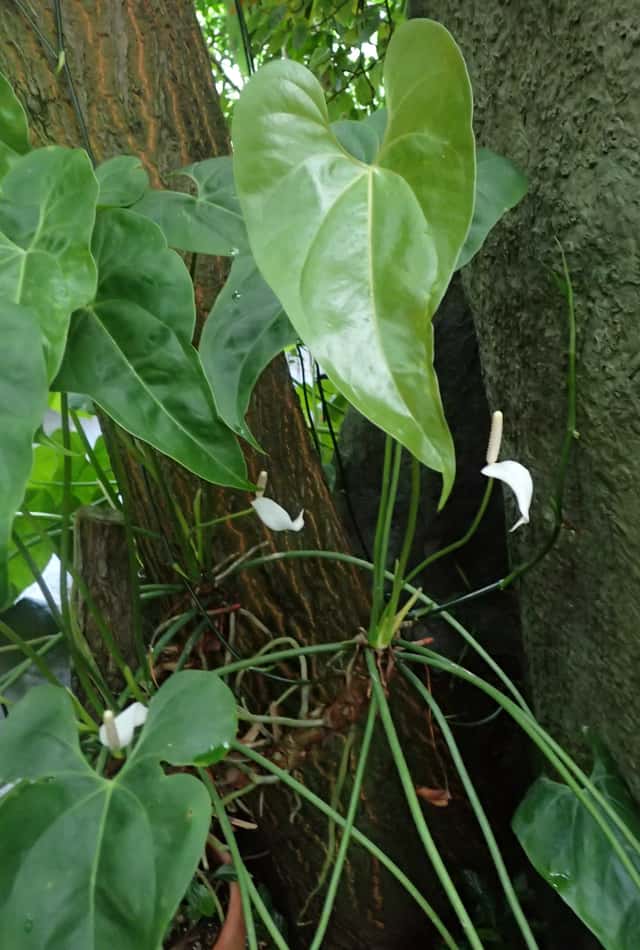
Araceae
How to Care for Water-Lily Anthurium (Anthurium nymphaeifolium)
Anthurium nymphaeifolium
Keep in bright indirect light, water when the top third of soil dries out, and maintain high humidity (70-90%). Avoid cold drafts and direct sunlight. Fertilize monthly during spring and summer.
Every 7 days
Partial shade
16° - 30°C
70% - 90%
Categories
What is Water-Lily Anthurium?
Water-Lily Anthurium (Anthurium nymphaeifolium) is a medium-care plant from the Araceae family. Anthurium nymphaeifolium is a rare and striking species native to northern South America, particularly Venezuela and Colombia. It produces large, peltate (shield-shaped) leaves arranged in an impressive rosette, resembling the leaves of water lilies (Nymphaea). This tropical foliage plant is highly...
Water-Lily Anthurium grows up to 90cm, spread of 100cm, watering every 7 days, 16°C – 30°C, 70–90% humidity. It is suitable for indoor environments and not safe for pets.
Without precautions, ingestion can cause irritation in pets. Keep out of reach of cats and dogs. Without adequate drainage, root rot can develop within 14 days.
How to Care for Water-Lily Anthurium?
TLDR: Water-Lily Anthurium needs Partial shade, watering every 7 days, and temperatures between 16-30°C with 70-90% humidity.
How Often Should You Water Water-Lily Anthurium?
Water approximately every 7 days when the top 3-4 cm of soil are dry. Avoid waterlogging — always use a pot with drainage holes. Reduce watering frequency in winter.
How Much Light Does Water-Lily Anthurium Need?
Prefers bright indirect light between 2,000 and 10,000 lux. Avoid direct sun which can scorch the large leaves. Best placed near an east- or north-facing window with filtered light.
What Is the Best Soil for Water-Lily Anthurium?
Use a well-draining, organic-rich mix: combine orchid bark, perlite, and peat or coco coir. Ideal pH between 5.5 and 6.5.
What Pot Should You Use for Water-Lily Anthurium?
Terracotta or ceramic pot with drainage holes. Avoid plastic pots that retain excess moisture. Medium to large size to accommodate the spreading rosette.
Care Schedule
Fertilize
Every 30 days
Misting
Every 3 days
Repot
Every 365 days
What Is Water-Lily Anthurium and Where Does It Come From?
Anthurium nymphaeifolium is a rare and striking species native to northern South America, particularly Venezuela and Colombia. It produces large, peltate (shield-shaped) leaves arranged in an impressive rosette, resembling the leaves of water lilies (Nymphaea). This tropical foliage plant is highly prized by collectors for its exotic, architectural appearance.
How to Propagate Water-Lily Anthurium?
Clump division
Divide in spring during active growth. Dust cuts with activated charcoal to prevent infection.
- 1 Carefully remove the plant from its pot
- 2 Separate offsets with intact roots using a sterilized knife
- 3 Plant each division in fresh, moist substrate
- 4 Keep in a humid location with indirect light until established
Materials needed:
Stem cutting
Use rooting hormone powder to improve success rates. Maintain humidity above 80%.
- 1 Cut a healthy stem with at least one node and one leaf
- 2 Allow the cut end to dry for a few hours
- 3 Plant in moist perlite and sphagnum moss mix
- 4 Keep in a humidity tent at 22-28°C
Materials needed:
How Big Does Water-Lily Anthurium Grow?
TLDR: Water-Lily Anthurium can reach up to 90cm tall with Medium growth rate.
Max height
90cm
Spread
1.0m
Growth rate
Medium
Foliage
Evergreen
Warning: Toxic Plant
This plant can be toxic if ingested. Keep out of reach of:
Plant Uses
Ornamental
Great for decoration
Air Purifying
Improves air quality
Is your plant showing symptoms?
Click on the symptom to discover possible causes:
What Diseases Commonly Affect Water-Lily Anthurium?
TLDR: Water-Lily Anthurium is susceptible to 6 known diseases. Monitor regularly for early detection.
Anthracnose
Anthracnose is a fungal disease caused by fungi in the genus Colletotrichum that affects many plants, including vegetables, fruits, and trees. The disease thrives in cool, wet conditions, causing dark, sunken lesions on leaves, stems, flowers, and fruits.
Bacterial Blight
Bacterial blight is a serious plant disease caused by pathogenic bacteria that enters plants through wounds or natural openings. It spreads rapidly in warm, wet conditions and can cause significant damage to leaves, stems, and flowers. The bacteria are transmitted by water splash, contaminated tools, and insects.
Root Rot
Root rot is a serious fungal disease that affects the root system of plants, causing them to decay and die. It is primarily caused by overwatering, poor drainage, or soil-borne fungi such as Pythium, Phytophthora, Rhizoctonia, and Fusarium. The disease thrives in waterlogged conditions where roots are deprived of oxygen, making them susceptible to fungal infection.
Spider Mites
Spider mites are tiny arachnids (less than 1/20 inch long) related to spiders and ticks that feed on plant sap. They thrive in hot, dry conditions and can cause significant damage to ornamental and vegetable plants. During severe infestations, crop losses can reach 14% or higher as these pests disrupt vital plant processes including photosynthesis, carbon dioxide absorption, and transpiration.
Meaning & Symbolism
Symbol of hospitality, abundance, and tropical exuberance in the cultures of northern South America.
Fun Facts
The epithet 'nymphaeifolium' means 'water-lily leaf' in Latin, referring to the resemblance of its leaves to those of the water lily (Nymphaea)
In the wild, this species can form rosettes over 1 meter in diameter
It is one of the few Anthurium species with truly peltate leaves, where the petiole attaches to the center of the leaf blade rather than the edge
Native to humid tropical forests of Venezuela and Colombia where it grows as an epiphyte or terrestrial plant
Frequently asked questions
How often should I water Anthurium nymphaeifolium?
Is Anthurium nymphaeifolium toxic to pets?
What light does Anthurium nymphaeifolium need?
Why are the leaves on my Anthurium turning yellow?
How often should I fertilize?
Compare with similar plants
| Attribute | Difficulty | Light | Watering | Pet Safe |
|---|---|---|---|---|
| Dark Fieldcap | Medium | Low light | 2d | ⚠️ |
| Azalea | Medium | Partial shade | 3d | ⚠️ |
| Bougainvillea | Medium | Direct sun | 7d | ⚠️ |
| Wild Lettuce | Medium | Direct sun | 7d | ⚠️ |



