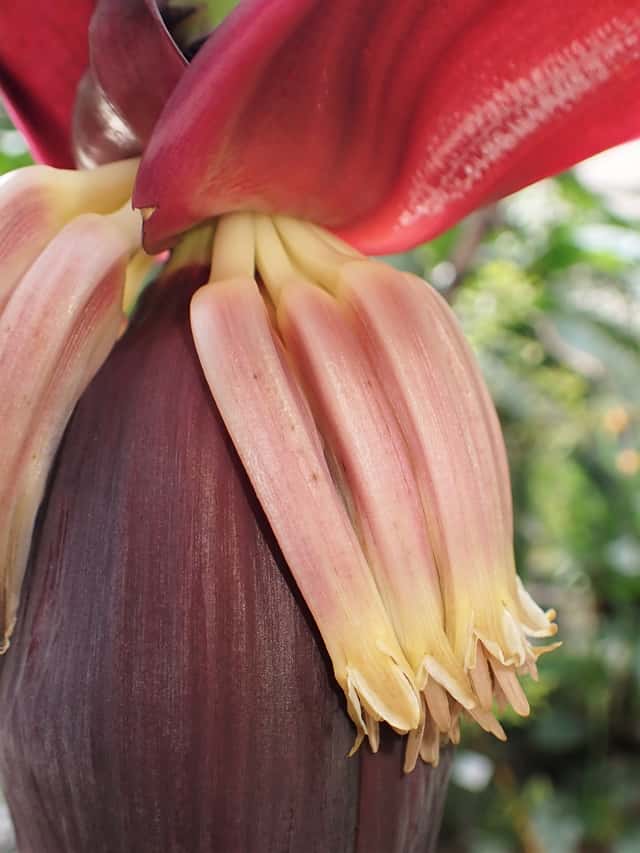
Musaceae
Wild Banana: Edible Plant
Musa acuminata
Provide full sun, consistent moisture, and well-draining fertile soil. Protect from strong winds to prevent leaf tearing. Fertilise monthly during the growing season.
Every 4 days
Direct sun
10° - 40°C
50% - 80%
Categories
What is Wild Banana?
Wild Banana (Musa acuminata) is a medium-care plant from the Musaceae family. Musa acuminata is the wild ancestor of most edible banana cultivars. Native to Southeast Asia, it is a fast-growing, herbaceous perennial that can reach 3–5 m tall. Its large paddle-shaped leaves and arching flower stalks make it a dramatic tropical statement plant. Unlike commercial bananas, wild s...
Wild Banana grows up to 5.0m, spread of 300cm, watering every 4 days, 10°C – 40°C, 50–80% humidity. It is suitable for indoor environments and safe for pets.
Unlike many popular species, Wild Banana is safe to keep around pets. Without adequate drainage, root rot can develop within 8 days.
How to Care for Wild Banana?
TLDR: Wild Banana needs Direct sun, watering every 4 days, and temperatures between 10-40°C with 50-80% humidity.
How Often Should You Water Wild Banana?
Water deeply 2–3 times per week in summer; reduce to once a week in cooler months. Never allow the root zone to dry out completely.
How Much Light Does Wild Banana Need?
Requires at least 6–8 hours of direct sunlight daily. Tolerates partial shade but produces fewer and smaller leaves.
What Is the Best Soil for Wild Banana?
Prefers rich, loamy soil with good drainage. Amend with compost and maintain a slightly acidic pH of 5.5–7.0.
Care Schedule
Fertilize
Every 14 days
Misting
Every 3 days
Rotate
Every 90 days
Repot
Every 730 days
What Is Wild Banana and Where Does It Come From?
Musa acuminata is the wild ancestor of most edible banana cultivars. Native to Southeast Asia, it is a fast-growing, herbaceous perennial that can reach 3–5 m tall. Its large paddle-shaped leaves and arching flower stalks make it a dramatic tropical statement plant. Unlike commercial bananas, wild specimens produce fruits filled with hard seeds.
How Big Does Wild Banana Grow?
TLDR: Wild Banana can reach up to 5.0m tall with Fast growth rate.
Max height
5.0m
Spread
3.0m
Growth rate
Fast
Foliage
Evergreen
Plant Uses
Edible
Can be consumed
Ornamental
Great for decoration
Is your plant showing symptoms?
Click on the symptom to discover possible causes:
What Diseases Commonly Affect Wild Banana?
TLDR: Wild Banana is susceptible to 14 known diseases. Monitor regularly for early detection.
Fusarium Wilt
Fusarium wilt is a serious fungal disease caused by the soil-borne fungus Fusarium oxysporum. The fungus invades roots and blocks the water-conducting vessels (xylem) of the plant, causing progressive wilting and eventual death. Host-specific forms of the pathogen exist that attack different plant species.
Leaf Spot
Leaf spot is a common fungal disease caused by various pathogens including Alternaria, Ascochyta, Colletotrichum, Septoria, and Venturia. It primarily affects leaves, causing discolored spots that can lead to premature leaf drop if left untreated.
Mosaic Virus
Mosaic virus is a group of plant viruses that cause mottled, patchy patterns on leaves and can affect a wide variety of plants. The virus creates characteristic yellow, white, and green mosaic patterns, often accompanied by stunted growth and deformed plant parts. This highly contagious disease spreads rapidly through insect vectors and contaminated tools.
Bacterial Wilt
Bacterial wilt is a fatal vascular disease caused by bacteria (Erwinia tracheiphila, Ralstonia solanacearum, Xanthomonas spp.) that infects the water-conducting tissue of plants. The bacteria multiply and block the flow of water and nutrients, causing rapid wilting and plant death within 1-2 weeks.
Meaning & Symbolism
Hindu sacred plant symbolizing luck, fertility, and prosperity; associated with abundance and auspiciousness in tropical cultures
Compare with similar plants
| Attribute | Difficulty | Light | Watering | Pet Safe |
|---|---|---|---|---|
| Dark Fieldcap | Medium | Low light | 2d | ⚠️ |
| Azalea | Medium | Partial shade | 3d | ⚠️ |
| Bougainvillea | Medium | Direct sun | 7d | ⚠️ |
| Wild Lettuce | Medium | Direct sun | 7d | ⚠️ |



