Rosaceae
Lady Banks' Rose (Rosa banksiae): Complete Care Guide
Rosa banksiae
Plant in full sun with well-drained soil. Once established, it is very drought tolerant. Light annual pruning after flowering keeps the plant vigorous. Train canes onto trellises or pergolas to guide growth. Fertilize in early spring to promote abundant blooming.
Every 7 days
Direct sun
-10° - 38°C
40% - 70%
Categories
What is Lady Banks' Rose?
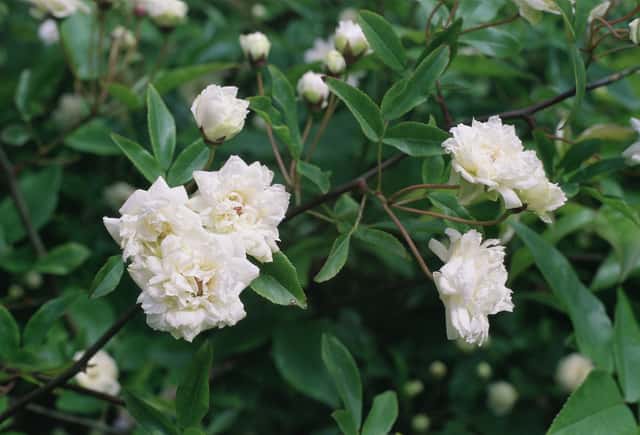
Lady Banks' Rose (Rosa banksiae) is a medium-care plant from the Rosaceae family. Lady Banks' Rose (Rosa banksiae) is a vigorous, nearly thornless climbing rose native to central and western China. In spring, it produces breathtaking cascades of small, fragrant flowers in white or yellow that can blanket entire walls, pergolas, and fences. One of the oldest roses in Western culti...
Lady Banks' Rose grows up to 12.0m, spread of 300cm, watering every 7 days, -10°C – 38°C, 40–70% humidity. It is not suitable for indoor environments and safe for pets.
Unlike many popular species, Lady Banks' Rose is safe to keep around pets.
How to Care for Lady Banks' Rose?
TLDR: Lady Banks' Rose needs Direct sun, watering every 7 days, and temperatures between -10-38°C with 40-70% humidity.
How Often Should You Water Lady Banks' Rose?
Water deeply every 7 days during the establishment year. Once established, Lady Banks' Rose is highly drought-tolerant and needs supplemental watering only during extended dry spells. Always water at the base — avoid wetting foliage to prevent fungal diseases.
How Much Light Does Lady Banks' Rose Need?
Requires full sun — at least 6 hours of direct sunlight daily. In partial shade, flowering is significantly reduced and the plant becomes more susceptible to fungal diseases. Ideal for south- or west-facing walls, trellises, arbors, and pergolas.
What Is the Best Soil for Lady Banks' Rose?
Prefers moderately fertile, loamy, humus-rich, well-drained soil with a pH of 6.0–7.5. Tolerates chalk, clay, and sandy soils. Avoid waterlogged conditions. Incorporate compost at planting time to improve soil structure and fertility.
What Pot Should You Use for Lady Banks' Rose?
Large containers with excellent drainage for young plants; in-ground planting is strongly preferred for mature climbers that need room to spread.
Care Schedule
Fertilize
Every 30 days
What Is Lady Banks' Rose and Where Does It Come From?
Lady Banks' Rose (Rosa banksiae) is a vigorous, nearly thornless climbing rose native to central and western China. In spring, it produces breathtaking cascades of small, fragrant flowers in white or yellow that can blanket entire walls, pergolas, and fences. One of the oldest roses in Western cultivation, it combines historical charm with remarkable toughness, drought tolerance, and disease resistance.
How to Propagate Lady Banks' Rose?
Semi-hardwood Stem Cutting
Use a humidity tent (clear plastic bag) to maintain moisture. Check for rooting after 4 weeks by gently tugging the cutting.
- 1 Take a 15-20 cm semi-hardwood cutting just below a node
- 2 Remove leaves from the lower third of the cutting
- 3 Dip the base into rooting hormone powder
- 4 Plant in a moist mix of sand and perlite
- 5 Keep in a semi-shaded spot with high humidity for 4-6 weeks
Materials needed:
Stem Layering
This method has a high success rate since the cane stays attached to the mother plant during rooting.
- 1 Select a long, flexible, healthy cane near the ground
- 2 Make a small notch on the underside of the cane
- 3 Bury the notched section 10 cm deep, leaving the tip exposed
- 4 Pin the buried section in place with a wire staple or stone
- 5 Water regularly and wait for rooting
Materials needed:
How Big Does Lady Banks' Rose Grow?
TLDR: Lady Banks' Rose can reach up to 12.0m tall with Fast growth rate.
Max height
12.0m
Spread
3.0m
Growth rate
Fast
Foliage
Semi-evergreen
Plant Uses
Ornamental
Great for decoration
Culinary Uses
- Petals are edible and can be used to garnish salads or make rose water
- In traditional Chinese medicine, rose petals have been used for centuries in aromatic preparations
Is your plant showing symptoms?
Click on the symptom to discover possible causes:
What Diseases Commonly Affect Lady Banks' Rose?
TLDR: Lady Banks' Rose is susceptible to 7 known diseases. Monitor regularly for early detection.
Black Spot
Black spot is the most serious fungal disease affecting roses, caused by the fungus Diplocarpon rosae. It is characterized by dark circular spots on leaves that progress to yellowing and premature leaf drop. The disease thrives in humid and cool conditions, especially early in the growing season.
Powdery Mildew
Powdery mildew is a common fungal disease caused by various fungi species including Erysiphe, Podosphaera, Oïdium, and Leveillula. It affects over 10,000 plant species worldwide. The disease thrives in warm, dry climates with high humidity and appears as a distinctive white powdery coating on plant surfaces.
Rust
Rust is a common fungal disease caused by fungi in the order Pucciniales that affects a wide variety of plants. The disease gets its name from the characteristic orange, yellow, or reddish-brown pustules that appear on leaves, resembling metal rust. This obligate fungal parasite requires living plants to survive and can cause significant economic losses in agricultural crops.
Aphids
Aphids are small, soft-bodied, pear-shaped insects (1/16 to 1/8 inch long) that feed by sucking nutrient-rich sap from plants. They reproduce rapidly and can quickly weaken plants, causing distorted growth and transmitting plant viruses. Aphids come in various colors including green, black, red, yellow, brown, and gray. They secrete honeydew, a sticky substance that attracts ants and encourages sooty mold growth.
Meaning & Symbolism
Named after Dorothea Lady Banks, wife of botanist Sir Joseph Banks. Symbolizes grace, elegance, and the enduring charm of heritage roses.
Fun Facts
The world's largest rose bush is a Lady Banks' Rose in Tombstone, Arizona — it covers over 8,000 square feet (743 m²) and is over 130 years old!
Unlike most roses, Lady Banks' Rose blooms on the previous year's canes, which is why pruning must happen right after flowering.
It was introduced to Europe in 1807 by plant hunter William Kerr, commissioned by Sir Joseph Banks to collect plants in China.
The flowers have a delicate violet-like fragrance, most noticeable in the early morning hours.
Frequently asked questions
How often should I water Lady Banks' Rose?
Does Lady Banks' Rose have thorns?
Is Lady Banks' Rose toxic to pets?
When does Lady Banks' Rose bloom?
How do I prune Lady Banks' Rose?
Compare with similar plants
| Attribute | Difficulty | Light | Watering | Pet Safe |
|---|---|---|---|---|
| Dark Fieldcap | Medium | Low light | 2d | ⚠️ |
| Azalea | Medium | Partial shade | 3d | ⚠️ |
| Bougainvillea | Medium | Direct sun | 7d | ⚠️ |
| Wild Lettuce | Medium | Direct sun | 7d | ⚠️ |



