Begoniaceae
Rex Begonia: The Complete Care Guide for Stunning Foliage
Begonia rex-cultorum
Keep in bright indirect light, away from direct sun. Water every 7 days, allowing the top 2-3 cm of soil to dry between waterings. Never wet the leaves. Maintain 50-80% humidity with a pebble tray. Fertilize monthly with a balanced fertilizer at half strength during spring and summer.
Every 7 days
Partial shade
15° - 24°C
50% - 80%
Categories
What is Rex Begonia?
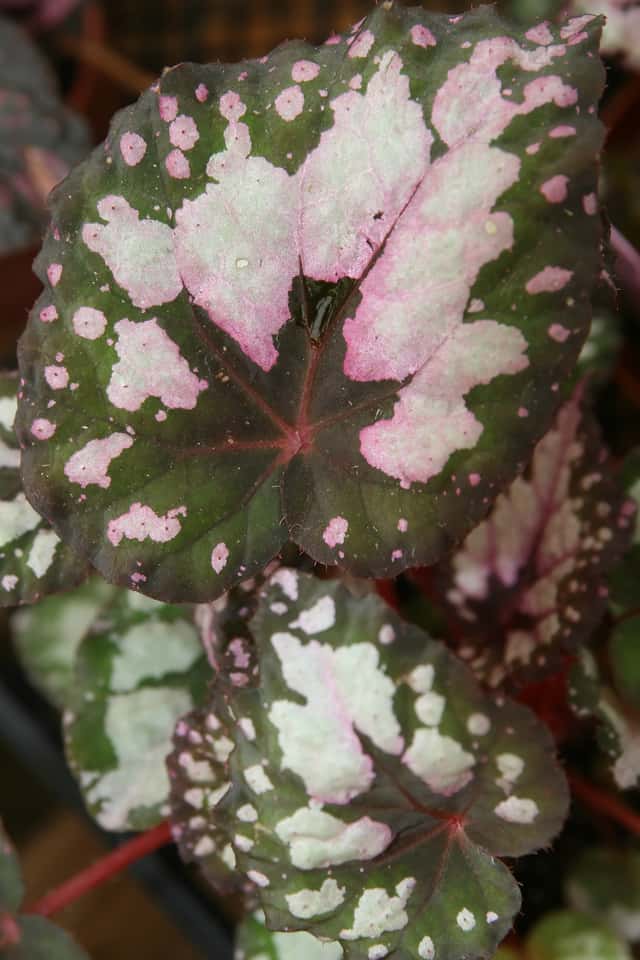
Rex Begonia (Begonia rex-cultorum) is a medium-care plant from the Begoniaceae family. Rex Begonia (Begonia rex-cultorum) is a cultivated hybrid group prized for its extraordinary ornamental foliage — displaying stunning patterns in silver, purple, red, green, and pink. A cross between Begonia rex and other species, it is grown exclusively as an indoor plant due to its need for stable...
Rex Begonia grows up to 45cm, spread of 45cm, watering every 7 days, 15°C – 24°C, 50–80% humidity. It is suitable for indoor environments and not safe for pets.
Without precautions, ingestion can cause irritation in pets. Keep out of reach of cats and dogs. Without adequate drainage, root rot can develop within 14 days.
How to Care for Rex Begonia?
TLDR: Rex Begonia needs Partial shade, watering every 7 days, and temperatures between 15-24°C with 50-80% humidity.
How Often Should You Water Rex Begonia?
Water only when the top 2-3 cm of soil feel dry. Use room-temperature water and pour directly onto the soil — wet leaves promote powdery mildew and botrytis. Never let the plant sit in standing water.
How Much Light Does Rex Begonia Need?
Place in bright indirect light, 60-90 cm from an east or west-facing window. Avoid direct sun, which scorches the delicate leaves, and very low light, which causes the colors to fade.
What Is the Best Soil for Rex Begonia?
Use a light, well-draining potting mix: combine potting soil with perlite (2:1 ratio). Ideal pH is 5.5-6.5. Never use dense or clay-heavy soil.
What Pot Should You Use for Rex Begonia?
Terracotta or ceramic pots are ideal as they allow good substrate aeration and prevent excess moisture. Always use pots with drainage holes.
Care Schedule
Fertilize
Every 30 days
Rotate
Every 30 days
Repot
Every 365 days
What Is Rex Begonia and Where Does It Come From?
Rex Begonia (Begonia rex-cultorum) is a cultivated hybrid group prized for its extraordinary ornamental foliage — displaying stunning patterns in silver, purple, red, green, and pink. A cross between Begonia rex and other species, it is grown exclusively as an indoor plant due to its need for stable humidity and temperature. WARNING: contains calcium oxalate crystals, making it toxic to cats, dogs, and humans if ingested.
How to Propagate Rex Begonia?
Leaf cutting
Keep the medium slightly moist, never waterlogged. Vent the dome daily for a few minutes to prevent fungal issues. Use sterilized tools.
- 1 Cut a healthy, mature leaf with a short petiole
- 2 Make cross-cuts across the main veins at 3-4 cm intervals
- 3 Lay segments face-down on moist, well-draining medium
- 4 Press gently to ensure contact with the substrate
- 5 Cover with a plastic dome to retain humidity
- 6 Keep at 20-24C in indirect light
- 7 Small plantlets will emerge from the cuts in 3-5 weeks
Materials needed:
Rhizome division
Divide in spring when the plant is actively growing. Dust cut surfaces with powdered charcoal to prevent infections.
- 1 Remove the plant from its pot and shake off excess soil
- 2 Locate the rhizomes and cut them apart with clean scissors
- 3 Ensure each division has at least 1-2 leaves and healthy roots
- 4 Plant each division in an individual pot with well-draining mix
- 5 Water lightly and keep in high humidity with indirect light
Materials needed:
How Big Does Rex Begonia Grow?
TLDR: Rex Begonia can reach up to 45cm tall with Slow growth rate.
Max height
45cm
Spread
45cm
Growth rate
Slow
Foliage
Evergreen
Warning: Toxic Plant
This plant can be toxic if ingested. Keep out of reach of:
Plant Uses
Ornamental
Great for decoration
Is your plant showing symptoms?
Click on the symptom to discover possible causes:
What Diseases Commonly Affect Rex Begonia?
TLDR: Rex Begonia is susceptible to 16 known diseases. Monitor regularly for early detection.
Powdery Mildew
Powdery mildew is a common fungal disease caused by various fungi species including Erysiphe, Podosphaera, Oïdium, and Leveillula. It affects over 10,000 plant species worldwide. The disease thrives in warm, dry climates with high humidity and appears as a distinctive white powdery coating on plant surfaces.
Root Rot
Root rot is a serious fungal disease that affects the root system of plants, causing them to decay and die. It is primarily caused by overwatering, poor drainage, or soil-borne fungi such as Pythium, Phytophthora, Rhizoctonia, and Fusarium. The disease thrives in waterlogged conditions where roots are deprived of oxygen, making them susceptible to fungal infection.
Gray Mold (Botrytis Blight)
Gray mold, caused by the fungus Botrytis cinerea, is one of the most common fungal diseases in plants. It affects over 200 plant species, including ornamentals, vegetables, fruits, and houseplants. The disease thrives in cool, humid conditions with poor air circulation, causing grayish spots and soft rot on infected tissues.
Gray Mold (Botrytis Blight)
Gray mold, caused by the fungus Botrytis cinerea, is a widespread necrotrophic pathogen affecting over 1,400 plant species. It thrives in cool, humid conditions and attacks weakened or aging plant tissues, causing soft rot and characteristic gray fuzzy growth.
Meaning & Symbolism
Symbolizes uniqueness and self-expression — its flamboyant, one-of-a-kind leaves are a reminder that beauty lies in being different.
Fun Facts
Rex Begonia is a garden hybrid — it does not exist as a wild species, being the result of decades of selection and cross-breeding by horticulturists.
Its leaves can reach up to 30 cm and display up to five different colors simultaneously, making each plant truly unique.
Although it blooms in spring and summer, the flowers are small and inconspicuous — the real star is always the foliage.
The name rex is Latin for king, a nod to the regal magnificence of its ornamental leaves.
Frequently asked questions
How often should I water Rex Begonia?
Is Rex Begonia toxic to pets?
Why are my Rex Begonia leaves losing their color?
How do I increase humidity for Rex Begonia?
When should I repot Rex Begonia?
Compare with similar plants
| Attribute | Difficulty | Light | Watering | Pet Safe |
|---|---|---|---|---|
| Dark Fieldcap | Medium | Low light | 2d | ⚠️ |
| Azalea | Medium | Partial shade | 3d | ⚠️ |
| Bougainvillea | Medium | Direct sun | 7d | ⚠️ |
| Wild Lettuce | Medium | Direct sun | 7d | ⚠️ |



