Bignoniaceae
Flame Vine (Pyrostegia venusta): Complete Care Guide
Pyrostegia venusta
Low-maintenance once established. Thrives in full sun with well-draining soil and moderate watering. Highly drought-tolerant when mature. Annual pruning after flowering promotes vigorous regrowth and abundant blooms.
Every 7 days
Direct sun
5° - 40°C
40% - 80%
Categories
What is Flame Vine?
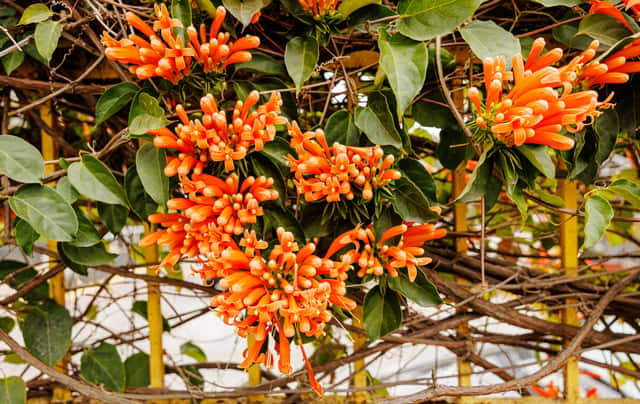
Flame Vine (Pyrostegia venusta) is a easy-care plant from the Bignoniaceae family. Pyrostegia venusta, commonly known as Flame Vine or Orange Trumpet Vine, is a spectacular Brazilian climbing plant celebrated for its cascading displays of vivid orange tubular flowers during winter and fall. A member of the Bignoniaceae family, it is one of the most ornamental vines in tropical and...
Flame Vine grows up to 12.0m, spread of 500cm, watering every 7 days, 5°C – 40°C, 40–80% humidity. It is not suitable for indoor environments and not safe for pets.
Unlike many tropical plants, Flame Vine tolerates watering mistakes. Best for beginners. Without precautions, ingestion can cause irritation in pets. Keep out of reach of cats and dogs.
How to Care for Flame Vine?
TLDR: Flame Vine needs Direct sun, watering every 7 days, and temperatures between 5-40°C with 40-80% humidity.
How Often Should You Water Flame Vine?
Water every 7 days during active growth. Established plants tolerate drought well. Avoid waterlogged soil — good drainage is essential to prevent root rot.
How Much Light Does Flame Vine Need?
Requires full sun (minimum 6 hours of direct sunlight daily). More sun means more intense and abundant orange blooms in winter. Will not flower well in shade.
What Is the Best Soil for Flame Vine?
Use well-draining, fertile soil rich in organic matter. Ideal mix: garden soil + compost + coarse sand (2:1:1). pH range 6.0–7.5.
What Pot Should You Use for Flame Vine?
Requires a robust support structure (pergola, wall, fence, trellis). Not suitable for small pots. Plant directly in the ground near a strong support structure.
Care Schedule
Fertilize
Every 180 days
What Is Flame Vine and Where Does It Come From?
Pyrostegia venusta, commonly known as Flame Vine or Orange Trumpet Vine, is a spectacular Brazilian climbing plant celebrated for its cascading displays of vivid orange tubular flowers during winter and fall. A member of the Bignoniaceae family, it is one of the most ornamental vines in tropical and subtropical gardens.
How to Propagate Flame Vine?
Stem Cutting
Use sterilized pruning shears. Keep substrate moist but never waterlogged. Rooting is faster in spring.
- 1 Cut a healthy semi-hardwood stem 15-20 cm long
- 2 Remove lower leaves, keeping 2-3 at the top
- 3 Dip the base in rooting hormone powder
- 4 Plant in moist, well-draining propagation mix
- 5 Keep in a shaded, humid spot for 4-6 weeks
Materials needed:
Seed Sowing
Germination is irregular. Fresh seeds have higher germination rates.
- 1 Collect mature seeds from dried pods
- 2 Sow in a tray with moist, fine substrate
- 3 Cover lightly with a thin layer of substrate
- 4 Keep in a warm, bright location
- 5 Transplant when seedlings reach 10 cm
Materials needed:
How Big Does Flame Vine Grow?
TLDR: Flame Vine can reach up to 12.0m tall with Fast growth rate.
Max height
12.0m
Spread
5.0m
Growth rate
Fast
Foliage
Evergreen
Warning: Toxic Plant
This plant can be toxic if ingested. Keep out of reach of:
Plant Uses
Ornamental
Great for decoration
Medicinal
Medicinal properties
Medicinal Uses
- Flowers and leaves traditionally used as a tonic and for treating leucoderma and vitiligo
- Roots used in Brazilian folk medicine for diarrhea and dysentery
Is your plant showing symptoms?
Click on the symptom to discover possible causes:
What Diseases Commonly Affect Flame Vine?
TLDR: Flame Vine is susceptible to 6 known diseases. Monitor regularly for early detection.
Root Rot
Root rot is a serious fungal disease that affects the root system of plants, causing them to decay and die. It is primarily caused by overwatering, poor drainage, or soil-borne fungi such as Pythium, Phytophthora, Rhizoctonia, and Fusarium. The disease thrives in waterlogged conditions where roots are deprived of oxygen, making them susceptible to fungal infection.
Powdery Mildew
Powdery mildew is a common fungal disease caused by various fungi species including Erysiphe, Podosphaera, Oïdium, and Leveillula. It affects over 10,000 plant species worldwide. The disease thrives in warm, dry climates with high humidity and appears as a distinctive white powdery coating on plant surfaces.
Spider Mites
Spider mites are tiny arachnids (less than 1/20 inch long) related to spiders and ticks that feed on plant sap. They thrive in hot, dry conditions and can cause significant damage to ornamental and vegetable plants. During severe infestations, crop losses can reach 14% or higher as these pests disrupt vital plant processes including photosynthesis, carbon dioxide absorption, and transpiration.
Aphids
Aphids are small, soft-bodied, pear-shaped insects (1/16 to 1/8 inch long) that feed by sucking nutrient-rich sap from plants. They reproduce rapidly and can quickly weaken plants, causing distorted growth and transmitting plant viruses. Aphids come in various colors including green, black, red, yellow, brown, and gray. They secrete honeydew, a sticky substance that attracts ants and encourages sooty mold growth.
Meaning & Symbolism
Joy, celebration, and tropical exuberance. In Brazil, its orange blooms are associated with the June festivities.
Fun Facts
Flame Vine can reach up to 12 meters in length when supported by structures
It flowers mainly in winter, making it one of the few vines to bring color to gardens during the cold season
Native to Brazil and South America, it occurs naturally in forests and cerrado
Its orange tubular flowers attract hummingbirds, making it important for local wildlife
Frequently asked questions
How often should I water Flame Vine?
Why is my Flame Vine not flowering?
Is Flame Vine toxic to pets?
When should I prune Flame Vine?
Can Flame Vine be grown in a pot?
Compare with similar plants
| Attribute | Difficulty | Light | Watering | Pet Safe |
|---|---|---|---|---|
| Field Maple | Easy | Bright indirect | 14d | ✓ |
| Silver Birch | Easy | Direct sun | 14d | ✓ |
| Cushion Bush | Easy | Direct sun | 14d | ✓ |
| Peruvian peppertree | Easy | Direct sun | 14d | ⚠️ |