Primulaceae
European Cyclamen (Cyclamen purpurascens): Complete Care Guide
Cyclamen purpurascens
Keep in a cool, bright location with indirect light. Water every 7 days using the bottom-watering method, avoiding wetting the tuber directly. Prefers humidity between 40-70% and temperatures of 10-20°C. Fertilize once per growing season and repot every 2 years.
Every 7 days
Partial shade
10° - 20°C
40% - 70%
Categories
What is European Cyclamen?
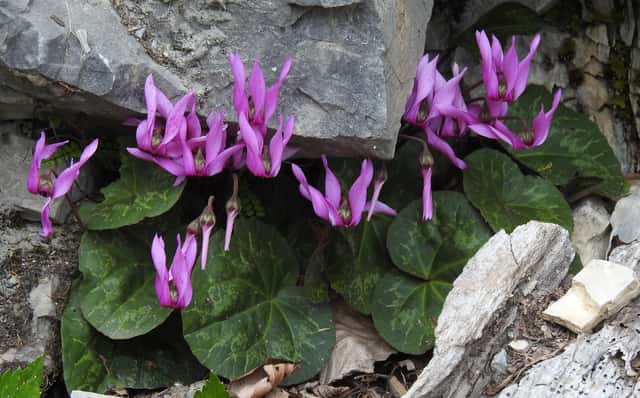
European Cyclamen (Cyclamen purpurascens) is a medium-care plant from the Primulaceae family. European Cyclamen (Cyclamen purpurascens) is a tuberous perennial in the family Primulaceae, native to the mountain forests of Central Europe. It is distinguished by its evergreen, heart-shaped leaves with elegant silver patterns and its sweetly fragrant flowers in shades of pink to deep purple, blo...
European Cyclamen grows up to 15cm, spread of 25cm, watering every 7 days, 10°C – 20°C, 40–70% humidity. It is suitable for indoor environments and not safe for pets.
Without precautions, ingestion can cause irritation in pets. Keep out of reach of cats and dogs. Without adequate drainage, root rot can develop within 14 days.
How to Care for European Cyclamen?
TLDR: European Cyclamen needs Partial shade, watering every 7 days, and temperatures between 10-20°C with 40-70% humidity.
How Often Should You Water European Cyclamen?
Water every 7 days, preferably by placing the pot in a shallow dish of water for 20-30 minutes and allowing the soil to absorb moisture from the base. Avoid wetting the leaves and tuber directly to prevent rot. Reduce watering frequency in summer during dormancy.
How Much Light Does European Cyclamen Need?
Place in bright indirect light or dappled shade, near a north- or east-facing window. Avoid intense direct sunlight, which can scorch the leaves. The plant naturally grows in dappled forest shade, so mimicking this environment works best.
What Is the Best Soil for European Cyclamen?
Use well-draining soil rich in organic matter, with a pH of 5.5-6.5 (slightly acidic). A mix of equal parts potting soil, peat or coco coir, and perlite works well. Ensure the pot has adequate drainage holes to prevent waterlogging of the tuber.
What Pot Should You Use for European Cyclamen?
Terracotta or ceramic pot with drainage holes. The porous clay helps regulate moisture and prevents tuber rot. Prefer not-too-large pots — cyclamen blooms better when roots are slightly snug.
Care Schedule
Fertilize
Every 90 days
Repot
Every 730 days
What Is European Cyclamen and Where Does It Come From?
European Cyclamen (Cyclamen purpurascens) is a tuberous perennial in the family Primulaceae, native to the mountain forests of Central Europe. It is distinguished by its evergreen, heart-shaped leaves with elegant silver patterns and its sweetly fragrant flowers in shades of pink to deep purple, blooming from summer through autumn. It is one of the hardiest cyclamen species, tolerating temperatures well below freezing.
How to Propagate European Cyclamen?
Seed Propagation
Cyclamen seeds require darkness to germinate. Keep the substrate moist but never waterlogged. Germination can be slow and irregular, taking several weeks.
- 1 Collect ripe seeds after flowering
- 2 Soak seeds in warm water for 12 hours
- 3 Sow in moist well-draining mix at 1 cm depth
- 4 Keep at 15-18°C in darkness until germination
- 5 Transplant seedlings after 2-3 pairs of true leaves appear
Materials needed:
Tuber Division
Tuber division is risky and can kill the plant. Only attempt with large, healthy specimens. Always sterilize tools to prevent disease transmission.
- 1 Wait for summer dormancy period
- 2 Carefully remove the tuber from the soil
- 3 Divide tuber with a sterilized knife, ensuring each section has growth buds (eyes)
- 4 Allow cut sections to callus for 24 hours in a dry, airy location
- 5 Plant in well-draining substrate with the top of the tuber slightly exposed
Materials needed:
How Big Does European Cyclamen Grow?
TLDR: European Cyclamen can reach up to 15cm tall with Slow growth rate.
Max height
15cm
Spread
25cm
Growth rate
Slow
Foliage
Evergreen
Warning: Toxic Plant
This plant can be toxic if ingested. Keep out of reach of:
Plant Uses
Ornamental
Great for decoration
Is your plant showing symptoms?
Click on the symptom to discover possible causes:
What Diseases Commonly Affect European Cyclamen?
TLDR: European Cyclamen is susceptible to 12 known diseases. Monitor regularly for early detection.
Gray Mold (Botrytis Blight)
Gray mold, caused by the fungus Botrytis cinerea, is one of the most common fungal diseases in plants. It affects over 200 plant species, including ornamentals, vegetables, fruits, and houseplants. The disease thrives in cool, humid conditions with poor air circulation, causing grayish spots and soft rot on infected tissues.
Root Rot
Root rot is a serious fungal disease that affects the root system of plants, causing them to decay and die. It is primarily caused by overwatering, poor drainage, or soil-borne fungi such as Pythium, Phytophthora, Rhizoctonia, and Fusarium. The disease thrives in waterlogged conditions where roots are deprived of oxygen, making them susceptible to fungal infection.
Fusarium Wilt
Fusarium wilt is a serious fungal disease caused by the soil-borne fungus Fusarium oxysporum. The fungus invades roots and blocks the water-conducting vessels (xylem) of the plant, causing progressive wilting and eventual death. Host-specific forms of the pathogen exist that attack different plant species.
Gray Mold (Botrytis Blight)
Gray mold, caused by the fungus Botrytis cinerea, is a widespread necrotrophic pathogen affecting over 1,400 plant species. It thrives in cool, humid conditions and attacks weakened or aging plant tissues, causing soft rot and characteristic gray fuzzy growth.
Meaning & Symbolism
European Cyclamen symbolizes diffidence, resignation, and bittersweet farewells in the language of flowers, but also represents sincere love and tender feelings.
Fun Facts
One of the few cyclamen species with genuinely fragrant flowers
Its tubers can live for decades, slowly increasing in size each year
It is the most northerly distributed cyclamen species in the wild, reaching Poland and Germany
Unlike most cyclamens, it retains its leaves year-round without a complete dormancy period
Frequently asked questions
How often should I water European Cyclamen?
Is European Cyclamen toxic to pets?
Why are my cyclamen leaves turning yellow?
When does European Cyclamen flower?
Can I grow European Cyclamen outdoors?
Compare with similar plants
| Attribute | Difficulty | Light | Watering | Pet Safe |
|---|---|---|---|---|
| Dark Fieldcap | Medium | Low light | 2d | ⚠️ |
| Azalea | Medium | Partial shade | 3d | ⚠️ |
| Bougainvillea | Medium | Direct sun | 7d | ⚠️ |
| Wild Lettuce | Medium | Direct sun | 7d | ⚠️ |



