Crassulaceae
Adromischus maculatus - Calico Hearts
Adromischus maculatus
Grow in bright indirect light, with a few hours of gentle direct sun in the morning or late afternoon. Water only when the substrate is completely dry, every 10-14 days during the growing season and less frequently in winter. Use well-draining substrate and avoid getting the leaves wet.
Every 14 days
Bright indirect
12° - 25°C
% - %
Categories
What is Calico Hearts?
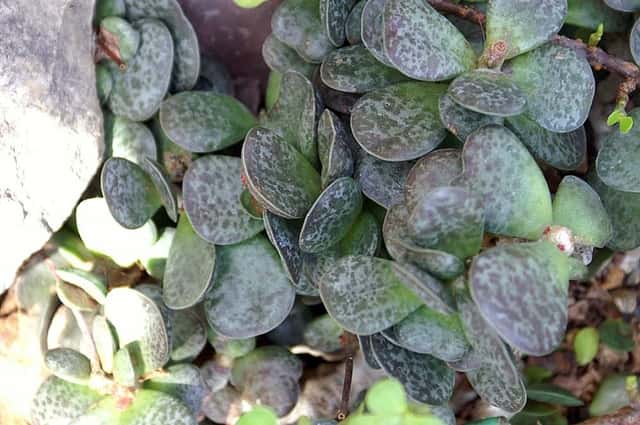
Calico Hearts (Adromischus maculatus) is a easy-care plant from the Crassulaceae family. A small perennial succulent endemic to the Western and Eastern Cape provinces of South Africa, where it grows on the sandy slopes of the Langeberg mountains. It forms small clusters of obovate, grayish-green to bronze leaves covered in brownish-purple spots that create a mottled pattern similar to c...
Calico Hearts grows up to 35cm, spread of 30cm, watering every 14 days, 12°C – 25°C. It is suitable for indoor environments and not safe for pets.
Unlike many tropical plants, Calico Hearts tolerates watering mistakes. Best for beginners. Without precautions, ingestion can cause irritation in pets. Keep out of reach of cats and dogs. Without adequate drainage, root rot can develop within 28 days.
How to Care for Calico Hearts?
TLDR: Calico Hearts needs Bright indirect, watering every 14 days, and temperatures between 12-25°C with 40-70% humidity.
How Often Should You Water Calico Hearts?
Allow the substrate to dry out completely between waterings. Water every 10-14 days in spring and summer, reducing to every 3-4 weeks in fall and winter. Avoid wetting the center of the rosette to prevent rot.
How Much Light Does Calico Hearts Need?
Prefers bright indirect light, with a few hours of gentle direct sun in the morning or late afternoon. Strong midday sun can scorch the leaves.
What Is the Best Soil for Calico Hearts?
Use a specific substrate for cacti and succulents, or mix potting soil with coarse sand and perlite to ensure good drainage.
What Pot Should You Use for Calico Hearts?
Terracotta or unglazed ceramic pots with drainage holes help prevent excess moisture in the substrate.
What Is Calico Hearts and Where Does It Come From?
A small perennial succulent endemic to the Western and Eastern Cape provinces of South Africa, where it grows on the sandy slopes of the Langeberg mountains. It forms small clusters of obovate, grayish-green to bronze leaves covered in brownish-purple spots that create a mottled pattern similar to calico fabric. An excellent choice for pots and water-wise succulent gardens.
How to Propagate Calico Hearts?
Leaf cutting
Do not bury the leaf or overwater before rooting, as this encourages rot. Use a cactus and succulent substrate.
- 1 Remove a healthy, mature leaf by gently twisting at the base, ensuring it comes off the stem whole
- 2 Let the leaf rest in a dry, airy place for 2 to 3 days until the end heals (callouses)
- 3 Place the calloused leaf on a well-draining substrate, with the cut end slightly in contact with the soil
- 4 Keep in a spot with bright indirect light and mist lightly only when the substrate dries out
- 5 After a few weeks, roots and a small rosette will emerge at the base of the leaf
Materials needed:
How Big Does Calico Hearts Grow?
TLDR: Calico Hearts can reach up to 35cm tall with Slow growth rate.
Max height
35cm
Spread
30cm
Growth rate
Slow
Foliage
Evergreen
Warning: Toxic Plant
This plant can be toxic if ingested. Keep out of reach of:
Plant Uses
Ornamental
Great for decoration
Is your plant showing symptoms?
Click on the symptom to discover possible causes:
What Diseases Commonly Affect Calico Hearts?
TLDR: Calico Hearts is susceptible to 8 known diseases. Monitor regularly for early detection.
Root Rot
Root rot is a serious fungal disease that affects the root system of plants, causing them to decay and die. It is primarily caused by overwatering, poor drainage, or soil-borne fungi such as Pythium, Phytophthora, Rhizoctonia, and Fusarium. The disease thrives in waterlogged conditions where roots are deprived of oxygen, making them susceptible to fungal infection.
Crown Rot
Crown rot is a serious fungal disease that attacks the crown (base) of the plant where the stem meets the soil. It is caused by various fungal pathogens including Phytophthora, Fusarium, and Rhizoctonia. The disease thrives in waterlogged conditions and can quickly spread to kill the entire plant if not addressed promptly.
Powdery Mildew
Powdery mildew is a common fungal disease caused by various fungi species including Erysiphe, Podosphaera, Oïdium, and Leveillula. It affects over 10,000 plant species worldwide. The disease thrives in warm, dry climates with high humidity and appears as a distinctive white powdery coating on plant surfaces.
Leaf Spot
Leaf spot is a common fungal disease caused by various pathogens including Alternaria, Ascochyta, Colletotrichum, Septoria, and Venturia. It primarily affects leaves, causing discolored spots that can lead to premature leaf drop if left untreated.
Meaning & Symbolism
Due to its heart-shaped leaves, it is often associated with lasting affection and resilience, qualities attributed to succulents that thrive in adverse conditions.
Fun Facts
It is endemic to the Langeberg Mountains in South Africa, growing on sandstone slopes.
The name Calico Hearts comes from the mottled pattern on its leaves, resembling calico fabric.
Its tubular flowers bloom in summer on upright stalks that can reach up to 40 cm tall.
Frequently asked questions
Is Adromischus maculatus toxic to pets?
How often should I water Adromischus maculatus?
Why is my Adromischus dropping leaves?
How do you propagate Adromischus maculatus?
Compare with similar plants
| Attribute | Difficulty | Light | Watering | Pet Safe |
|---|---|---|---|---|
| Field Maple | Easy | Bright indirect | 14d | ✓ |
| Silver Birch | Easy | Direct sun | 14d | ✓ |
| Common Blanketflower | Easy | Direct sun | 10d | ✓ |
| Cushion Bush | Easy | Direct sun | 14d | ✓ |





