Plantaginaceae
Pond Water-starwort (Callitriche stagnalis): Complete Care Guide
Callitriche stagnalis
Very easy to grow aquatic plant. Requires clean water, moderate to full sunlight, and cool temperatures. Fast-growing — prune regularly to prevent it from overcrowding other aquatic species. Does not tolerate warm or polluted water.
Every 1 days
Partial shade
5° - 23°C
80% - 100%
Categories
What is Pond Water-starwort?
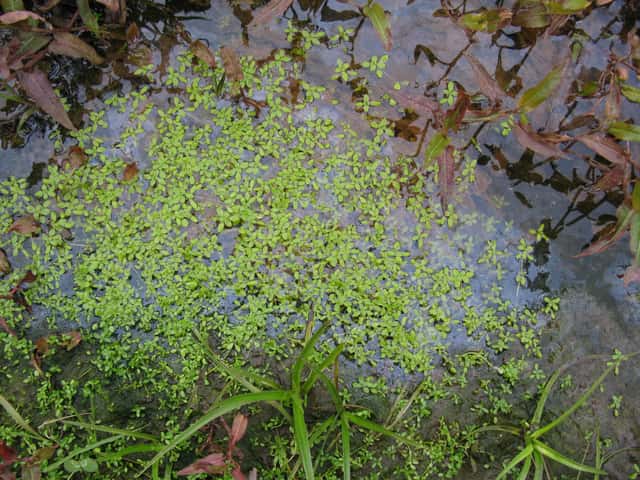
Pond Water-starwort (Callitriche stagnalis) is a easy-care plant from the Plantaginaceae family. Callitriche stagnalis, commonly known as Pond Water-starwort, is a delicate aquatic plant native to Europe and naturalized worldwide. It thrives in ponds, slow-moving streams, and waterlogged areas, forming attractive floating mats of bright green star-shaped leaf rosettes on the water surface. It i...
Pond Water-starwort grows up to 10cm, spread of 50cm, watering every 1 days, 5°C – 23°C, 80–100% humidity. It is suitable for indoor environments and safe for pets.
Unlike many tropical plants, Pond Water-starwort tolerates watering mistakes. Best for beginners. Unlike many popular species, Pond Water-starwort is safe to keep around pets. Without adequate drainage, root rot can develop within 7 days.
How to Care for Pond Water-starwort?
TLDR: Pond Water-starwort needs Partial shade, watering every 1 days, and temperatures between 5-23°C with 80-100% humidity.
How Often Should You Water Pond Water-starwort?
As a true aquatic plant, watering is continuous — keep permanently submerged or floating in water. Maintain water quality with regular partial changes and good oxygenation.
How Much Light Does Pond Water-starwort Need?
Prefers moderate to full sun. Provide 6–8 hours of light per day. Avoid deep shade, which inhibits growth and encourages algae.
What Is the Best Soil for Pond Water-starwort?
Plant directly in silty or loamy substrate at the bottom of ponds or tanks, at 15–45 cm depth. Prefers mineral-rich muddy soil. Does not require a particularly fertile substrate.
What Pot Should You Use for Pond Water-starwort?
Open tank, garden pond, or low-rimmed aquarium. For aquariums, plant directly in the bottom substrate — no pot needed.
Care Schedule
Fertilize
Every 30 days
What Is Pond Water-starwort and Where Does It Come From?
Callitriche stagnalis, commonly known as Pond Water-starwort, is a delicate aquatic plant native to Europe and naturalized worldwide. It thrives in ponds, slow-moving streams, and waterlogged areas, forming attractive floating mats of bright green star-shaped leaf rosettes on the water surface. It is an excellent oxygenator for garden ponds and aquariums.
How to Propagate Pond Water-starwort?
Stem Cutting
Cuttings root very easily in water. No rooting hormone needed. Change water regularly to prevent rot.
- 1 Cut a healthy stem 10-15 cm long
- 2 Remove leaves from the lower portion of the stem
- 3 Place the stem directly in water or silty substrate
- 4 Keep in a well-lit spot — rooting occurs naturally within days
Materials needed:
Seed Propagation
Seeds germinate best in shallow water at 15-20°C.
- 1 Collect mature seeds from the parent plant
- 2 Allow seeds to fall naturally to the pond bottom or plant in moist silty substrate in shallow water
- 3 Keep in a bright location with clean water
Materials needed:
How Big Does Pond Water-starwort Grow?
TLDR: Pond Water-starwort can reach up to 10cm tall with Fast growth rate.
Max height
10cm
Spread
50cm
Growth rate
Fast
Foliage
Deciduous
Plant Uses
Ornamental
Great for decoration
Is your plant showing symptoms?
Click on the symptom to discover possible causes:
What Diseases Commonly Affect Pond Water-starwort?
TLDR: Pond Water-starwort is susceptible to 3 known diseases. Monitor regularly for early detection.
Root Rot
Root rot is a serious fungal disease that affects the root system of plants, causing them to decay and die. It is primarily caused by overwatering, poor drainage, or soil-borne fungi such as Pythium, Phytophthora, Rhizoctonia, and Fusarium. The disease thrives in waterlogged conditions where roots are deprived of oxygen, making them susceptible to fungal infection.
Slugs and Snails
Slugs and snails are mollusks that feed on plant tissue, causing irregular holes in leaves and damage to young seedlings. They are most active at night and in moist conditions, leaving characteristic silvery slime trails. These pests can quickly devastate gardens, especially during wet seasons.
Nutrient Deficiency
Nutrient deficiency occurs when a plant cannot access one or more essential mineral elements in sufficient quantities for healthy growth. Plants require 17 essential nutrients: macronutrients (N, P, K, Ca, Mg, S) and micronutrients (Fe, Zn, Mn, Cu, B, Mo, Cl). Each plays a unique role in metabolism, structure, and reproduction. Deficiencies arise from depleted soils, incorrect pH blocking uptake, poor watering practices leaching nutrients, root damage, or imbalanced fertilization. Understanding whether a nutrient is mobile or immobile determines where symptoms first appear: mobile nutrients (N, P, K, Mg) show symptoms on older leaves first, while immobile nutrients (Ca, Fe, Zn, Cu, B) show symptoms on new growth first.
Fun Facts
One of the most common aquatic plants in European streams, capable of colonizing new habitats within weeks
Its floating leaves form a star-shaped rosette on the water surface, giving the plant its evocative common name
It is considered invasive in several regions outside Europe, including the USA and Australia
It acts as a natural bioindicator of water quality — it disappears when water becomes too polluted
Frequently asked questions
Does Pond Water-starwort need soil?
How often should I prune Pond Water-starwort?
Is Pond Water-starwort toxic to fish or animals?
What is the ideal temperature for Pond Water-starwort?
Can I grow Pond Water-starwort in a closed aquarium?
Compare with similar plants
| Attribute | Difficulty | Light | Watering | Pet Safe |
|---|---|---|---|---|
| Field Maple | Easy | Bright indirect | 14d | ✓ |
| Silver Birch | Easy | Direct sun | 14d | ✓ |
| Cushion Bush | Easy | Direct sun | 14d | ✓ |
| Peruvian peppertree | Easy | Direct sun | 14d | ⚠️ |