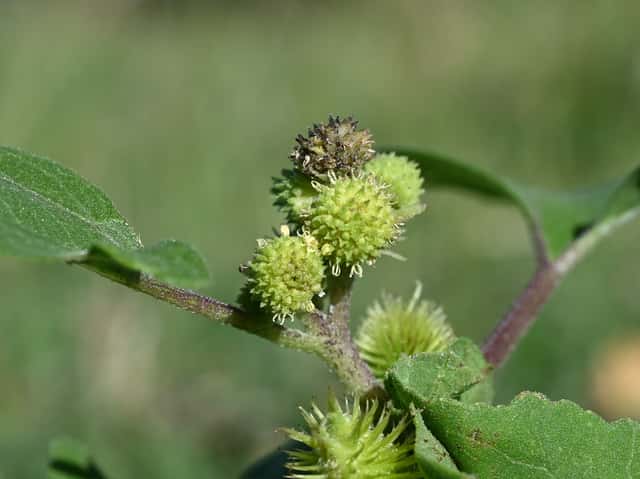
Asteraceae
Rough Cocklebur (Xanthium strumarium)
Xanthium strumarium
Rough Cocklebur is an extremely hardy and self-sufficient annual weed requiring virtually no intentional care. It thrives in full sun with moderate water, tolerates a wide range of soils and pH levels, and grows aggressively in disturbed, moist environments. It requires no fertilization, misting, or rotation. If grown in a controlled setting for study or medicinal research, simply ensure full sun access and moderate soil moisture.
Every 7 days
Bright indirect
5° - 40°C
30% - 80%
Categories
What is Rough Cocklebur?
Rough Cocklebur (Xanthium strumarium) is a easy-care plant from the Asteraceae family. Xanthium strumarium, known as Rough Cocklebur, is an annual herbaceous weed belonging to the Asteraceae family. It is a cosmopolitan invasive species found on all continents except Antarctica, thriving in disturbed soils, floodplains, roadsides, and agricultural fields. It is best known for its hard...
Rough Cocklebur grows up to 2.0m, spread of 90cm, watering every 7 days, 5°C – 40°C, 30–80% humidity. It is not suitable for indoor environments and not safe for pets.
Unlike many tropical plants, Rough Cocklebur tolerates watering mistakes. Best for beginners. Without precautions, ingestion can cause irritation in pets. Keep out of reach of cats and dogs.
How to Care for Rough Cocklebur?
TLDR: Rough Cocklebur needs Bright indirect, watering every 7 days, and temperatures between 5-40°C with 30-80% humidity.
How Often Should You Water Rough Cocklebur?
Water only when soil is dry in controlled cultivation. In its natural habitat it tolerates flooding and drought cycles. If potted for study, water every 7 days or when the top 2 cm of soil are dry.
How Much Light Does Rough Cocklebur Need?
Requires full sun (6+ hours daily). Will grow in partial shade but produces fewer burs and reduced vigor. Direct outdoor light is ideal.
What Is the Best Soil for Rough Cocklebur?
Thrives in loamy, moist, well-drained soils. Tolerates sandy loam, clay loam, and silt. pH range 5.5–8.0. No amendments required.
What Pot Should You Use for Rough Cocklebur?
Not recommended for pot cultivation due to invasive and toxic nature. If used for research, use a large terracotta or plastic container (minimum 30L) with drainage holes.
What Is Rough Cocklebur and Where Does It Come From?
Xanthium strumarium, known as Rough Cocklebur, is an annual herbaceous weed belonging to the Asteraceae family. It is a cosmopolitan invasive species found on all continents except Antarctica, thriving in disturbed soils, floodplains, roadsides, and agricultural fields. It is best known for its hard, spiny burs that cling to animal fur and clothing — a property that inspired the invention of velcro. The plant is highly toxic, particularly in the seedling and cotyledon stages, where it contains carboxyatractyloside, a diterpenoid glycoside fatal to livestock and potentially to humans.
How to Propagate Rough Cocklebur?
Seed propagation
Seeds require stratification or scarification to improve germination. Handle all parts with gloves — seedlings are HIGHLY TOXIC (carboxyatractyloside).
- 1 Collect mature burs in autumn
- 2 Remove seeds from burs carefully (wear gloves — seeds are toxic)
- 3 Sow seeds directly into moist loamy soil at 1-2 cm depth
- 4 Keep moist until germination (7-14 days at 15-25°C)
- 5 Thin seedlings to 30 cm apart
Materials needed:
How Big Does Rough Cocklebur Grow?
TLDR: Rough Cocklebur can reach up to 2.0m tall with Fast growth rate.
Max height
2.0m
Spread
90cm
Growth rate
Fast
Foliage
Deciduous
Warning: Toxic Plant
This plant can be toxic if ingested. Keep out of reach of:
Plant Uses
Medicinal
Medicinal properties
Medicinal Uses
- Used in traditional Chinese medicine (Cang Er Zi) for rhinitis, sinusitis, and headaches
- Seeds used in folk remedies for malaria and joint pain
- Aerial parts have demonstrated antifungal and antibacterial properties in studies
Is your plant showing symptoms?
Click on the symptom to discover possible causes:
What Diseases Commonly Affect Rough Cocklebur?
TLDR: Rough Cocklebur is susceptible to 9 known diseases. Monitor regularly for early detection.
Powdery Mildew
Powdery mildew is a common fungal disease caused by various fungi species including Erysiphe, Podosphaera, Oïdium, and Leveillula. It affects over 10,000 plant species worldwide. The disease thrives in warm, dry climates with high humidity and appears as a distinctive white powdery coating on plant surfaces.
Rust
Rust is a common fungal disease caused by fungi in the order Pucciniales that affects a wide variety of plants. The disease gets its name from the characteristic orange, yellow, or reddish-brown pustules that appear on leaves, resembling metal rust. This obligate fungal parasite requires living plants to survive and can cause significant economic losses in agricultural crops.
Alternaria Leaf Spot
Alternaria leaf spot is a common fungal disease caused by Alternaria solani and Alternaria alternata that affects a wide range of plants including tomatoes, potatoes, brassicas, and ornamentals. The disease thrives in warm, humid conditions and can cause significant crop damage if left untreated. Spores overwinter on plant debris and can attach to seeds, making complete elimination difficult.
Anthracnose
Anthracnose is a fungal disease caused by fungi in the genus Colletotrichum that affects many plants, including vegetables, fruits, and trees. The disease thrives in cool, wet conditions, causing dark, sunken lesions on leaves, stems, flowers, and fruits.
Meaning & Symbolism
In folklore, the cocklebur symbolizes persistence and resilience — its burs cling to all they touch, just as challenges cling to life. It is also credited with inspiring velcro, symbolizing the power of observing nature for innovation.
Fun Facts
Inspired the invention of velcro in 1941 when George de Mestral observed its burs clinging to his dog's fur
Cotyledons contain enough carboxyatractyloside to kill a pig weighing 100 kg
The plant can grow from a tiny seedling to 2 meters tall within a single growing season
Xanthium burs have been found in Egyptian archaeological sites dating back thousands of years
Frequently asked questions
Is Rough Cocklebur dangerous to pets?
What makes the cocklebur so invasive?
Did cocklebur really inspire velcro?
When is Rough Cocklebur most toxic?
Can Rough Cocklebur be used medicinally?
Compare with similar plants
| Attribute | Difficulty | Light | Watering | Pet Safe |
|---|---|---|---|---|
| Field Maple | Easy | Bright indirect | 14d | ✓ |
| Silver Birch | Easy | Direct sun | 14d | ✓ |
| Cushion Bush | Easy | Direct sun | 14d | ✓ |
| Wild Lettuce | Medium | Direct sun | 7d | ⚠️ |





