Betulaceae
European hop-hornbeam: Low Water Needs
Ostrya carpinifolia
A very hardy and easy-to-cultivate plant, the European hop-hornbeam requires very little maintenance once established in the ground. It prefers sunny or slightly shaded positions, calcareous and well-drained soil, and does not tolerate waterlogging. It resists both intense cold (down to about -20°C) and the summer heat typical of sub-Mediterranean environments.
Every 14 days
Bright indirect
-20° - 35°C
% - %
Categories
What is European hop-hornbeam?
European hop-hornbeam (Ostrya carpinifolia) is a easy-care plant from the Betulaceae family. The European hop-hornbeam (Ostrya carpinifolia) is a deciduous tree of the Betulaceae family, widespread in the hilly and sub-mountainous areas of Southern Europe, the Balkans, and Southwestern Asia. It grows wild from sea level up to about 1300 m, often on calcareous soils and arid slopes, where it...
European hop-hornbeam grows up to 20.0m, spread of 1200cm, watering every 14 days, -20°C – 35°C. It is not suitable for indoor environments and safe for pets.
Unlike many tropical plants, European hop-hornbeam tolerates watering mistakes. Best for beginners. Unlike many popular species, European hop-hornbeam is safe to keep around pets.
How to Care for European hop-hornbeam?
TLDR: European hop-hornbeam needs Bright indirect, watering every 14 days, and temperatures between -20-35°C with 40-70% humidity.
How Often Should You Water European hop-hornbeam?
In the first years after planting, water regularly to encourage establishment, keeping the soil slightly moist but never soggy. Once mature, the tree is satisfied with seasonal rainfall except during prolonged periods of drought.
How Much Light Does European hop-hornbeam Need?
Prefers full sun positions; it also tolerates light shade, especially in hotter climates, but performs best in terms of flowering and autumn color if it receives direct light for most of the day.
What Is the Best Soil for European hop-hornbeam?
It adapts even to poor and rocky soils but prefers calcareous, deep, and well-drained soils. Avoid compact clay soils or those subject to waterlogging, to which it is very sensitive.
What Pot Should You Use for European hop-hornbeam?
It is not a species suitable for permanent pot cultivation, given the size it reaches as an adult: it should be intended for open ground in gardens, parks, or tree-lined avenues. Young seedlings can be grown temporarily in large, deep containers with excellent drainage, awaiting final transplanting, ideally between October and November.
What Is European hop-hornbeam and Where Does It Come From?
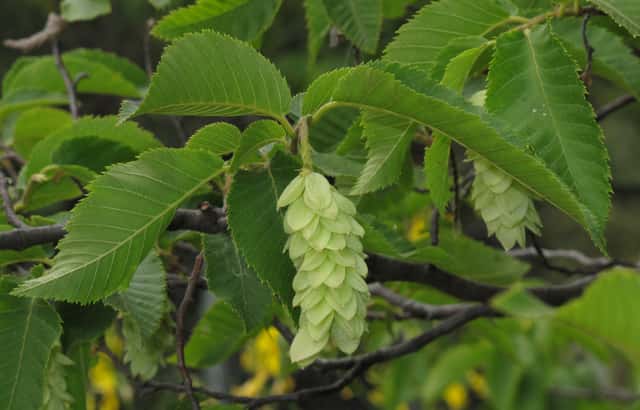
The European hop-hornbeam (Ostrya carpinifolia) is a deciduous tree of the Betulaceae family, widespread in the hilly and sub-mountainous areas of Southern Europe, the Balkans, and Southwestern Asia. It grows wild from sea level up to about 1300 m, often on calcareous soils and arid slopes, where it acts as a pioneer species capable of colonizing poor and degraded soils. It typically reaches 15-20 meters in height, with an oval crown, reddish-brown bark that flakes into thin plates, ovate serrated leaves similar to those of the common hornbeam but with more pronounced veins, and fruits enclosed in membranous bracts gathered in infructescences resembling hop cones, from which its English name "hop-hornbeam" is derived.
How Big Does European hop-hornbeam Grow?
TLDR: European hop-hornbeam can reach up to 20.0m tall with Medium growth rate.
Max height
20.0m
Spread
12.0m
Growth rate
Medium
Foliage
Deciduous
Plant Uses
Ornamental
Great for decoration
Is your plant showing symptoms?
Click on the symptom to discover possible causes:
What Diseases Commonly Affect European hop-hornbeam?
TLDR: European hop-hornbeam is susceptible to 6 known diseases. Monitor regularly for early detection.
Root Rot
Root rot is a serious fungal disease that affects the root system of plants, causing them to decay and die. It is primarily caused by overwatering, poor drainage, or soil-borne fungi such as Pythium, Phytophthora, Rhizoctonia, and Fusarium. The disease thrives in waterlogged conditions where roots are deprived of oxygen, making them susceptible to fungal infection.
Powdery Mildew
Powdery mildew is a common fungal disease caused by various fungi species including Erysiphe, Podosphaera, Oïdium, and Leveillula. It affects over 10,000 plant species worldwide. The disease thrives in warm, dry climates with high humidity and appears as a distinctive white powdery coating on plant surfaces.
Leaf Spot
Leaf spot is a common fungal disease caused by various pathogens including Alternaria, Ascochyta, Colletotrichum, Septoria, and Venturia. It primarily affects leaves, causing discolored spots that can lead to premature leaf drop if left untreated.
Canker
Canker is a disease caused by various fungi and bacteria that create necrotic, sunken areas on bark of branches, stems, and trunks. Pathogens enter through wounds and natural openings, especially when plants are stressed. Canker can gradually weaken or kill branches by disrupting water and nutrient flow.
Meaning & Symbolism
Due to its ability to take root in poor soils and steep slopes where other species struggle, the European hop-hornbeam is traditionally associated with resilience and adaptation. Its wood, among the hardest and most compact of European hardwoods, has made it a symbol of robustness for centuries, used for tools, agricultural implements, and as excellent firewood in Apennine and pre-Alpine rural communities.
Compare with similar plants
| Attribute | Difficulty | Light | Watering | Pet Safe |
|---|---|---|---|---|
| Field Maple | Easy | Bright indirect | 14d | ✓ |
| Silver Birch | Easy | Direct sun | 14d | ✓ |
| Cushion Bush | Easy | Direct sun | 14d | ✓ |
| Peruvian peppertree | Easy | Direct sun | 14d | ⚠️ |
Choose & Compare
Sources & References
- Ostrya carpinifolia - Trees and Shrubs Online
- Ostrya carpinifolia | European hop hornbeam - Van den Berk Nurseries
- Carpino nero - Giardinaggio.net
- Ossigeno - Carpino nero (Ostrya carpinifolia)
- How To Grow Ostrya carpinifolia - EarthOne
- Ostrya carpinifolia - Missouri Botanical Garden Plant Finder
- European Hop-hornbeam (Ostrya carpinifolia) - Botanical Realm
- Ostrya carpinifolia in Europe: distribution, habitat, usage and threats





