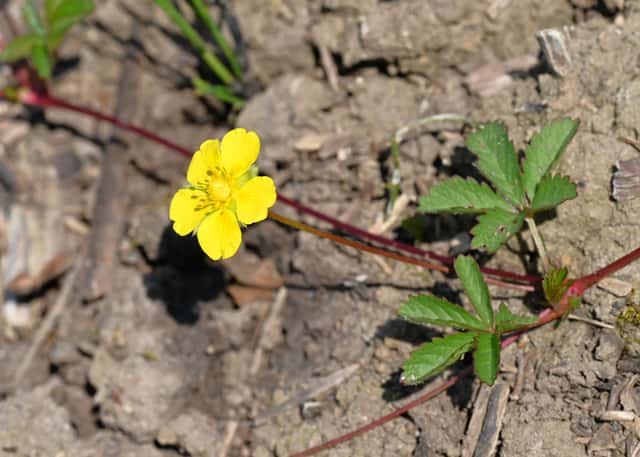
Rosaceae
Creeping Cinquefoil (Potentilla reptans)
Potentilla reptans
Easy-going and drought-tolerant once established, creeping cinquefoil asks for little beyond full sun to light shade and soil that drains reasonably well. Water new plantings regularly during the first season, then only during extended dry spells.
Every 7 days
Bright indirect
-15° - 35°C
40% - 80%
Categories
What is Creeping Cinquefoil?
Creeping Cinquefoil (Potentilla reptans) is a easy-care plant from the Rosaceae family. Creeping cinquefoil (Potentilla reptans) is a low-growing perennial in the rose family, native to Europe, western Asia and North Africa. Its trailing stems root at every node, forming dense mats of five-fingered leaflets studded with bright yellow, five-petaled flowers from June to September. Equall...
Creeping Cinquefoil grows up to 20cm, spread of 100cm, watering every 7 days, -15°C – 35°C, 40–80% humidity. It is not suitable for indoor environments and safe for pets.
Unlike many tropical plants, Creeping Cinquefoil tolerates watering mistakes. Best for beginners. Unlike many popular species, Creeping Cinquefoil is safe to keep around pets.
How to Care for Creeping Cinquefoil?
TLDR: Creeping Cinquefoil needs Bright indirect, watering every 7 days, and temperatures between -15-35°C with 40-80% humidity.
How Often Should You Water Creeping Cinquefoil?
Keep the soil evenly moist while plants establish; afterwards water only if there has been less than 2.5cm of rain in a week.
How Much Light Does Creeping Cinquefoil Need?
Grows best in full sun but tolerates partial shade; low light leads to leggy stems and fewer flowers.
What Is the Best Soil for Creeping Cinquefoil?
Tolerates chalk, clay, loam and sandy soils as long as drainage is adequate; avoid waterlogged ground to prevent root rot.
What Pot Should You Use for Creeping Cinquefoil?
Best grown directly in the ground or in a wide, shallow container that lets the runners trail over the edge.
What Is Creeping Cinquefoil and Where Does It Come From?
Creeping cinquefoil (Potentilla reptans) is a low-growing perennial in the rose family, native to Europe, western Asia and North Africa. Its trailing stems root at every node, forming dense mats of five-fingered leaflets studded with bright yellow, five-petaled flowers from June to September. Equally at home as a groundcover or a persistent lawn weed, it thrives almost anywhere with a little sun.
How to Propagate Creeping Cinquefoil?
Runner division
Keep newly divided plantlets consistently moist for the first two weeks until new growth appears.
- 1 Locate a rooted node along a trailing stem
- 2 Cut the runner on either side of the rooted section
- 3 Lift the rooted plantlet with its roots intact
- 4 Replant immediately in moist, well-draining soil
Materials needed:
Seed sowing
Seeds often benefit from a period of cold stratification before germinating reliably.
- 1 Collect ripe seed heads in late summer
- 2 Sow seeds on the surface of moist, well-draining soil
- 3 Keep in a cold frame or sheltered spot over winter
- 4 Transplant seedlings once they have several true leaves
Materials needed:
How Big Does Creeping Cinquefoil Grow?
TLDR: Creeping Cinquefoil can reach up to 20cm tall with Fast growth rate.
Max height
20cm
Spread
1.0m
Growth rate
Fast
Foliage
Deciduous
Plant Uses
Ground Cover
Soil coverage
Medicinal
Medicinal properties
Ornamental
Great for decoration
Medicinal Uses
- Traditional astringent for wound care
- Root extracts used for mild antimicrobial rinses
Is your plant showing symptoms?
Click on the symptom to discover possible causes:
What Diseases Commonly Affect Creeping Cinquefoil?
TLDR: Creeping Cinquefoil is susceptible to 8 known diseases. Monitor regularly for early detection.
Powdery Mildew
Powdery mildew is a common fungal disease caused by various fungi species including Erysiphe, Podosphaera, Oïdium, and Leveillula. It affects over 10,000 plant species worldwide. The disease thrives in warm, dry climates with high humidity and appears as a distinctive white powdery coating on plant surfaces.
Downy Mildew
Downy mildew is a fungal-like disease caused by oomycetes (water molds) that thrives in cool, wet conditions. It affects a wide range of plants, causing yellowing leaves with fuzzy white-gray growth underneath, leading to defoliation and reduced yields if left untreated.
Rust
Rust is a common fungal disease caused by fungi in the order Pucciniales that affects a wide variety of plants. The disease gets its name from the characteristic orange, yellow, or reddish-brown pustules that appear on leaves, resembling metal rust. This obligate fungal parasite requires living plants to survive and can cause significant economic losses in agricultural crops.
Leaf Spot
Leaf spot is a common fungal disease caused by various pathogens including Alternaria, Ascochyta, Colletotrichum, Septoria, and Venturia. It primarily affects leaves, causing discolored spots that can lead to premature leaf drop if left untreated.
Meaning & Symbolism
The five-petaled yellow flower has long symbolized the five senses, protection and quiet resilience in European folklore.
Fun Facts
Its trailing stems root at almost every leaf node, letting a single plant colonize a wide area in one season.
The five-petaled yellow flowers are a favorite nectar source for the grizzled skipper butterfly caterpillar.
Root extracts have shown mild antimicrobial activity against common wound pathogens in traditional medicine studies.
Frequently asked questions
Is creeping cinquefoil invasive?
Is Potentilla reptans toxic to pets?
How do I stop creeping cinquefoil taking over my lawn?
Does creeping cinquefoil need fertilizer?
Compare with similar plants
| Attribute | Difficulty | Light | Watering | Pet Safe |
|---|---|---|---|---|
| Field Maple | Easy | Bright indirect | 14d | ✓ |
| Silver Birch | Easy | Direct sun | 14d | ✓ |
| Cushion Bush | Easy | Direct sun | 14d | ✓ |
| Peruvian peppertree | Easy | Direct sun | 14d | ⚠️ |





