Rubiaceae
scarletbush: Full Sun Plant
Hamelia patens
Firebush is a resilient, low-maintenance shrub that thrives in full sun and well-drained soil. While drought-tolerant once established, it produces the most flowers with regular watering and occasional pruning to maintain shape.
Every 8 days
Direct sun
10° - 38°C
50% - 80%
Categories
What is scarletbush?
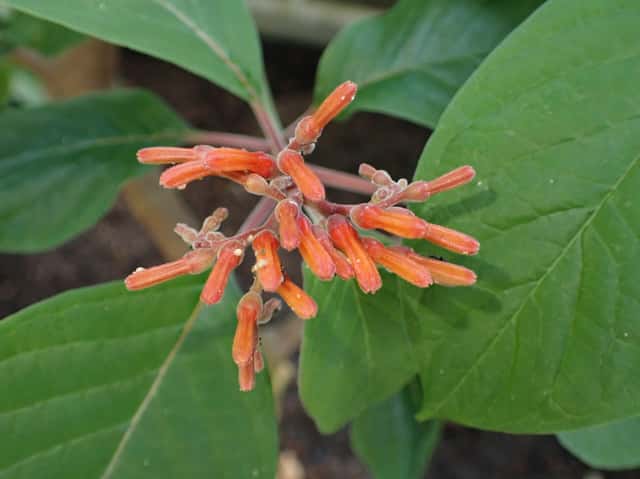
scarletbush (Hamelia patens) is a easy-care plant from the Rubiaceae family. Hamelia patens, commonly known as firebush or scarletbush, is a fast-growing perennial shrub native to the American subtropics. It is highly prized for its vibrant, tubular reddish-orange flowers that bloom almost year-round in warm climates, serving as a primary nectar source for hummingbirds and b...
scarletbush grows up to 3.7m, spread of 244cm, watering every 8 days, 10°C – 38°C, 50–80% humidity. It is suitable for indoor environments and safe for pets.
Unlike many tropical plants, scarletbush tolerates watering mistakes. Best for beginners. Unlike many popular species, scarletbush is safe to keep around pets. Without adequate drainage, root rot can develop within 16 days.
How to Care for scarletbush?
TLDR: scarletbush needs Direct sun, watering every 8 days, and temperatures between 10-38°C with 50-80% humidity.
How Often Should You Water scarletbush?
Water deeply when the top inch of soil feels dry. In containers, ensure water drains freely to avoid 'wet feet'.
How Much Light Does scarletbush Need?
For the most prolific flowering and deepest leaf color, place in a location that receives at least 6 to 8 hours of direct sunlight daily.
What Is the Best Soil for scarletbush?
Thrives in a wide range of soils but prefers a rich, loamy mix with a slightly acidic to neutral pH.
What Pot Should You Use for scarletbush?
Large terracotta or glazed ceramic pot with excellent drainage holes to prevent root rot.
Care Schedule
Fertilize
Every 30 days
Repot
Every 730 days
What Is scarletbush and Where Does It Come From?
Hamelia patens, commonly known as firebush or scarletbush, is a fast-growing perennial shrub native to the American subtropics. It is highly prized for its vibrant, tubular reddish-orange flowers that bloom almost year-round in warm climates, serving as a primary nectar source for hummingbirds and butterflies. The foliage often turns a beautiful bronze-red in the autumn.
How to Propagate scarletbush?
Softwood Stem Cuttings
- Keep the soil consistently moist but not soggy
- Avoid direct sunlight until roots are established
- 1 Take Cutting
Cut a 4-6 inch section of new, non-flowering growth just below a node.
- 2 Prepare Stem
Remove the leaves from the bottom half of the cutting to expose the nodes.
- 3 Planting
Dip the end in rooting hormone and insert into a moist mix of perlite and peat moss.
- 4 Environment
Cover with a plastic bag to maintain humidity and place in bright, indirect light.
Materials needed:
Seed Propagation
- Maintain a soil temperature of 21-25 degrees Celsius for best results
- Use a misting bottle to water to avoid washing away tiny seeds
- 1 Harvest Seeds
Collect fully ripe, black berries from the plant.
- 2 Clean Seeds
Mash the berries and wash away the pulp to extract the small seeds.
- 3 Sowing
Sow seeds on the surface of a fine seed-starting mix; do not cover deeply as they need light to germinate.
Materials needed:
How Big Does scarletbush Grow?
TLDR: scarletbush can reach up to 3.7m tall with Fast growth rate.
Max height
3.7m
Spread
2.4m
Growth rate
Fast
Foliage
Evergreen
Plant Uses
Ornamental
Great for decoration
Medicinal
Medicinal properties
Medicinal Uses
- Topical treatment for skin rashes and insect bites
- Used in traditional medicine as an anti-inflammatory
- Leaf extracts used for wound healing and fungal infections
Culinary Uses
- Ripe berries are edible and used in Mexico to make a fermented beverage
- Berries can be cooked into jams or syrups
Is your plant showing symptoms?
Click on the symptom to discover possible causes:
What Diseases Commonly Affect scarletbush?
TLDR: scarletbush is susceptible to 9 known diseases. Monitor regularly for early detection.
Root Rot
Root rot is a serious fungal disease that affects the root system of plants, causing them to decay and die. It is primarily caused by overwatering, poor drainage, or soil-borne fungi such as Pythium, Phytophthora, Rhizoctonia, and Fusarium. The disease thrives in waterlogged conditions where roots are deprived of oxygen, making them susceptible to fungal infection.
Powdery Mildew
Powdery mildew is a common fungal disease caused by various fungi species including Erysiphe, Podosphaera, Oïdium, and Leveillula. It affects over 10,000 plant species worldwide. The disease thrives in warm, dry climates with high humidity and appears as a distinctive white powdery coating on plant surfaces.
Leaf Spot
Leaf spot is a common fungal disease caused by various pathogens including Alternaria, Ascochyta, Colletotrichum, Septoria, and Venturia. It primarily affects leaves, causing discolored spots that can lead to premature leaf drop if left untreated.
Aphids
Aphids are small, soft-bodied, pear-shaped insects (1/16 to 1/8 inch long) that feed by sucking nutrient-rich sap from plants. They reproduce rapidly and can quickly weaken plants, causing distorted growth and transmitting plant viruses. Aphids come in various colors including green, black, red, yellow, brown, and gray. They secrete honeydew, a sticky substance that attracts ants and encourages sooty mold growth.
Meaning & Symbolism
Symbolizes intense energy, passion, and the ability to attract beauty and vitality into one's life.
Compare with similar plants
| Attribute | Difficulty | Light | Watering | Pet Safe |
|---|---|---|---|---|
| Field Maple | Easy | Bright indirect | 14d | ✓ |
| Silver Birch | Easy | Direct sun | 14d | ✓ |
| Cushion Bush | Easy | Direct sun | 14d | ✓ |
| Peruvian peppertree | Easy | Direct sun | 14d | ⚠️ |





