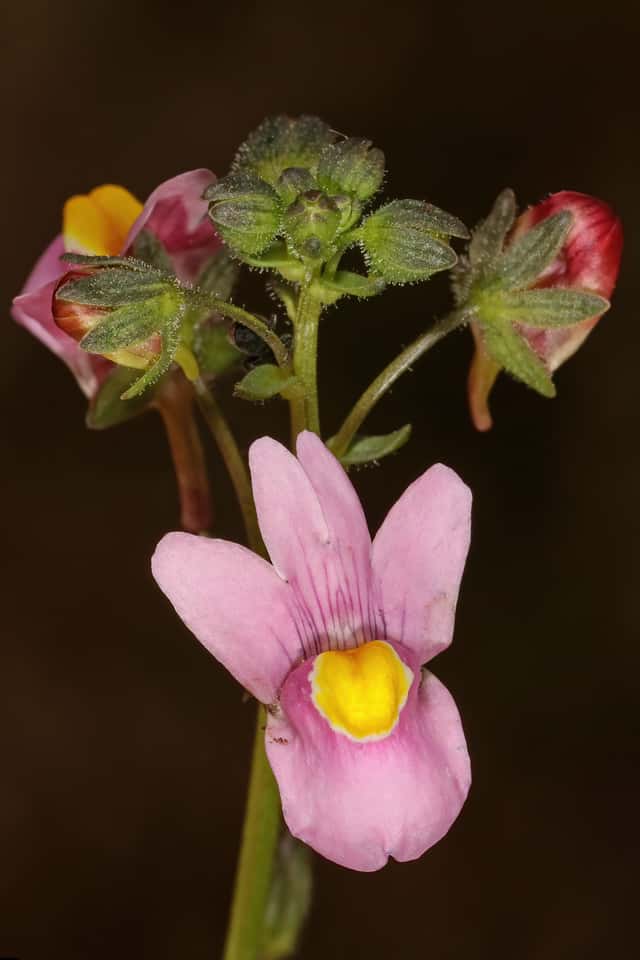
Scrophulariaceae
Mauve Nemesia: Ground Cover Plant
Nemesia fruticans
Nemesia fruticans requires a sunny or partially shaded location with well-drained, slightly acidic soil (pH 6-7). Water regularly, keeping the soil moist but not waterlogged. Fertilize weekly with organic liquid fertilizer during the blooming season. Prune lightly after peak flowering to encourage new blooms. It is sensitive to hard frosts and excessive heat; it prefers temperatures between 41 and 72 °F (5-22 °C).
Every 4 days
Bright indirect
5° - 22°C
40% - 70%
Categories
What is Mauve Nemesia?
Mauve Nemesia (Nemesia fruticans) is a easy-care plant from the Scrophulariaceae family. Nemesia fruticans is a perennial plant native to South Africa, valued as a cool-season ornamental for its abundant and showy flowers in a wide range of colors: white, yellow, orange, pink, red, purple, and blue. It belongs to the Scrophulariaceae family and grows in a compact, bushy habit, reaching...
Mauve Nemesia grows up to 50cm, spread of 30cm, watering every 4 days, 5°C – 22°C, 40–70% humidity. It is suitable for indoor environments and safe for pets.
Unlike many tropical plants, Mauve Nemesia tolerates watering mistakes. Best for beginners. Unlike many popular species, Mauve Nemesia is safe to keep around pets. Without adequate drainage, root rot can develop within 8 days.
How to Care for Mauve Nemesia?
TLDR: Mauve Nemesia needs Bright indirect, watering every 4 days, and temperatures between 5-22°C with 40-70% humidity.
How Often Should You Water Mauve Nemesia?
Water when the top inch of the soil is dry to the touch. Avoid wetting the foliage to prevent fungal diseases. In pots, check moisture more frequently during the summer, as the substrate dries out faster. Never let the plant sit in standing water: root rot is the main problem in overwatered conditions.
How Much Light Does Mauve Nemesia Need?
Place the plant in a spot with at least 6-8 hours of direct sunlight per day. In climates with hot summers, protect it from late afternoon sun to prolong flowering. Indoors, place it within 12 inches (30 cm) of a south- or east-facing window.
What Is the Best Soil for Mauve Nemesia?
Use fertile, well-draining substrate rich in organic matter. Mix garden soil with perlite or vermiculite in a 2:1 ratio to improve aeration. The optimal pH is between 6.0 and 7.0. Avoid compact clay soils or those that retain moisture for prolonged periods.
What Pot Should You Use for Mauve Nemesia?
Terracotta pots are ideal because they allow the substrate to breathe and reduce the risk of waterlogging. Ensure the container has drainage holes. For hanging baskets, use a lightweight mix with plenty of perlite. Repot every spring if the plant shows signs of being root-bound.
Care Schedule
Fertilize
Every 7 days
Repot
Every 365 days
What Is Mauve Nemesia and Where Does It Come From?
Nemesia fruticans is a perennial plant native to South Africa, valued as a cool-season ornamental for its abundant and showy flowers in a wide range of colors: white, yellow, orange, pink, red, purple, and blue. It belongs to the Scrophulariaceae family and grows in a compact, bushy habit, reaching between 8 and 20 inches (20-50 cm) in height. It is ideal for pots, hanging baskets, garden borders, and pollinator gardens. It blooms most vigorously in spring and fall when temperatures are cool, and may slow its flowering during the hottest summer months.
How to Propagate Mauve Nemesia?
Seeds
- 1 Sow seeds indoors 6-8 weeks before the last frost at a temperature of 59-64 °F (15-18 °C).
- 2 Place seeds on the surface of a moist, fine substrate; do not cover them, as they need light to germinate.
- 3 Maintain constant humidity with a spray bottle. Germination occurs in 7-14 days.
- 4 Transplant seedlings outdoors after the last frost, spacing plants 8-12 inches (20-30 cm) apart.
Cuttings
- 1 Take 3-4 inch (7-10 cm) stem cuttings in spring or early fall, cutting below a node.
- 2 Remove lower leaves and dip the base in rooting hormone powder.
- 3 Insert the cutting into a moist substrate of equal parts perlite and peat moss.
- 4 Keep in a warm, bright spot without direct sunlight until resistance is felt when gently tugged (4-6 weeks).
How Big Does Mauve Nemesia Grow?
TLDR: Mauve Nemesia can reach up to 50cm tall with Fast growth rate.
Max height
50cm
Spread
30cm
Growth rate
Fast
Foliage
Deciduous
Plant Uses
Ornamental
Great for decoration
Ground Cover
Soil coverage
Is your plant showing symptoms?
Click on the symptom to discover possible causes:
What Diseases Commonly Affect Mauve Nemesia?
TLDR: Mauve Nemesia is susceptible to 6 known diseases. Monitor regularly for early detection.
Root Rot
Root rot is a serious fungal disease that affects the root system of plants, causing them to decay and die. It is primarily caused by overwatering, poor drainage, or soil-borne fungi such as Pythium, Phytophthora, Rhizoctonia, and Fusarium. The disease thrives in waterlogged conditions where roots are deprived of oxygen, making them susceptible to fungal infection.
Powdery Mildew
Powdery mildew is a common fungal disease caused by various fungi species including Erysiphe, Podosphaera, Oïdium, and Leveillula. It affects over 10,000 plant species worldwide. The disease thrives in warm, dry climates with high humidity and appears as a distinctive white powdery coating on plant surfaces.
Botrytis
Spider Mites
Spider mites are tiny arachnids (less than 1/20 inch long) related to spiders and ticks that feed on plant sap. They thrive in hot, dry conditions and can cause significant damage to ornamental and vegetable plants. During severe infestations, crop losses can reach 14% or higher as these pests disrupt vital plant processes including photosynthesis, carbon dioxide absorption, and transpiration.
Compare with similar plants
| Attribute | Difficulty | Light | Watering | Pet Safe |
|---|---|---|---|---|
| Field Maple | Easy | Bright indirect | 14d | ✓ |
| Silver Birch | Easy | Direct sun | 14d | ✓ |
| Cushion Bush | Easy | Direct sun | 14d | ✓ |
| Peruvian peppertree | Easy | Direct sun | 14d | ⚠️ |





