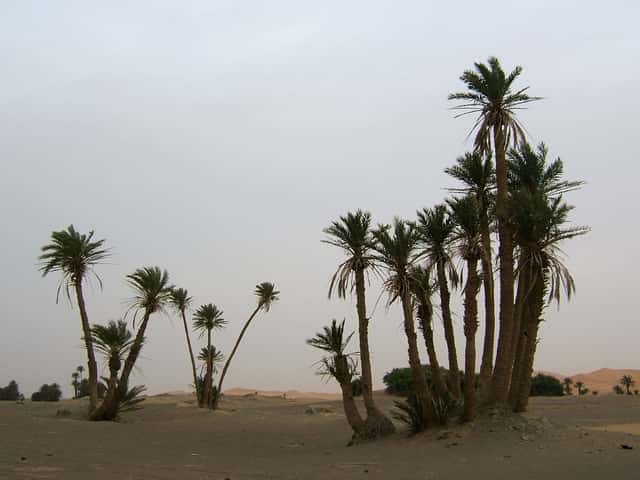
Arecaceae
Date Palm — The Palm Tree of Sacred Fruits
Phoenix dactylifera
Tough and drought-tolerant plant. Requires full sun and well-drained sandy soil. Water every 1-2 weeks. Best suited for outdoor gardens in hot, arid climates.
Every 14 days
Direct sun
10° - 50°C
30% - 60%
Categories
What is Date Palm?
Date Palm (Phoenix dactylifera) is a easy-care plant from the Arecaceae family. Phoenix dactylifera, commonly known as the Date Palm, is a majestic palm tree native to the Middle East and North Africa. It can reach up to 30 meters in height and has been cultivated for over 5,000 years for its nutritious fruits — dates — and exceptional ornamental value.
Date Palm grows up to 30.0m, spread of 900cm, watering every 14 days, 10°C – 50°C, 30–60% humidity. It is not suitable for indoor environments and safe for pets.
Unlike many tropical plants, Date Palm tolerates watering mistakes. Best for beginners. Unlike many popular species, Date Palm is safe to keep around pets.
How to Care for Date Palm?
TLDR: Date Palm needs Direct sun, watering every 14 days, and temperatures between 10-50°C with 30-60% humidity.
How Often Should You Water Date Palm?
Water every 1-2 weeks, allowing the soil to fully dry out between waterings. Avoid waterlogging — date palms are very sensitive to overwatering, which causes root rot.
How Much Light Does Date Palm Need?
Requires full, direct sunlight for at least 6-8 hours per day. The more light, the better the growth and fruit production.
What Is the Best Soil for Date Palm?
Prefers sandy, light, well-draining soils. Tolerates calcareous and saline soils. Avoid clay or compacted soils that retain excessive moisture.
What Pot Should You Use for Date Palm?
For container growing, use large terracotta or ceramic pots with excellent drainage. In gardens, plant directly in the ground.
Care Schedule
Fertilize
Every 90 days
What Is Date Palm and Where Does It Come From?
Phoenix dactylifera, commonly known as the Date Palm, is a majestic palm tree native to the Middle East and North Africa. It can reach up to 30 meters in height and has been cultivated for over 5,000 years for its nutritious fruits — dates — and exceptional ornamental value.
How to Propagate Date Palm?
Seed propagation
Use fresh seeds from non-pasteurized dates for higher germination rates. Keep substrate slightly moist but never waterlogged.
- 1 Remove the seed from a ripe date and clean thoroughly
- 2 Soak the seed in warm water for 24-48 hours
- 3 Plant in moist sandy substrate 2 cm deep
- 4 Keep in a warm location with temperatures above 20°C
- 5 Wait for germination, which occurs in 2-4 weeks
Materials needed:
Basal offshoots
This is the preferred method to maintain the mother plant characteristics. Best done in early spring.
- 1 Identify basal offshoots at least 1 meter tall
- 2 Carefully remove with a sterilized knife
- 3 Allow cut to dry for 24 hours before planting
- 4 Plant in well-draining sandy soil
- 5 Water moderately until roots are established
Materials needed:
How Big Does Date Palm Grow?
TLDR: Date Palm can reach up to 30.0m tall with Slow growth rate.
Max height
30.0m
Spread
9.0m
Growth rate
Slow
Foliage
Evergreen
Plant Uses
Ornamental
Great for decoration
Edible
Can be consumed
Medicinal Uses
- Dates rich in fiber and minerals have digestive properties; used in traditional Arab medicine to boost the immune system
Culinary Uses
- Fresh and dried dates consumed as fruit
- Ingredient in sweets, date syrup, and molasses
- Used in Arab and Mediterranean cuisine in savory dishes and desserts
Is your plant showing symptoms?
Click on the symptom to discover possible causes:
What Diseases Commonly Affect Date Palm?
TLDR: Date Palm is susceptible to 5 known diseases. Monitor regularly for early detection.
Root Rot
Root rot is a serious fungal disease that affects the root system of plants, causing them to decay and die. It is primarily caused by overwatering, poor drainage, or soil-borne fungi such as Pythium, Phytophthora, Rhizoctonia, and Fusarium. The disease thrives in waterlogged conditions where roots are deprived of oxygen, making them susceptible to fungal infection.
Fusarium Wilt
Fusarium wilt is a serious fungal disease caused by the soil-borne fungus Fusarium oxysporum. The fungus invades roots and blocks the water-conducting vessels (xylem) of the plant, causing progressive wilting and eventual death. Host-specific forms of the pathogen exist that attack different plant species.
Leaf Spot
Leaf spot is a common fungal disease caused by various pathogens including Alternaria, Ascochyta, Colletotrichum, Septoria, and Venturia. It primarily affects leaves, causing discolored spots that can lead to premature leaf drop if left untreated.
Root-Knot Nematodes
Root-knot nematodes (Meloidogyne species) are microscopic roundworms that parasitize plant roots, causing characteristic galls or knots. These soil-borne pests are among the most economically damaging plant pathogens worldwide, affecting a wide range of ornamental and edible plants. The nematodes inject enzymes into root cells, causing abnormal swelling and disrupting water and nutrient uptake.
Meaning & Symbolism
In the Middle East, the Date Palm is a symbol of life, abundance, and hospitality. It is a sacred tree in Islam, Judaism, and Christianity.
Fun Facts
Date palms can live for over 100 years and continue producing fruit
A single palm can produce over 100 kg of dates per year
Date palm cultivation dates back over 5,000 years in Mesopotamia
Dates are one of the highest naturally occurring sugar-content foods found in nature
Frequently asked questions
How often should I water a Date Palm?
Can a Date Palm be grown indoors?
When does a Date Palm start producing fruit?
Is the Date Palm toxic to pets?
How do I know if my Date Palm is getting enough light?
Compare with similar plants
| Attribute | Difficulty | Light | Watering | Pet Safe |
|---|---|---|---|---|
| Field Maple | Easy | Bright indirect | 14d | ✓ |
| Silver Birch | Easy | Direct sun | 14d | ✓ |
| Common Blanketflower | Easy | Direct sun | 10d | ✓ |
| Cushion Bush | Easy | Direct sun | 14d | ✓ |





