Moraceae
Dorstenia (Shield Flower): The Exotic Caudiciform Succulent with Disc-Shaped Blooms
Dorstenia
A slow-growing caudiciform succulent that thrives with moderate watering, allowing soil to dry completely between waterings. Needs bright indirect light or morning sun. Essential: excellent drainage to prevent caudex rot. Low fertilizer needs. Excellent as a houseplant or collector specimen.
Every 10 days
Bright indirect
10° - 35°C
30% - 60%
Categories
What is Shield Flower?
Shield Flower (Dorstenia) is a medium-care plant from the Moraceae family. Dorstenia is a captivating genus of caudiciform succulents in the Moraceae family — the same family as figs and breadfruit. Native to arid regions of East Africa and the Arabian Peninsula, including Ethiopia, Somalia, Kenya, Tanzania, Saudi Arabia, Yemen, and Oman, it is prized by collectors for its...
Shield Flower grows up to 40cm, spread of 20cm, watering every 10 days, 10°C – 35°C, 30–60% humidity. It is suitable for indoor environments and safe for pets.
Unlike many popular species, Shield Flower is safe to keep around pets. Without adequate drainage, root rot can develop within 20 days.
How to Care for Shield Flower?
TLDR: Shield Flower needs Bright indirect, watering every 10 days, and temperatures between 10-35°C with 30-60% humidity.
How Often Should You Water Shield Flower?
Water every 7–10 days in the growing season (spring through summer), letting the substrate dry out completely between sessions. In winter, reduce to once every 2–3 weeks. Never allow the pot to sit in standing water — excess moisture causes rapid root and caudex rot.
How Much Light Does Shield Flower Need?
Place near a bright east- or south-facing window. The plant needs at least 7–8 hours of diffused sunlight daily. Avoid prolonged direct midday sun, which can scorch leaves. Insufficient light causes leaf drop and stunted growth.
What Is the Best Soil for Shield Flower?
Use a fast-draining cactus and succulent potting mix amended with extra perlite or coarse sand. Soil pH between 6.5 and 7.5 is ideal. Avoid moisture-retentive mixes or heavy clay-based soils, which will cause root rot.
What Pot Should You Use for Shield Flower?
Use terracotta or clay pots with generous drainage holes. These porous materials absorb excess moisture from the soil, significantly reducing the risk of caudex rot. Avoid sealed plastic pots without adequate drainage.
Care Schedule
Fertilize
Every 30 days
Repot
Every 730 days
What Is Shield Flower and Where Does It Come From?
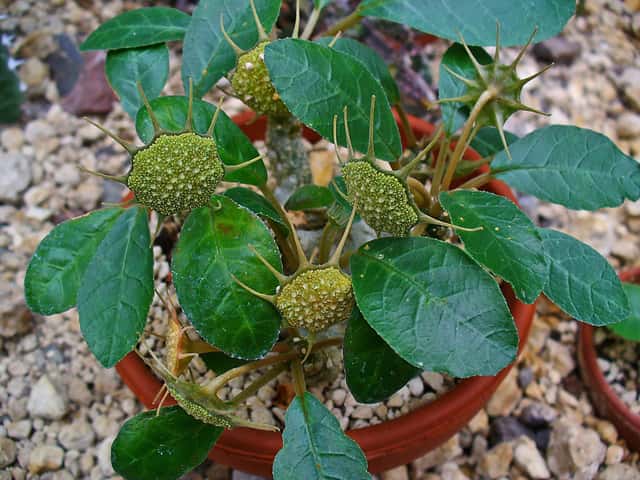
Dorstenia is a captivating genus of caudiciform succulents in the Moraceae family — the same family as figs and breadfruit. Native to arid regions of East Africa and the Arabian Peninsula, including Ethiopia, Somalia, Kenya, Tanzania, Saudi Arabia, Yemen, and Oman, it is prized by collectors for its swollen water-storing caudex and uniquely bizarre hypanthodium inflorescences — flat, disc- or shield-shaped structures that serve as composite flower heads. Despite its exotic appearance, Dorstenia is relatively easy to grow indoors when given bright light and well-draining soil.
How to Propagate Shield Flower?
Seed Propagation
Dorstenia is self-fertile and often self-sows around the pot. Keep moisture consistent without overwatering. Germination can be irregular — be patient.
- 1 Collect ripe seeds from the hypanthodium after they naturally eject
- 2 Sow on lightly moistened succulent mix
- 3 Maintain temperature around 21°C (70°F)
- 4 Cover with clear plastic to retain humidity
- 5 Remove cover once seedlings emerge
Materials needed:
Stem Cuttings
Use sterile tools. Only take cuttings from plants at least 2–3 years old. Do not wet the callous before planting, as this encourages rot.
- 1 Take a healthy stem cutting 5–10 cm long
- 2 Allow the cut end to callous for 2–3 days in a dry spot
- 3 Plant in dry succulent substrate
- 4 Water lightly after 5–7 days
- 5 Keep in bright indirect light
Materials needed:
How Big Does Shield Flower Grow?
TLDR: Shield Flower can reach up to 40cm tall with Slow growth rate.
Max height
40cm
Spread
20cm
Growth rate
Slow
Foliage
Evergreen
Plant Uses
Ornamental
Great for decoration
Medicinal
Medicinal properties
Medicinal Uses
- Parts of the Dorstenia plant have been used in traditional African medicine to treat skin infections and digestive ailments
Is your plant showing symptoms?
Click on the symptom to discover possible causes:
What Diseases Commonly Affect Shield Flower?
TLDR: Shield Flower is susceptible to 6 known diseases. Monitor regularly for early detection.
Root Rot
Root rot is a serious fungal disease that affects the root system of plants, causing them to decay and die. It is primarily caused by overwatering, poor drainage, or soil-borne fungi such as Pythium, Phytophthora, Rhizoctonia, and Fusarium. The disease thrives in waterlogged conditions where roots are deprived of oxygen, making them susceptible to fungal infection.
Overwatering
Overwatering occurs when plants receive too much water, depriving roots of oxygen and causing root rot. This environmental stress is one of the most common causes of houseplant death, as waterlogged soil prevents roots from breathing and functioning properly.
Aphids
Aphids are small, soft-bodied, pear-shaped insects (1/16 to 1/8 inch long) that feed by sucking nutrient-rich sap from plants. They reproduce rapidly and can quickly weaken plants, causing distorted growth and transmitting plant viruses. Aphids come in various colors including green, black, red, yellow, brown, and gray. They secrete honeydew, a sticky substance that attracts ants and encourages sooty mold growth.
Mealybugs
Mealybugs are small, soft-bodied insects covered with a white, waxy, cottony material. They are common pests of houseplants and outdoor plants in mild climates. These sap-sucking insects feed on plant tissue, causing damage, stunted growth, and can lead to plant death if left untreated. They produce sticky honeydew which attracts sooty mold.
Meaning & Symbolism
In parts of East Africa and the Arabian Peninsula, Dorstenia is regarded as a symbol of resilience and good fortune — a plant that endures harsh conditions and still flourishes.
Fun Facts
Dorstenia belongs to the Moraceae family — the same botanical family as figs, mulberries, and breadfruit
Its unusual disc-shaped structures are not single flowers but hypanthodia — flattened receptacles bearing dozens of tiny flowers
The caudex can store enough water to survive weeks without irrigation, making Dorstenia remarkably drought-resistant
Dorstenia is self-fertile and can eject its seeds several centimetres away from the parent plant
Frequently asked questions
How often should I water Dorstenia?
Is Dorstenia toxic to pets or humans?
Where should I place my Dorstenia indoors?
How do I propagate Dorstenia?
Why is my Dorstenia dropping leaves?
Compare with similar plants
| Attribute | Difficulty | Light | Watering | Pet Safe |
|---|---|---|---|---|
| Dark Fieldcap | Medium | Low light | 2d | ⚠️ |
| Azalea | Medium | Partial shade | 3d | ⚠️ |
| Bougainvillea | Medium | Direct sun | 7d | ⚠️ |
| Wild Lettuce | Medium | Direct sun | 7d | ⚠️ |
Choose & Compare
Sources & References
- Dorstenia Foetida Guide: How to Grow & Care for Grendelion – GardenBeast
- Complete and detailed guide on the care of Dorstenia foetida – Jardineria On
- Growing Dorstenia: A Complete Guide to Cultivating This Unique Succulent – WhatFlower
- How to Grow and Care for Dorstenia – World of Succulents
- Dorstenia foetida Plant Care – Greg App



