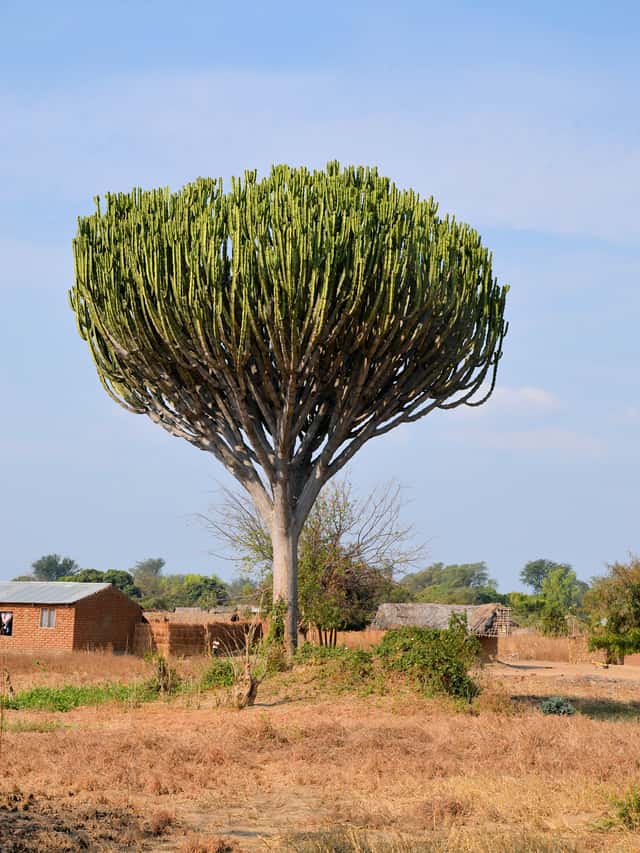
Euphorbiaceae
Candelabra Tree (Euphorbia ingens): Complete Care Guide
Euphorbia ingens
Extremely low-maintenance and drought-tolerant. Thrives in full direct sun, minimal watering, and fast-draining sandy soil. Avoid overwatering and cold below 5°C. The sap is severely toxic — keep away from children and pets at all times.
Every 21 days
Direct sun
5° - 40°C
30% - 50%
Categories
What is Candelabra Tree?
Candelabra Tree (Euphorbia ingens) is a easy-care plant from the Euphorbiaceae family. Euphorbia ingens, commonly known as the Candelabra Tree, is a striking succulent tree native to southern Africa. In its natural habitat it can grow over 12 meters tall, with upright green columnar branches arranged like a giant candelabra. It is widely cultivated as an ornamental plant in tropical a...
Candelabra Tree grows up to 12.0m, spread of 500cm, watering every 21 days, 5°C – 40°C, 30–50% humidity. It is suitable for indoor environments and not safe for pets.
Unlike many tropical plants, Candelabra Tree tolerates watering mistakes. Best for beginners. Without precautions, ingestion can cause irritation in pets. Keep out of reach of cats and dogs. Without adequate drainage, root rot can develop within 42 days.
How to Care for Candelabra Tree?
TLDR: Candelabra Tree needs Direct sun, watering every 21 days, and temperatures between 5-40°C with 30-50% humidity.
How Often Should You Water Candelabra Tree?
Water every 21 days on average, only when soil is completely dry. In winter, reduce to once monthly or less. Never allow water to pool in the saucer. Overwatering is the leading cause of death in this species.
How Much Light Does Candelabra Tree Need?
Requires intense, direct sunlight for at least 4–6 hours per day. Place near south- or west-facing windows. Insufficient light causes irreversible etiolated (weak, thin) growth.
What Is the Best Soil for Candelabra Tree?
Use cactus and succulent potting mix, or blend regular soil with coarse sand and perlite for rapid drainage. Avoid rich organic substrates that retain moisture.
What Pot Should You Use for Candelabra Tree?
Terracotta or ceramic pot with drainage holes. Avoid plastic pots that retain moisture. For large specimens, use heavy pots to ensure stability.
Care Schedule
Fertilize
Every 90 days
Repot
Every 730 days
What Is Candelabra Tree and Where Does It Come From?
Euphorbia ingens, commonly known as the Candelabra Tree, is a striking succulent tree native to southern Africa. In its natural habitat it can grow over 12 meters tall, with upright green columnar branches arranged like a giant candelabra. It is widely cultivated as an ornamental plant in tropical and subtropical gardens and is increasingly popular as a large indoor specimen. WARNING: the milky white sap is severely toxic to humans, cats, and dogs — always handle with thick gloves and eye protection.
How to Propagate Candelabra Tree?
Stem Cutting
The white latex is severely toxic — never touch eyes or mouth. Ensure the cut is fully calloused before planting to prevent rot.
- 1 Wear thick gloves and eye protection before cutting
- 2 Cut a healthy stem segment with a sharp, sterilized knife
- 3 Rinse the cut with cold water to remove latex, then let dry in shade for 3–5 days until calloused
- 4 Plant in dry succulent mix and avoid watering for 2 weeks
- 5 Place in a bright, warm location to encourage rooting
Materials needed:
Seed Propagation
Seed germination is slow and irregular. Stem cuttings are the most reliable propagation method.
- 1 Sow in lightly moist succulent substrate
- 2 Maintain temperature between 20°C and 25°C
- 3 Cover lightly or leave exposed
- 4 Germination occurs in 2–6 weeks with adequate light and warmth
Materials needed:
How Big Does Candelabra Tree Grow?
TLDR: Candelabra Tree can reach up to 12.0m tall with Slow growth rate.
Max height
12.0m
Spread
5.0m
Growth rate
Slow
Foliage
Evergreen
Warning: Toxic Plant
This plant can be toxic if ingested. Keep out of reach of:
Plant Uses
Ornamental
Great for decoration
Is your plant showing symptoms?
Click on the symptom to discover possible causes:
What Diseases Commonly Affect Candelabra Tree?
TLDR: Candelabra Tree is susceptible to 11 known diseases. Monitor regularly for early detection.
Root Rot
Root rot is a serious fungal disease that affects the root system of plants, causing them to decay and die. It is primarily caused by overwatering, poor drainage, or soil-borne fungi such as Pythium, Phytophthora, Rhizoctonia, and Fusarium. The disease thrives in waterlogged conditions where roots are deprived of oxygen, making them susceptible to fungal infection.
Overwatering
Overwatering occurs when plants receive too much water, depriving roots of oxygen and causing root rot. This environmental stress is one of the most common causes of houseplant death, as waterlogged soil prevents roots from breathing and functioning properly.
Gray Mold (Botrytis Blight)
Gray mold, caused by the fungus Botrytis cinerea, is a widespread necrotrophic pathogen affecting over 1,400 plant species. It thrives in cool, humid conditions and attacks weakened or aging plant tissues, causing soft rot and characteristic gray fuzzy growth.
Powdery Mildew
Powdery mildew is a common fungal disease caused by various fungi species including Erysiphe, Podosphaera, Oïdium, and Leveillula. It affects over 10,000 plant species worldwide. The disease thrives in warm, dry climates with high humidity and appears as a distinctive white powdery coating on plant surfaces.
Meaning & Symbolism
In southern African cultures, Euphorbia ingens symbolizes protection and resilience, traditionally planted as impenetrable living fences around rural homesteads.
Fun Facts
In the wild, Euphorbia ingens can exceed 12 meters in height and live for decades, forming enormous canopies.
The white latex contains phorbol esters, highly irritating compounds also studied for potential medical applications.
It is used as a natural living fence across southern Africa due to its density, spines, and impenetrability.
Despite looking like a cactus, Euphorbia ingens belongs to a completely different plant family — Euphorbiaceae.
Frequently asked questions
How often should I water a Candelabra Tree?
Is the Candelabra Tree toxic to cats and dogs?
How much sun does Euphorbia ingens need?
Can I grow a Candelabra Tree indoors?
How do I know if I am overwatering?
Compare with similar plants
| Attribute | Difficulty | Light | Watering | Pet Safe |
|---|---|---|---|---|
| Field Maple | Easy | Bright indirect | 14d | ✓ |
| Silver Birch | Easy | Direct sun | 14d | ✓ |
| Cushion Bush | Easy | Direct sun | 14d | ✓ |
| Peruvian peppertree | Easy | Direct sun | 14d | ⚠️ |





