Fagaceae
Oriental Beech (Fagus orientalis) – Complete Care Guide
Fagus orientalis
Oriental Beech thrives in full sun with well-drained loamy soil and a slightly acidic to neutral pH. Water young trees weekly during their first two growing seasons; established trees are relatively drought tolerant. Prune lightly in late autumn or early spring to maintain shape. Fertilization is generally not required in suitable native soils. This tree is best suited to large open landscapes, parks, and woodland gardens.
Every 14 days
Bright indirect
-29° - 35°C
40% - 70%
Categories
What is Oriental Beech?
Oriental Beech (Fagus orientalis) is a medium-care plant from the Fagaceae family. Fagus orientalis, commonly known as the Oriental Beech, is a magnificent large deciduous tree native to the Caucasus region, northern Turkey, and northern Iran. It is one of the most impressive broadleaf trees in its natural range, reaching heights of 25–40 metres with a broad, dense, rounded crown....
Oriental Beech grows up to 30.0m, spread of 2000cm, watering every 14 days, -29°C – 35°C, 40–70% humidity. It is not suitable for indoor environments and not safe for pets.
Without precautions, ingestion can cause irritation in pets. Keep out of reach of cats and dogs.
How to Care for Oriental Beech?
TLDR: Oriental Beech needs Bright indirect, watering every 14 days, and temperatures between -29-35°C with 40-70% humidity.
How Often Should You Water Oriental Beech?
Water young Oriental Beech trees deeply once a week, especially during hot or dry spells. Once established (after 2–3 years), supplemental watering is only needed during prolonged droughts. Avoid waterlogged soil, as this species is sensitive to root rot. Always water at the base of the tree, not on the foliage.
How Much Light Does Oriental Beech Need?
Oriental Beech grows best in full sun but tolerates partial shade, especially when young. In woodland settings, young trees show impressive shade tolerance. For best growth, vigour, and autumn colour display, plant in an open position with at least 6 hours of direct sunlight per day.
What Is the Best Soil for Oriental Beech?
Plant Oriental Beech in moist, well-drained loamy or sandy-loamy soil. It tolerates chalky and mildly acidic to alkaline conditions (pH 5.5–7.5). Avoid heavy clay or waterlogged sites. Rich organic matter in the soil will encourage faster establishment. Do not plant in compacted or paved areas, as this species requires room for its extensive surface root system.
What Is Oriental Beech and Where Does It Come From?
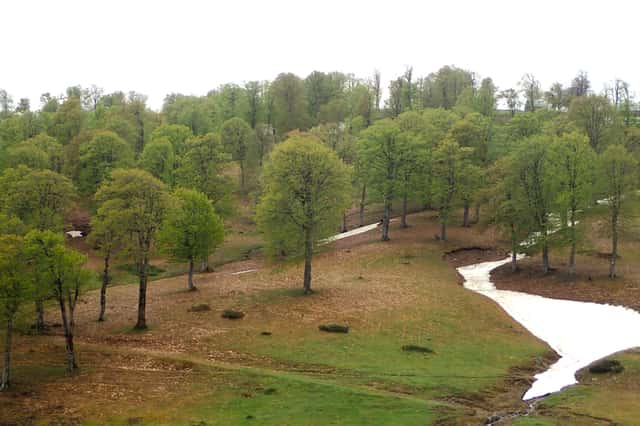
Fagus orientalis, commonly known as the Oriental Beech, is a magnificent large deciduous tree native to the Caucasus region, northern Turkey, and northern Iran. It is one of the most impressive broadleaf trees in its natural range, reaching heights of 25–40 metres with a broad, dense, rounded crown. Its smooth silver-grey bark, lush green foliage, and brilliant autumn colours make it a highly valued ornamental and forestry tree. It is closely related to the European Beech (Fagus sylvatica) but is better adapted to hotter, drier climates and grows faster in its early years.
How to Propagate Oriental Beech?
Seed propagation
Seed viability is often low. Use fresh mast collected from healthy trees and stratify immediately for best results. Protect from rodents during cold stratification.
- 1 Collect ripe beechnuts (mast) in autumn after they fall naturally
- 2 Cold-stratify seeds in damp sand or vermiculite at 2–4°C for 12–16 weeks
- 3 Sow in deep containers with well-drained, loamy compost in early spring
- 4 Keep moist but not waterlogged; germination occurs over 4–8 weeks
- 5 Grow on in a sheltered nursery bed for 2–3 years before transplanting
Materials needed:
Grafting
Grafting onto Fagus sylvatica rootstock is the most reliable method for producing true-to-type specimens. Keep humidity high around the graft union during healing.
- 1 Select a vigorous Fagus sylvatica rootstock of pencil thickness
- 2 Take scion wood from healthy current-season growth in late winter
- 3 Perform whip-and-tongue or cleft grafting in early spring before bud burst
- 4 Bind with grafting tape and keep in a humid, sheltered environment
- 5 Remove tape once union is established and harden off gradually
Materials needed:
How Big Does Oriental Beech Grow?
TLDR: Oriental Beech can reach up to 30.0m tall with Medium growth rate.
Max height
30.0m
Spread
20.0m
Growth rate
Medium
Foliage
Deciduous
Warning: Toxic Plant
This plant can be toxic if ingested. Keep out of reach of:
Plant Uses
Ornamental
Great for decoration
Is your plant showing symptoms?
Click on the symptom to discover possible causes:
What Diseases Commonly Affect Oriental Beech?
TLDR: Oriental Beech is susceptible to 5 known diseases. Monitor regularly for early detection.
Root Rot
Root rot is a serious fungal disease that affects the root system of plants, causing them to decay and die. It is primarily caused by overwatering, poor drainage, or soil-borne fungi such as Pythium, Phytophthora, Rhizoctonia, and Fusarium. The disease thrives in waterlogged conditions where roots are deprived of oxygen, making them susceptible to fungal infection.
Canker
Canker is a disease caused by various fungi and bacteria that create necrotic, sunken areas on bark of branches, stems, and trunks. Pathogens enter through wounds and natural openings, especially when plants are stressed. Canker can gradually weaken or kill branches by disrupting water and nutrient flow.
Phytophthora
The Phytophthora genus consists of soil-borne oomycetes (water molds) that act as plant pathogens, primarily affecting trees and woody plants. It typically spreads through the root system, leading to systemic decline and eventual plant collapse.
Scale Insects
Scale insects are small sap-sucking pests that appear as brown, shell-like bumps on plant stems and leaves. There are over 25 species, divided into armored (hard) and unarmored (soft) scales. They feed by piercing plant tissue and extracting sap, which weakens the plant and can lead to yellowing, stunted growth, and even death if left untreated. They also excrete honeydew, which attracts ants and promotes sooty mold growth.
Meaning & Symbolism
The Oriental Beech is a symbol of strength, longevity, wisdom, and enduring knowledge. In many Eastern European and Caucasian traditions, ancient beech forests are considered sacred spaces of learning and reflection. The tree is associated with prosperity and the preservation of ancestral wisdom.
Fun Facts
Oriental Beech can live for over 500 years in the wild, with some ancient specimens in the Caucasus estimated to be more than 1,000 years old.
Unlike many trees, Fagus orientalis lower branches often retain their dead leaves through winter — a phenomenon known as marcescence.
The seeds of Oriental Beech, called beechnuts or mast, are an important food source for wildlife including bears, wild boar, and squirrels.
Oriental Beech is considered more heat and drought tolerant than European Beech, making it increasingly valuable in the context of climate change.
Frequently asked questions
How often should I water an Oriental Beech tree?
Is Oriental Beech suitable for small gardens?
Is Oriental Beech toxic to dogs?
What is the difference between Oriental Beech and European Beech?
When does Oriental Beech drop its leaves?
Compare with similar plants
| Attribute | Difficulty | Light | Watering | Pet Safe |
|---|---|---|---|---|
| Dark Fieldcap | Medium | Low light | 2d | ⚠️ |
| Azalea | Medium | Partial shade | 3d | ⚠️ |
| Bougainvillea | Medium | Direct sun | 7d | ⚠️ |
| Wild Lettuce | Medium | Direct sun | 7d | ⚠️ |



