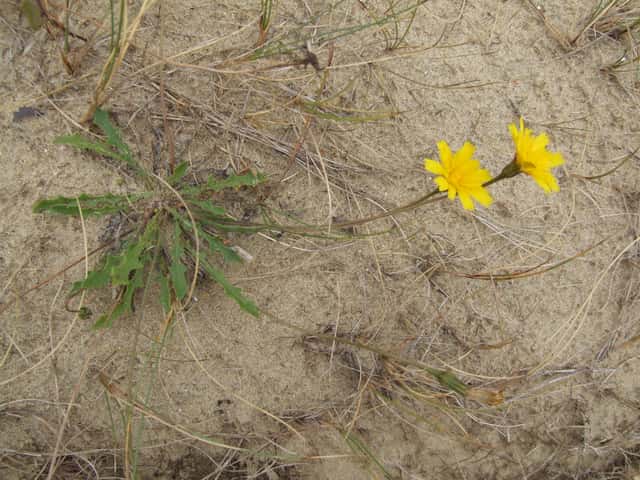
Asteraceae
Lesser Hawkbit – Leontodon saxatilis
Leontodon saxatilis
Lesser Hawkbit is a resilient, low-maintenance wildflower best grown in full sun in sandy or well-drained soil. Water sparingly—allow the soil to almost dry out between waterings. It tolerates drought, poor soils, and neglect, making it ideal for wildflower meadows, rockeries, and naturalistic plantings. No regular fertilising, misting, or repotting is needed.
Every 10 days
Direct sun
-20° - 35°C
40% - 70%
Categories
What is Lesser Hawkbit?
Lesser Hawkbit (Leontodon saxatilis) is a easy-care plant from the Asteraceae family. Leontodon saxatilis, commonly known as Lesser Hawkbit or Hairy Hawkbit, is a low-growing perennial wildflower in the family Asteraceae. It forms a basal rosette of lobed, bristly-haired leaves from which emerge slender, leafless stems bearing solitary bright yellow flowerheads that closely resemble...
Lesser Hawkbit grows up to 30cm, spread of 20cm, watering every 10 days, -20°C – 35°C, 40–70% humidity. It is not suitable for indoor environments and safe for pets.
Unlike many tropical plants, Lesser Hawkbit tolerates watering mistakes. Best for beginners. Unlike many popular species, Lesser Hawkbit is safe to keep around pets.
How to Care for Lesser Hawkbit?
TLDR: Lesser Hawkbit needs Direct sun, watering every 10 days, and temperatures between -20-35°C with 40-70% humidity.
How Often Should You Water Lesser Hawkbit?
Water deeply but infrequently, approximately every 7–14 days depending on temperature. Allow the soil to dry almost completely between waterings. Overwatering on heavy soils can cause root rot.
How Much Light Does Lesser Hawkbit Need?
Grow in full sun (6+ hours of direct sunlight per day). The plant will not thrive in shade—it naturally occupies open grassland and dune habitats.
What Is the Best Soil for Lesser Hawkbit?
Plant in sandy, chalky, or well-draining soil with a pH of 5.5–7.5. Avoid heavy clay soils. Poor to moderately fertile soils actually suit it better, mimicking its natural habitat.
What Is Lesser Hawkbit and Where Does It Come From?
Leontodon saxatilis, commonly known as Lesser Hawkbit or Hairy Hawkbit, is a low-growing perennial wildflower in the family Asteraceae. It forms a basal rosette of lobed, bristly-haired leaves from which emerge slender, leafless stems bearing solitary bright yellow flowerheads that closely resemble a small dandelion. Native to Europe and North Africa, it thrives in grassy habitats on sandy, calcareous or well-drained soils and flowers prolifically from June through October.
How to Propagate Lesser Hawkbit?
Seed sowing
Division
How Big Does Lesser Hawkbit Grow?
TLDR: Lesser Hawkbit can reach up to 30cm tall with Slow growth rate.
Max height
30cm
Spread
20cm
Growth rate
Slow
Foliage
Deciduous
Plant Uses
Ornamental
Great for decoration
Medicinal
Medicinal properties
Medicinal Uses
- Leaves have been used in traditional European herbal medicine as a mild digestive tonic and diuretic.
Culinary Uses
- Young leaves are edible and can be used raw in salads or cooked like spinach, similar to dandelion greens.
Is your plant showing symptoms?
Click on the symptom to discover possible causes:
What Diseases Commonly Affect Lesser Hawkbit?
TLDR: Lesser Hawkbit is susceptible to 5 known diseases. Monitor regularly for early detection.
Powdery Mildew
Powdery mildew is a common fungal disease caused by various fungi species including Erysiphe, Podosphaera, Oïdium, and Leveillula. It affects over 10,000 plant species worldwide. The disease thrives in warm, dry climates with high humidity and appears as a distinctive white powdery coating on plant surfaces.
Aphids
Aphids are small, soft-bodied, pear-shaped insects (1/16 to 1/8 inch long) that feed by sucking nutrient-rich sap from plants. They reproduce rapidly and can quickly weaken plants, causing distorted growth and transmitting plant viruses. Aphids come in various colors including green, black, red, yellow, brown, and gray. They secrete honeydew, a sticky substance that attracts ants and encourages sooty mold growth.
Slugs and Snails
Slugs and snails are mollusks that feed on plant tissue, causing irregular holes in leaves and damage to young seedlings. They are most active at night and in moist conditions, leaving characteristic silvery slime trails. These pests can quickly devastate gardens, especially during wet seasons.
Leaf Spot
Leaf spot is a common fungal disease caused by various pathogens including Alternaria, Ascochyta, Colletotrichum, Septoria, and Venturia. It primarily affects leaves, causing discolored spots that can lead to premature leaf drop if left untreated.
Fun Facts
Despite its delicate appearance, Lesser Hawkbit can colonise disturbed ground, roadsides, and coastal dunes, making it a pioneer species in open habitats.
Its flowers open only in sunshine and close on overcast days—a trait shared with many members of the daisy family.
The forked hairs on its leaves are a key identification feature that distinguishes it from the closely related Cat's-ear (Hypochaeris) and Autumnal Hawkbit (Scorzoneroides).
Bees, hoverflies, and small butterflies frequently visit its flowers for nectar and pollen throughout summer and into autumn.
Compare with similar plants
| Attribute | Difficulty | Light | Watering | Pet Safe |
|---|---|---|---|---|
| Field Maple | Easy | Bright indirect | 14d | ✓ |
| Silver Birch | Easy | Direct sun | 14d | ✓ |
| Cushion Bush | Easy | Direct sun | 14d | ✓ |
| Wild Lettuce | Medium | Direct sun | 7d | ⚠️ |





