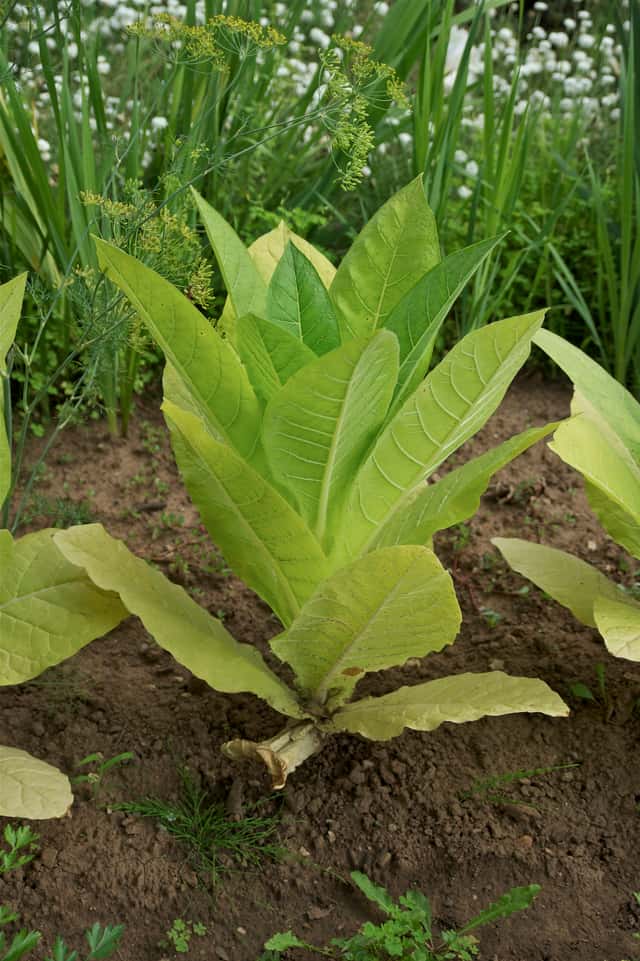
Solanaceae
Tobacco: Medicinal Uses & Care Tips
Nicotiana tabacum
Tobacco is an easy-care, fast-growing plant. It prefers full sun to partial shade, consistent, generous watering during spring and summer, and fertile, organically rich, well-draining soil. It is sensitive to overwatering, which can cause root rot.
Every 7 days
Bright indirect
15° - 30°C
% - %
Categories
What is Tobacco?
Tobacco (Nicotiana tabacum) is a easy-care plant from the Solanaceae family. Nicotiana tabacum, commonly known as tobacco, is an annual herbaceous plant in the Solanaceae family, native to the tropical and subtropical regions of the Americas, with origins in Bolivia and the Andean region. It grows 1 to 3 meters tall, with large, sticky, aromatic leaves that can exceed 50 cm...
Tobacco grows up to 3.0m, spread of 60cm, watering every 7 days, 15°C – 30°C. It is suitable for indoor environments and not safe for pets.
Unlike many tropical plants, Tobacco tolerates watering mistakes. Best for beginners. Without precautions, ingestion can cause irritation in pets. Keep out of reach of cats and dogs. Without adequate drainage, root rot can develop within 14 days.
How to Care for Tobacco?
TLDR: Tobacco needs Bright indirect, watering every 7 days, and temperatures between 15-30°C with 40-70% humidity.
How Often Should You Water Tobacco?
Water generously during spring and summer, letting the topsoil dry out slightly between waterings. Reduce watering in winter and avoid waterlogging, since excess moisture promotes root rot.
How Much Light Does Tobacco Need?
Place the plant in full sun or light partial shade; the more light it receives, the more vigorous its growth and flowering will be.
What Is the Best Soil for Tobacco?
Use a fertile, organically rich, well-draining soil with a pH between 6.0 and 7.5. Add potsherds or gravel at the bottom of the pot to improve drainage.
What Pot Should You Use for Tobacco?
A pot at least 18-20 cm in diameter with good drainage; consider bamboo stakes for taller varieties.
Care Schedule
Fertilize
Every 14 days
Repot
Every 365 days
What Is Tobacco and Where Does It Come From?
Nicotiana tabacum, commonly known as tobacco, is an annual herbaceous plant in the Solanaceae family, native to the tropical and subtropical regions of the Americas, with origins in Bolivia and the Andean region. It grows 1 to 3 meters tall, with large, sticky, aromatic leaves that can exceed 50 cm in length. It produces branched panicle inflorescences with tubular white, pink, or cream flowers in summer and fall. It is the main species used commercially to produce tobacco leaf.
How to Propagate Tobacco?
Seed Sowing
Sow onto moist seed compost at around 16 degrees C; transplant seedlings to small pots and then to their final container after the last frost.
- 1 Sow seeds on moist compost, barely covering them since they need light to germinate
- 2 Keep the compost moist at around 16 degrees C until germination, which takes 2 to 3 weeks
- 3 Transplant seedlings into 8 cm pots once they have several true leaves
- 4 Move to the final 18-20 cm pot and place outdoors after the last frost
Materials needed:
How Big Does Tobacco Grow?
TLDR: Tobacco can reach up to 3.0m tall with Fast growth rate.
Max height
3.0m
Spread
60cm
Growth rate
Fast
Foliage
Deciduous
Warning: Toxic Plant
This plant can be toxic if ingested. Keep out of reach of:
Plant Uses
Ornamental
Great for decoration
Medicinal
Medicinal properties
Medicinal Uses
- Historically used in poultices for wounds and respiratory ailments (traditional use only, not recommended without supervision due to toxicity)
Is your plant showing symptoms?
Click on the symptom to discover possible causes:
What Diseases Commonly Affect Tobacco?
TLDR: Tobacco is susceptible to 5 known diseases. Monitor regularly for early detection.
Mosaic Virus
Mosaic virus is a group of plant viruses that cause mottled, patchy patterns on leaves and can affect a wide variety of plants. The virus creates characteristic yellow, white, and green mosaic patterns, often accompanied by stunted growth and deformed plant parts. This highly contagious disease spreads rapidly through insect vectors and contaminated tools.
Downy Mildew
Downy mildew is a fungal-like disease caused by oomycetes (water molds) that thrives in cool, wet conditions. It affects a wide range of plants, causing yellowing leaves with fuzzy white-gray growth underneath, leading to defoliation and reduced yields if left untreated.
Aphids
Aphids are small, soft-bodied, pear-shaped insects (1/16 to 1/8 inch long) that feed by sucking nutrient-rich sap from plants. They reproduce rapidly and can quickly weaken plants, causing distorted growth and transmitting plant viruses. Aphids come in various colors including green, black, red, yellow, brown, and gray. They secrete honeydew, a sticky substance that attracts ants and encourages sooty mold growth.
Whiteflies
Whiteflies are small, soft-bodied, winged insects closely related to aphids and mealybugs. They are moth-like in appearance, about 1/16 inch long, triangular in shape, and gray-white in color. These sap-sucking pests feed on plant tissue, causing yellowing, stunted growth, and wilting. They also excrete honeydew, which attracts ants and promotes sooty mold growth. Whiteflies can transmit serious plant viruses.
Meaning & Symbolism
For many Indigenous peoples of the Americas, tobacco is a sacred plant, used in purification rituals, offerings, and spiritual communication long before becoming a global commercial crop.
Compare with similar plants
| Attribute | Difficulty | Light | Watering | Pet Safe |
|---|---|---|---|---|
| Field Maple | Easy | Bright indirect | 14d | ✓ |
| Silver Birch | Easy | Direct sun | 14d | ✓ |
| Common Blanketflower | Easy | Direct sun | 10d | ✓ |
| Cushion Bush | Easy | Direct sun | 14d | ✓ |





