Papaveraceae
Yellow Corydalis (Pseudofumaria lutea) Care Guide
Pseudofumaria lutea
Low-maintenance and shade-loving, yellow corydalis thrives in cool, moist, well-drained soil tucked into wall crevices or woodland borders. It asks for little beyond consistent moisture in summer and protection from soggy winter soil.
Every 5 days
Low light
10° - 24°C
40% - 60%
Categories
What is Yellow Corydalis?
Yellow Corydalis (Pseudofumaria lutea) is a easy-care plant from the Papaveraceae family. Pseudofumaria lutea, commonly known as yellow corydalis or rock fumewort, is a compact, clump-forming perennial in the poppy family (Papaveraceae). Native to shaded limestone crevices in the Alps of Italy and Switzerland, it has naturalized across old walls, pavements, and rockeries throughout Europ...
Yellow Corydalis grows up to 40cm, spread of 45cm, watering every 5 days, 10°C – 24°C, 40–60% humidity. It is not suitable for indoor environments and safe for pets.
Unlike many tropical plants, Yellow Corydalis tolerates watering mistakes. Best for beginners. Unlike many popular species, Yellow Corydalis is safe to keep around pets.
How to Care for Yellow Corydalis?
TLDR: Yellow Corydalis needs Low light, watering every 5 days, and temperatures between 10-24°C with 40-60% humidity.
How Often Should You Water Yellow Corydalis?
Keep the soil evenly moist during the growing season, especially in hot weather, but avoid waterlogging in winter — soggy roots in cold, wet soil are the main cause of decline.
How Much Light Does Yellow Corydalis Need?
Grows best in light shade to full shade and tolerates heavy shade well. Bright, indirect light is ideal; full sun can scorch the delicate ferny foliage.
What Is the Best Soil for Yellow Corydalis?
Prefers rich, well-drained, slightly acidic to neutral soil. Adding gravel or grit improves drainage in heavier soils and mimics the rocky crevices it favors in the wild.
What Pot Should You Use for Yellow Corydalis?
A shallow, wide terracotta or hypertufa trough with excellent drainage suits its shallow root system and rockery habit best.
What Is Yellow Corydalis and Where Does It Come From?
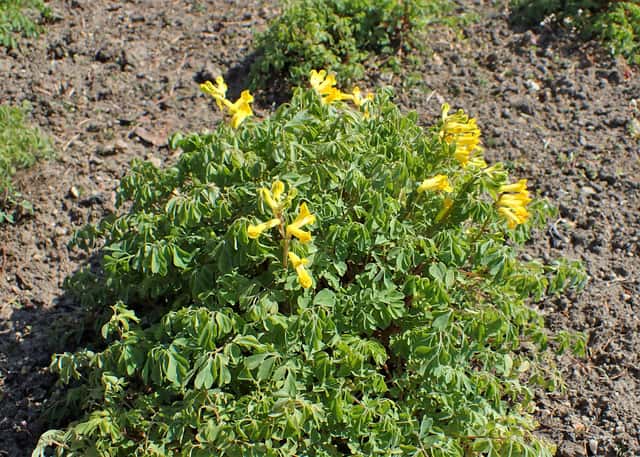
Pseudofumaria lutea, commonly known as yellow corydalis or rock fumewort, is a compact, clump-forming perennial in the poppy family (Papaveraceae). Native to shaded limestone crevices in the Alps of Italy and Switzerland, it has naturalized across old walls, pavements, and rockeries throughout Europe and North America. Its ferny, blue-green foliage forms tidy mounds topped with clusters of bright golden-yellow, short-spurred flowers that bloom almost continuously from late spring through the first hard frost.
How to Propagate Yellow Corydalis?
Seed sowing
Seed viability drops quickly, so sow fresh seed as soon as possible; the plant usually self-seeds reliably without help.
- 1 Collect ripe seed pods in early fall before they split open
- 2 Sow fresh seed on the soil surface in a shaded bed or tray
- 3 Allow a warm period followed by a cold winter stratification outdoors
- 4 Watch for seedlings to emerge the following spring
Materials needed:
Division
Roots are fragile and resent disturbance, so division is rarely successful compared to letting the plant self-seed.
- 1 Carefully lift an established clump in early spring
- 2 Separate the brittle rootstock into sections with buds attached
- 3 Replant sections immediately in shaded, well-drained soil
- 4 Keep evenly moist until new growth appears
Materials needed:
How Big Does Yellow Corydalis Grow?
TLDR: Yellow Corydalis can reach up to 40cm tall with Medium growth rate.
Max height
40cm
Spread
45cm
Growth rate
Medium
Foliage
Deciduous
Plant Uses
Ornamental
Great for decoration
Ground Cover
Soil coverage
Is your plant showing symptoms?
Click on the symptom to discover possible causes:
What Diseases Commonly Affect Yellow Corydalis?
TLDR: Yellow Corydalis is susceptible to 4 known diseases. Monitor regularly for early detection.
Downy Mildew
Downy mildew is a fungal-like disease caused by oomycetes (water molds) that thrives in cool, wet conditions. It affects a wide range of plants, causing yellowing leaves with fuzzy white-gray growth underneath, leading to defoliation and reduced yields if left untreated.
Rust
Rust is a common fungal disease caused by fungi in the order Pucciniales that affects a wide variety of plants. The disease gets its name from the characteristic orange, yellow, or reddish-brown pustules that appear on leaves, resembling metal rust. This obligate fungal parasite requires living plants to survive and can cause significant economic losses in agricultural crops.
Aphids
Aphids are small, soft-bodied, pear-shaped insects (1/16 to 1/8 inch long) that feed by sucking nutrient-rich sap from plants. They reproduce rapidly and can quickly weaken plants, causing distorted growth and transmitting plant viruses. Aphids come in various colors including green, black, red, yellow, brown, and gray. They secrete honeydew, a sticky substance that attracts ants and encourages sooty mold growth.
Slugs and Snails
Slugs and snails are mollusks that feed on plant tissue, causing irregular holes in leaves and damage to young seedlings. They are most active at night and in moist conditions, leaving characteristic silvery slime trails. These pests can quickly devastate gardens, especially during wet seasons.
Meaning & Symbolism
Its cheerful, ever-blooming yellow flowers are often linked to resilience and quiet persistence, since the plant readily colonizes the harshest cracks in old stone walls.
Fun Facts
It thrives rooted into the mortar of old stone walls and pavement cracks, needing almost no soil.
It blooms almost continuously from late spring until the first hard frost.
Despite being harmless to cats, dogs, and humans, it is toxic to horses.
Frequently asked questions
How much sun does yellow corydalis need?
Is Pseudofumaria lutea toxic?
Why does yellow corydalis spread so much in my garden?
What diseases affect yellow corydalis?
Compare with similar plants
| Attribute | Difficulty | Light | Watering | Pet Safe |
|---|---|---|---|---|
| Field Maple | Easy | Bright indirect | 14d | ✓ |
| Silver Birch | Easy | Direct sun | 14d | ✓ |
| Cushion Bush | Easy | Direct sun | 14d | ✓ |
| Peruvian peppertree | Easy | Direct sun | 14d | ⚠️ |





