Amaryllidaceae
Clivia gardenii: The Green-tip Forest Lily
Clivia gardenii
Grow in bright, indirect light or dappled shade, never direct sun. Water when the top of the soil is dry, reducing watering in winter, and use a well-draining, humus-rich mix. Feed monthly during the growing season and avoid disturbing the roots, as this plant flowers best when slightly pot-bound.
Every 10 days
Partial shade
10° - 27°C
40% - 60%
Categories
What is Green-tip Forest Lily?
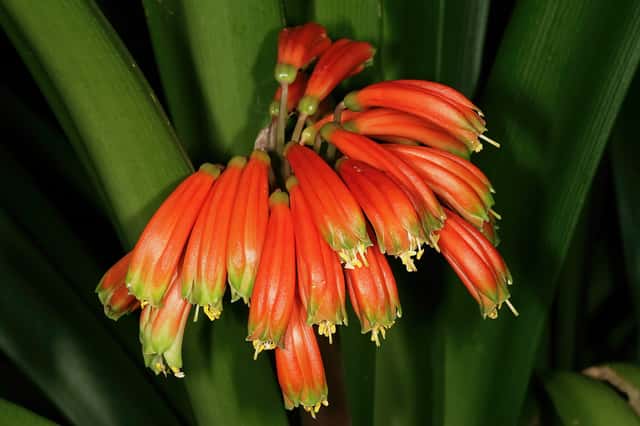
Green-tip Forest Lily (Clivia gardenii) is a easy-care plant from the Amaryllidaceae family. Clivia gardenii is a clump-forming evergreen perennial native to the shaded forests of KwaZulu-Natal and the Eastern Cape in South Africa. A close, more delicate relative of the popular Clivia miniata, it produces slender, tubular, drooping orange flowers with distinctive green tips in autumn and wi...
Green-tip Forest Lily grows up to 60cm, spread of 60cm, watering every 10 days, 10°C – 27°C, 40–60% humidity. It is suitable for indoor environments and not safe for pets.
Unlike many tropical plants, Green-tip Forest Lily tolerates watering mistakes. Best for beginners. Without precautions, ingestion can cause irritation in pets. Keep out of reach of cats and dogs. Without adequate drainage, root rot can develop within 20 days.
How to Care for Green-tip Forest Lily?
TLDR: Green-tip Forest Lily needs Partial shade, watering every 10 days, and temperatures between 10-27°C with 40-60% humidity.
How Often Should You Water Green-tip Forest Lily?
Let the top few centimeters of soil dry out between waterings; reduce watering significantly in winter. Never let the pot sit in water, as the fleshy roots rot easily.
How Much Light Does Green-tip Forest Lily Need?
Bright, indirect light or filtered shade is ideal; direct sun scorches the leaves, while deep shade reduces flowering.
What Is the Best Soil for Green-tip Forest Lily?
Use a well-draining, humus-rich potting mix with added compost and coarse sand or perlite to prevent waterlogging.
What Pot Should You Use for Green-tip Forest Lily?
A wide, sturdy pot only slightly larger than the root ball, as Clivia flowers best when pot-bound; ensure good drainage holes.
Care Schedule
Fertilize
Every 30 days
Rotate
Every 14 days
Repot
Every 1095 days
What Is Green-tip Forest Lily and Where Does It Come From?
Clivia gardenii is a clump-forming evergreen perennial native to the shaded forests of KwaZulu-Natal and the Eastern Cape in South Africa. A close, more delicate relative of the popular Clivia miniata, it produces slender, tubular, drooping orange flowers with distinctive green tips in autumn and winter, followed by bright red berries. Its strappy, dark green leaves grow from a thick rhizome and thrive in the dappled shade of forest understories. Slow-growing but long-lived, it is prized by collectors for its subtle beauty and shade tolerance.
How to Propagate Green-tip Forest Lily?
Clump division
Use clean, sharp tools and let cut surfaces callous briefly before potting to reduce rot risk.
- 1 Remove the plant from its pot after flowering has finished
- 2 Gently separate offsets that have their own roots and at least 4-5 leaves
- 3 Pot each division into a well-draining mix and keep lightly moist
- 4 Avoid fertilizing until new growth appears
Materials needed:
Seed propagation
Seeds lose viability quickly, so sow them as soon as possible after harvesting.
- 1 Harvest ripe red berries and clean the pulp from the large seeds
- 2 Sow seeds immediately on the surface of a well-draining mix
- 3 Keep warm and consistently moist until germination
- 4 Grow on in bright, indirect light for 2-3 years before flowering
Materials needed:
How Big Does Green-tip Forest Lily Grow?
TLDR: Green-tip Forest Lily can reach up to 60cm tall with Slow growth rate.
Max height
60cm
Spread
60cm
Growth rate
Slow
Foliage
Evergreen
Warning: Toxic Plant
This plant can be toxic if ingested. Keep out of reach of:
Plant Uses
Ornamental
Great for decoration
Medicinal
Medicinal properties
Medicinal Uses
- Historically used in South African traditional medicine for childbirth complications and snakebite, though this practice is discouraged due to toxic alkaloids
Is your plant showing symptoms?
Click on the symptom to discover possible causes:
What Diseases Commonly Affect Green-tip Forest Lily?
TLDR: Green-tip Forest Lily is susceptible to 11 known diseases. Monitor regularly for early detection.
Root Rot
Root rot is a serious fungal disease that affects the root system of plants, causing them to decay and die. It is primarily caused by overwatering, poor drainage, or soil-borne fungi such as Pythium, Phytophthora, Rhizoctonia, and Fusarium. The disease thrives in waterlogged conditions where roots are deprived of oxygen, making them susceptible to fungal infection.
Crown Rot
Crown rot is a serious fungal disease that attacks the crown (base) of the plant where the stem meets the soil. It is caused by various fungal pathogens including Phytophthora, Fusarium, and Rhizoctonia. The disease thrives in waterlogged conditions and can quickly spread to kill the entire plant if not addressed promptly.
Anthracnose
Anthracnose is a fungal disease caused by fungi in the genus Colletotrichum that affects many plants, including vegetables, fruits, and trees. The disease thrives in cool, wet conditions, causing dark, sunken lesions on leaves, stems, flowers, and fruits.
Bacterial Soft Rot
Bacterial soft rot is a destructive plant disease caused primarily by bacteria from the genera Pectobacterium (formerly Erwinia) and Dickeya. These bacteria produce enzymes that break down plant cell walls, causing rapid and foul-smelling tissue decomposition. It mainly affects succulent tissues such as tubers, fruits, stems, and bulbs, being especially problematic in warm and humid conditions.
Meaning & Symbolism
In Chinese culture, Clivia symbolizes good fortune, honor, and prosperity, and is a traditional gift during Lunar New Year celebrations.
Fun Facts
Its flowers hang downward in slender tubes, unlike the upright trumpet flowers of its cousin Clivia miniata
It can live for decades and actually flowers best when its roots are crowded in the pot
The species is named after Major Robert Garden, a British soldier stationed in KwaZulu-Natal in the 1850s
Frequently asked questions
Is Clivia gardenii toxic to pets?
How often should I water Clivia gardenii?
Does Clivia gardenii need direct sun?
Why is my Clivia gardenii not flowering?
Compare with similar plants
| Attribute | Difficulty | Light | Watering | Pet Safe |
|---|---|---|---|---|
| Field Maple | Easy | Bright indirect | 14d | ✓ |
| Silver Birch | Easy | Direct sun | 14d | ✓ |
| Common Blanketflower | Easy | Direct sun | 10d | ✓ |
| Cushion Bush | Easy | Direct sun | 14d | ✓ |





