Brassicaceae
Wallflower: Aromatic Plant
Erysimum × cheiri
Wallflower is easy to grow in a sunny, sheltered spot with free-draining soil. Water moderately during dry periods, allowing the soil to dry slightly between waterings. Deadhead spent blooms to prolong flowering. Fertilize every four weeks during the growing season at half strength. Cut back lightly after flowering to maintain a tidy shape. In mild climates the plant may persist as a short-lived perennial, but it is usually treated as a biennial and replaced after flowering.
Every 7 days
Direct sun
-5° - 25°C
30% - 50%
Categories
What is Wallflower?
Wallflower (Erysimum × cheiri) is a easy-care plant from the Brassicaceae family. Erysimum × cheiri, the common wallflower, is a fragrant-flowering subshrub in the family Brassicaceae, native to the Aegean region of Greece and widely naturalized across Europe. Typically grown as a biennial, it forms compact rosettes of narrow, lance-shaped, grey-green leaves in its first year bef...
Wallflower grows up to 60cm, spread of 45cm, watering every 7 days, -5°C – 25°C, 30–50% humidity. It is not suitable for indoor environments and not safe for pets.
Unlike many tropical plants, Wallflower tolerates watering mistakes. Best for beginners. Without precautions, ingestion can cause irritation in pets. Keep out of reach of cats and dogs.
How to Care for Wallflower?
TLDR: Wallflower needs Direct sun, watering every 7 days, and temperatures between -5-25°C with 30-50% humidity.
How Often Should You Water Wallflower?
Water deeply approximately once a week during dry weather, letting the top few centimetres of soil dry out before watering again. Wallflowers are drought-tolerant and strongly dislike waterlogged conditions; overly wet soil quickly leads to root rot. Always water at the base—wetting the foliage or flowers encourages fungal disease. In winter, reduce watering significantly, especially on heavy soils.
How Much Light Does Wallflower Need?
Wallflowers require a minimum of six hours of direct sunlight per day. Plant in full sun for the most prolific flowering and strongest fragrance. In very hot climates, light afternoon shade may prevent heat stress, but in temperate zones avoid shaded positions entirely—low light results in leggy growth and poor blooming.
What Is the Best Soil for Wallflower?
Use free-draining, moderately fertile soil with a pH between 6.0 and 7.5. Wallflowers thrive in gritty, sandy, or chalky soils and naturalize readily on old walls and stony banks. Avoid heavy clay or moisture-retentive composts. Improve drainage by incorporating coarse grit or perlite. Lime the soil if it is acidic, as wallflowers prefer neutral to slightly alkaline conditions.
What Pot Should You Use for Wallflower?
If grown in containers, choose terracotta or ceramic pots with generous drainage holes—at least 30 cm diameter to accommodate the root system. Use a gritty, well-draining compost mixed with perlite or horticultural grit. Avoid plastic pots that retain moisture. Containers should be placed in full sun and watered less frequently than border plantings to prevent root rot.
Care Schedule
Fertilize
Every 28 days
What Is Wallflower and Where Does It Come From?
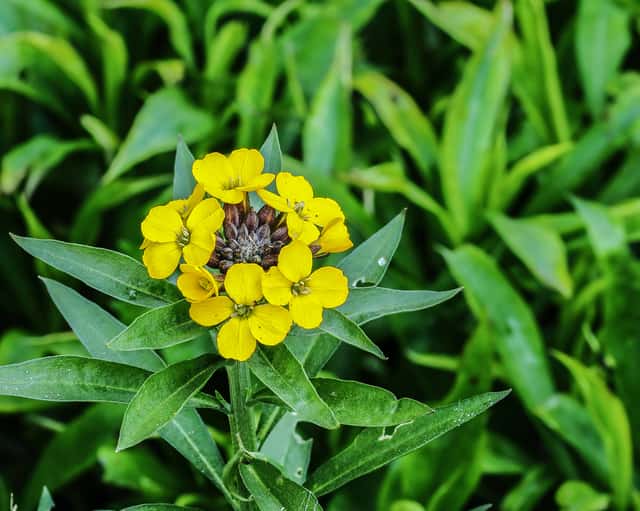
Erysimum × cheiri, the common wallflower, is a fragrant-flowering subshrub in the family Brassicaceae, native to the Aegean region of Greece and widely naturalized across Europe. Typically grown as a biennial, it forms compact rosettes of narrow, lance-shaped, grey-green leaves in its first year before producing abundant clusters of four-petalled flowers in shades of yellow, orange, red, burgundy, and purple from spring into early summer. Flowers emit a rich, sweet, spicy fragrance that intensifies in the evening, making the wallflower a long-favoured cottage garden classic. The plant thrives in well-drained, slightly alkaline soils and tolerates dry, rocky conditions—historically establishing itself on old walls and masonry, from which its common name derives. All parts contain cheiranthin, a cardiac glycoside, and are toxic if ingested in quantity.
How to Propagate Wallflower?
How Big Does Wallflower Grow?
TLDR: Wallflower can reach up to 60cm tall with Medium growth rate.
Max height
60cm
Spread
45cm
Growth rate
Medium
Foliage
Semi-evergreen
Warning: Toxic Plant
This plant can be toxic if ingested. Keep out of reach of:
Plant Uses
Ornamental
Great for decoration
Aromatic
Pleasant fragrance
Medicinal
Medicinal properties
Medicinal Uses
- Traditional cardiotonic use in small doses (contains cheiranthin, a cardiac glycoside)
- Historically used as a diuretic and emmenagogue
- Applied in folk medicine for antirheumatic and antispasmodic effects
- Essential oil used in perfumery; diluted preparations have a calming aromatic effect
- CAUTION: all parts are toxic in large quantities—never use without expert guidance
Is your plant showing symptoms?
Click on the symptom to discover possible causes:
What Diseases Commonly Affect Wallflower?
TLDR: Wallflower is susceptible to 7 known diseases. Monitor regularly for early detection.
Root Rot
Root rot is a serious fungal disease that affects the root system of plants, causing them to decay and die. It is primarily caused by overwatering, poor drainage, or soil-borne fungi such as Pythium, Phytophthora, Rhizoctonia, and Fusarium. The disease thrives in waterlogged conditions where roots are deprived of oxygen, making them susceptible to fungal infection.
Downy Mildew
Downy mildew is a fungal-like disease caused by oomycetes (water molds) that thrives in cool, wet conditions. It affects a wide range of plants, causing yellowing leaves with fuzzy white-gray growth underneath, leading to defoliation and reduced yields if left untreated.
Leaf Spot
Leaf spot is a common fungal disease caused by various pathogens including Alternaria, Ascochyta, Colletotrichum, Septoria, and Venturia. It primarily affects leaves, causing discolored spots that can lead to premature leaf drop if left untreated.
Aphids
Aphids are small, soft-bodied, pear-shaped insects (1/16 to 1/8 inch long) that feed by sucking nutrient-rich sap from plants. They reproduce rapidly and can quickly weaken plants, causing distorted growth and transmitting plant viruses. Aphids come in various colors including green, black, red, yellow, brown, and gray. They secrete honeydew, a sticky substance that attracts ants and encourages sooty mold growth.
Meaning & Symbolism
In the Victorian language of flowers the wallflower stands for fidelity and faithfulness, particularly faithfulness in adversity—a gift exchanged between devoted lovers. Its name cheiri derives from the Greek word for "hand," recalling the medieval custom of carrying fragrant flower-posies to festivals. During the Middle Ages, knights wore wallflowers in their caps as tokens of loyalty, and legend holds that the flower first grew where a lord's daughter fell after leaping from castle walls to elope with her forbidden suitor. The plant has also become a cultural metaphor for quiet, overlooked beauty.
Compare with similar plants
| Attribute | Difficulty | Light | Watering | Pet Safe |
|---|---|---|---|---|
| Field Maple | Easy | Bright indirect | 14d | ✓ |
| Silver Birch | Easy | Direct sun | 14d | ✓ |
| Cushion Bush | Easy | Direct sun | 14d | ✓ |
| Peruvian peppertree | Easy | Direct sun | 14d | ⚠️ |